

268
when averaged over the globe. Nevertheless, let us use the notations of the globally
averaged case of Section 4., which lead to
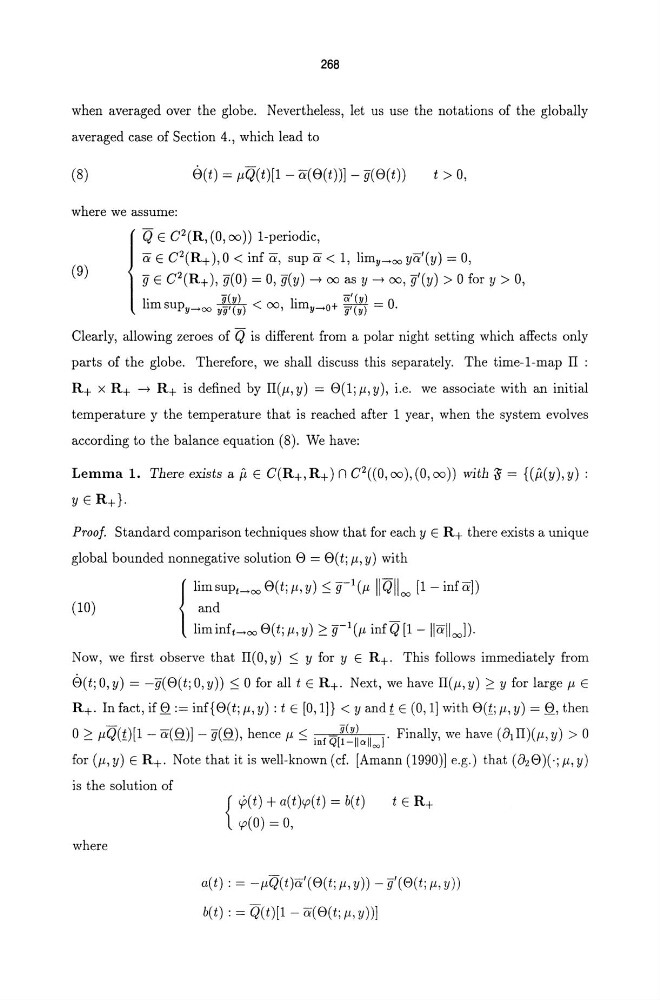
(8)
e(t) = ~Q(t)[l - a(8(t))] - g(8(t)) t > 0,
where we assume:
(9)
{
Q E C 2 (R,(0, 00)) I-periodic,
a E C 2 (R+),0 < inf a, sup a < 1, limy_ oo ya'(y) = 0,
g E C 2 (R+), g(O) = 0, g(y) --+ 00 as y --+ 00, g'(y) > 0 for y > 0,
1 ·
...TI1tL
1·
,,' (y) 0
ImSUpy_oo yg'(Y) < 00, Imy_o+ g'(Y) = .
Clearly, allowing zeroes of Q is different from a polar night setting which affects only
parts of the globe. Therefore, we shall discuss this separately. The time-I-map TI :
R+ x R+ --+ R+ is defined by TI(~, y) = 8(1;~, y), i.e. we associate with an initial
temperature y the temperature that is reached after 1 year, when the system evolves
according to the balance equation (8). We have:
Lemma 1. Tbere exists a p, E C(R+,R+) n C 2 ((0, 00),(0, 00)) witb ~ = {(p,(y),y) :
y E R+}.
Proof. Standard comparison techniques show that for each y E R+ there exists a unique
global bounded nonnegative solution 8 = 8( t; ~, y) with
(10)
{
limsuPt_oo 8(t;~, y) 5: g-l(~ IIQlloo [1- infa])
and
liminft_ oo 8(t;~, y) ~ g-l(~ infQ[l-lIa ll oo ]).
Now, we first observe that TI(O, y) 5: y for y E R+. This follows immediately from
e(t; 0, y) = -g(8(t; 0, y)) 5: 0 for all t E R+. Next, we have TI(Il, y) ~ y for large Il E
R+. In fact, if 0.:= inf{8(t;~, y) : t E [0, I]} < y and t E (0,1] with 8(t;~, y) = 0., then
o ~ ~Q(t)[l - a(0.)] - g(0.), hence ~ 5: inf Q[~~~allooJ" Finally, we have (81TI)(~, y) > 0
for (~,y) E R+. Note that it is well-known (cf. [Amann (1990)] e.g.) that (828)(·;~,y)
is the solution of
where
{
cp(O) = 0,
aCt) : = -~Q(t)a'(8(t;~, y)) - g'(8(t;~, y))
bet) : = Q(t)[l - a(8(t;~, y))]
when averaged over the globe. Nevertheless, let us use the notations of the globally
averaged case of Section 4., which lead to
(8)
e(t) = ~Q(t)[l - a(8(t))] - g(8(t)) t > 0,
where we assume:
(9)
{
Q E C 2 (R,(0, 00)) I-periodic,
a E C 2 (R+),0 < inf a, sup a < 1, limy_ oo ya'(y) = 0,
g E C 2 (R+), g(O) = 0, g(y) --+ 00 as y --+ 00, g'(y) > 0 for y > 0,
1 ·
...TI1tL
1·
,,' (y) 0
ImSUpy_oo yg'(Y) < 00, Imy_o+ g'(Y) = .
Clearly, allowing zeroes of Q is different from a polar night setting which affects only
parts of the globe. Therefore, we shall discuss this separately. The time-I-map TI :
R+ x R+ --+ R+ is defined by TI(~, y) = 8(1;~, y), i.e. we associate with an initial
temperature y the temperature that is reached after 1 year, when the system evolves
according to the balance equation (8). We have:
Lemma 1. Tbere exists a p, E C(R+,R+) n C 2 ((0, 00),(0, 00)) witb ~ = {(p,(y),y) :
y E R+}.
Proof. Standard comparison techniques show that for each y E R+ there exists a unique
global bounded nonnegative solution 8 = 8( t; ~, y) with
(10)
{
limsuPt_oo 8(t;~, y) 5: g-l(~ IIQlloo [1- infa])
and
liminft_ oo 8(t;~, y) ~ g-l(~ infQ[l-lIa ll oo ]).
Now, we first observe that TI(O, y) 5: y for y E R+. This follows immediately from
e(t; 0, y) = -g(8(t; 0, y)) 5: 0 for all t E R+. Next, we have TI(Il, y) ~ y for large Il E
R+. In fact, if 0.:= inf{8(t;~, y) : t E [0, I]} < y and t E (0,1] with 8(t;~, y) = 0., then
o ~ ~Q(t)[l - a(0.)] - g(0.), hence ~ 5: inf Q[~~~allooJ" Finally, we have (81TI)(~, y) > 0
for (~,y) E R+. Note that it is well-known (cf. [Amann (1990)] e.g.) that (828)(·;~,y)
is the solution of
where
{
aCt) : = -~Q(t)a'(8(t;~, y)) - g'(8(t;~, y))
bet) : = Q(t)[l - a(8(t;~, y))]