

257
nonnegative parameter, the albedo a and the outgoing terrestrial long-wave radiation
flux g, which can be thought of as g( u) = e( u )u 4 according to the Stefan-Boltzmann
law, but with a temperature dependent (greenhouse effect) effe~tive emissivity e(u).
As already mentioned in the introduction, we assume here that (model)temperature
and albedo are directly coupled. If we restrict our attention for the moment to the
ice-albedo, we would expect its highest values over polar regions that are all-year long
covered by ice or snow and its lowest values over tropical oceans or rainforests. Now,
utilizing the model temperature u in order to predict ice- or snow-cover one selects
values 0 < !f. < ii and assumes that regions with temperatures always below !f. have a
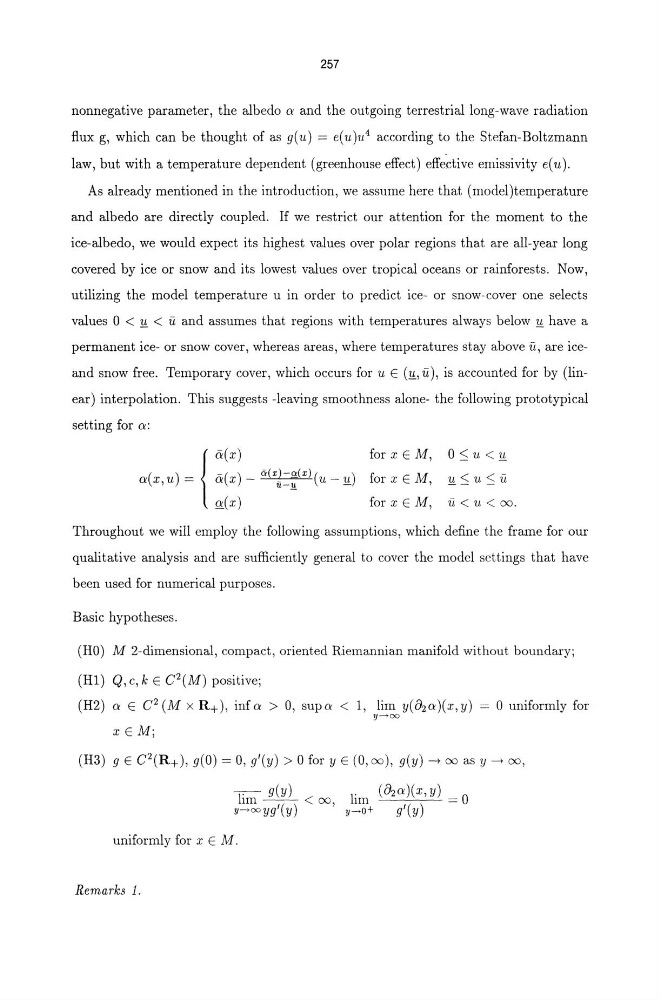
permanent ice- or snow cover, whereas areas, where temperatures stay above ii, are iceand snow free. Temporary cover, which occurs for u E (!f., ii), is accounted for by (linear) interpolation. This suggests -leaving smoothness alone- the following prototypical
setting for a:
{
a(x)
for x E M, 0:::; u a(x,u) = a(x) - (>(x~::::(x)(u -!f.) for x E M, !f.:::; u:::; ii
Q.(x)
forxEM, ii
qualitative analysis and are sufficiently general to cover the model settings that have
been used for numerical purposes.
Basic hypotheses.
(HO) M 2-dimensional, compact, oriented Riemannian manifold without boundary;
(HI) Q, c, k E C2(M) positive;
(H2) a E C 2 (M x R+), infa > 0, supa < 1, lim y(iha)(x,y)
y~oo
o uniformly for
xEM;
(H3) 9 E C 2 (R+), g(O) = 0, g'(y) > 0 for y E (0,00), g(y) -> 00 as y -> 00,
lim g(y) < 00 lim (o2a)(x,y) = 0
y~ooyg'(y)
'y~o+
g'(Y)
uniformly for x E M.
Remarks 1.
nonnegative parameter, the albedo a and the outgoing terrestrial long-wave radiation
flux g, which can be thought of as g( u) = e( u )u 4 according to the Stefan-Boltzmann
law, but with a temperature dependent (greenhouse effect) effe~tive emissivity e(u).
As already mentioned in the introduction, we assume here that (model)temperature
and albedo are directly coupled. If we restrict our attention for the moment to the
ice-albedo, we would expect its highest values over polar regions that are all-year long
covered by ice or snow and its lowest values over tropical oceans or rainforests. Now,
utilizing the model temperature u in order to predict ice- or snow-cover one selects
values 0 < !f. < ii and assumes that regions with temperatures always below !f. have a
permanent ice- or snow cover, whereas areas, where temperatures stay above ii, are iceand snow free. Temporary cover, which occurs for u E (!f., ii), is accounted for by (linear) interpolation. This suggests -leaving smoothness alone- the following prototypical
setting for a:
{
a(x)
for x E M, 0:::; u a(x,u) = a(x) - (>(x~::::(x)(u -!f.) for x E M, !f.:::; u:::; ii
Q.(x)
forxEM, ii
qualitative analysis and are sufficiently general to cover the model settings that have
been used for numerical purposes.
Basic hypotheses.
(HO) M 2-dimensional, compact, oriented Riemannian manifold without boundary;
(HI) Q, c, k E C2(M) positive;
(H2) a E C 2 (M x R+), infa > 0, supa < 1, lim y(iha)(x,y)
y~oo
o uniformly for
xEM;
(H3) 9 E C 2 (R+), g(O) = 0, g'(y) > 0 for y E (0,00), g(y) -> 00 as y -> 00,
lim g(y) < 00 lim (o2a)(x,y) = 0
y~ooyg'(y)
'y~o+
g'(Y)
uniformly for x E M.
Remarks 1.