

240
vant simplification is to assume f == O. Thus the new formulation is the following: given
w an open bounded subset of n, Yo, Yd : n -+ IR and f > 0 find Ve : (0, T) x w -+ IR such
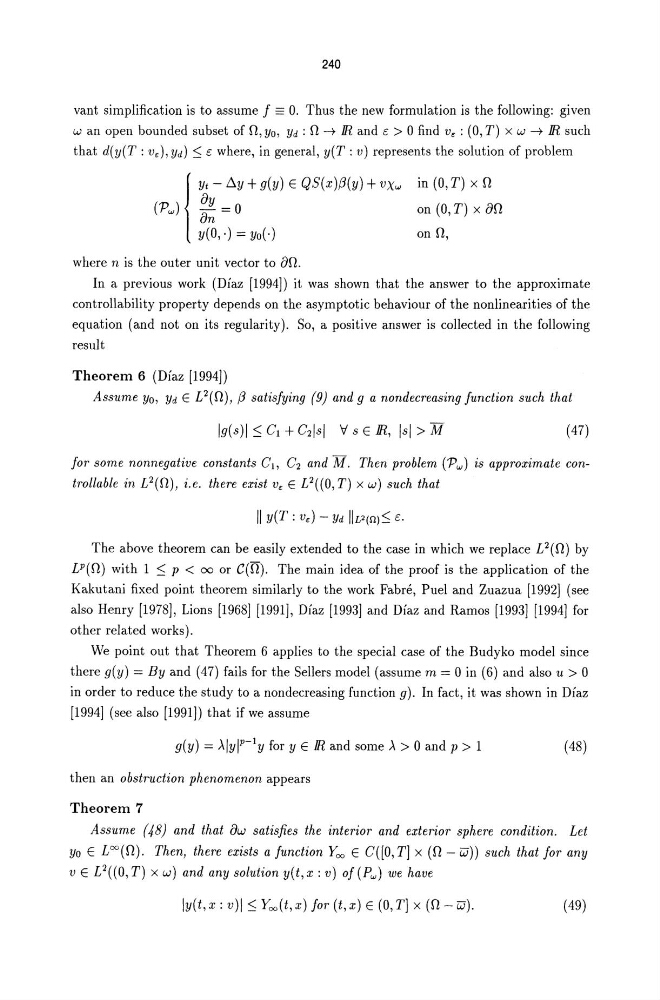
that d(y(T: Ve),Yd) :::; f where, in general, y(T: v) represents the solution of problem
1
Yt - D.y + g(y) E QS(x){3(y)+ vxw in (0, T) x n
(Pw) ay = 0
on (0, T) x an
an
y(O")=Yo(')
onn,
where n is the outer unit vector to an.
In a previous work (Diaz [1994]) it was shown that the answer to the approximate
controllability property depends on the asymptotic behaviour of the nonlinearities of the
equation (and not on its regularity). So, a positive answer is collected in the following
result
Theorem 6 (Dfaz [1994])
Assume Yo, Yd E L2(n), (3 satisfying (9) and 9 a nondecreasing function such that
(47)
for some nonnegative constants GI, G2 and M. Then problem (Pw ) is approximate controllable in L 2 (n), i.e. there exist v, E L2((0,T) x w) such that
The above theorem can be easily extended to the case in which we replace L2(n) by
LP(n) with 1 :::; p < 00 or C(TI). The main idea of the proof is the application of the
Kakutani fixed point theorem similarly to the work Fabre, Puel and Zuazua [1992] (see
also Henry [1978]' Lions [1968] [1991]' Dfaz [1993] and Diaz and Ramos [1993] [1994] for
other related works).
We point out that Theorem 6 applies to the special case of the Budyko model since
there g(y) = By and (47) fails for the Sellers model (assume m = 0 in (6) and also u > 0
in order to reduce the study to a nondecreasing function g). In fact, it was shown in Dfaz
[1994] (see also [1991]) that if we assume
g(y) = ,\lyIP-Iy for y E IR and some ,\ > 0 and p > 1
(48)
then an obstruction phenomenon appears
Theorem 7
Assume (48) and that ow satisfies the interior and exterior sphere condition. Let
Yo E LOO(n). Then, there exists a function Yoo E G([O, TJ X (n - w)) such that for any
v E L2( (0, T) x w) and any solution y(t, x : v) of (Pw) we have
Iy(t,x: v)l:::; Yoo(t,x) for (t,x) E (O,T] x (n-w).
( 49)
vant simplification is to assume f == O. Thus the new formulation is the following: given
w an open bounded subset of n, Yo, Yd : n -+ IR and f > 0 find Ve : (0, T) x w -+ IR such
that d(y(T: Ve),Yd) :::; f where, in general, y(T: v) represents the solution of problem
1
Yt - D.y + g(y) E QS(x){3(y)+ vxw in (0, T) x n
(Pw) ay = 0
on (0, T) x an
an
y(O")=Yo(')
onn,
where n is the outer unit vector to an.
In a previous work (Diaz [1994]) it was shown that the answer to the approximate
controllability property depends on the asymptotic behaviour of the nonlinearities of the
equation (and not on its regularity). So, a positive answer is collected in the following
result
Theorem 6 (Dfaz [1994])
Assume Yo, Yd E L2(n), (3 satisfying (9) and 9 a nondecreasing function such that
(47)
for some nonnegative constants GI, G2 and M. Then problem (Pw ) is approximate controllable in L 2 (n), i.e. there exist v, E L2((0,T) x w) such that
The above theorem can be easily extended to the case in which we replace L2(n) by
LP(n) with 1 :::; p < 00 or C(TI). The main idea of the proof is the application of the
Kakutani fixed point theorem similarly to the work Fabre, Puel and Zuazua [1992] (see
also Henry [1978]' Lions [1968] [1991]' Dfaz [1993] and Diaz and Ramos [1993] [1994] for
other related works).
We point out that Theorem 6 applies to the special case of the Budyko model since
there g(y) = By and (47) fails for the Sellers model (assume m = 0 in (6) and also u > 0
in order to reduce the study to a nondecreasing function g). In fact, it was shown in Dfaz
[1994] (see also [1991]) that if we assume
g(y) = ,\lyIP-Iy for y E IR and some ,\ > 0 and p > 1
(48)
then an obstruction phenomenon appears
Theorem 7
Assume (48) and that ow satisfies the interior and exterior sphere condition. Let
Yo E LOO(n). Then, there exists a function Yoo E G([O, TJ X (n - w)) such that for any
v E L2( (0, T) x w) and any solution y(t, x : v) of (Pw) we have
Iy(t,x: v)l:::; Yoo(t,x) for (t,x) E (O,T] x (n-w).
( 49)