

223
the test function lul q - 1 signu (more precisely, by a smooth approximation of this function)
and a simple integration by parts shows that
~ llu1qdx ~ 0,
which gives the result.
•
Theorem 1 can be obtained from an abstract perturbation result (see Vrabie [1987] and
Dfaz-Vrabie [1987]) assuming that the operator A = a<.p generates a compact semigroup.
By a result due to H.Brezis (see the reference in the book of Vrabie [1987]) this condition
is equivalent to know that
"for any K> 0 the set {w E L2(1) :11 w Ili2(l) +<.p(w) ~ K} }
(16)
is relatively compact in L2(1)".
This is proved in the following auxiliary result:
Lemma 1 (i) Let p given by (8) and assume p > 2. Then for any q E [1,p/2) we have
that
(17)
with continuous imbedding. Moreover, for any r E [1,00] we have
v c 1'(J),
(18)
where the imbedding is continuous and compact for any r E [1,00].
(ii) 1/1 < p ~ 2, then we have the continuous imbedding V C U(1l for any q E [1,00) if
P = 2 and any q E [l,p') with p' = 2p/(2 - pl.
(iii) If 1 < p ~ 2, the imbedding V C L2(J) is always compact.
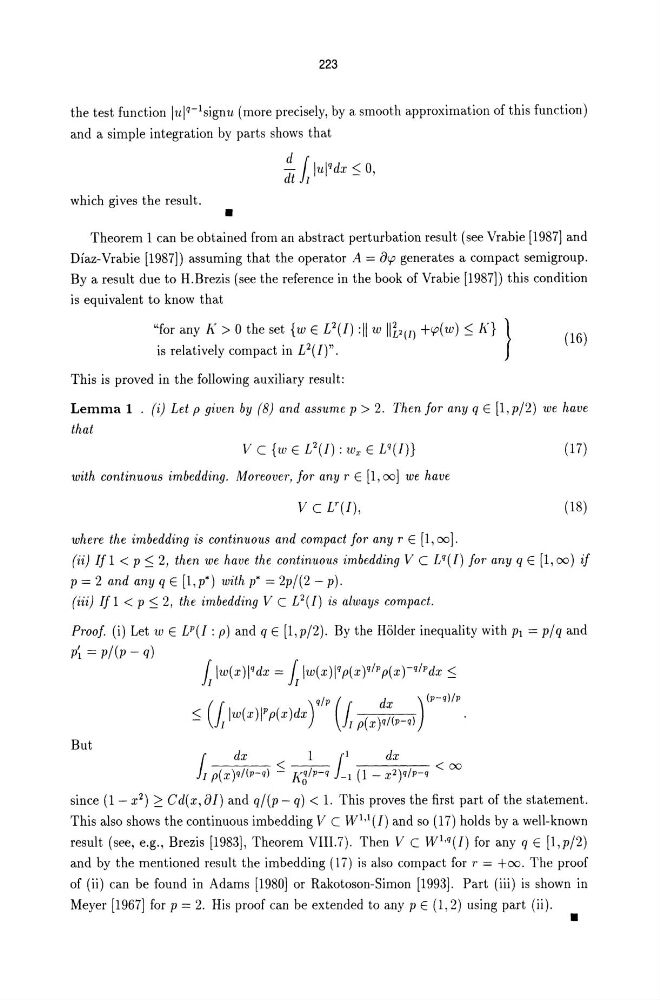
Proof. (i) Let w E U(1: p) and q E [1,p/2). By the Holder inequality with PI = p/q and
p~ = p/(p - q)
But
(
dx
< _1_ /1 dx < 00
if p(x)q/(p-q) - K'!/p-q -1 (1 - x2 )q/p-q
since (1 - x 2 ) 2' : Cd(x, aJ) and q/(p - q) < 1. This proves the first part of the statement.
This also shows the continuous imbedding V C Wl,1(1) and so (17) holds by a well-known
result (see, e.g., Brezis [1983], Theorem VIII.7). Then V C w 1 ,q(1) for any q E [1,p/2)
and by the mentioned result the imbedding (17) is also compact for r = +00. The proof
of (ii) can be found in Adams [1980] or Rakotoson-Simon [1993]. Part (iii) is shown in
Meyer [1967] for p = 2. His proof can be extended to any p E (1,2) using part (ii) . •
the test function lul q - 1 signu (more precisely, by a smooth approximation of this function)
and a simple integration by parts shows that
~ llu1qdx ~ 0,
which gives the result.
•
Theorem 1 can be obtained from an abstract perturbation result (see Vrabie [1987] and
Dfaz-Vrabie [1987]) assuming that the operator A = a<.p generates a compact semigroup.
By a result due to H.Brezis (see the reference in the book of Vrabie [1987]) this condition
is equivalent to know that
"for any K> 0 the set {w E L2(1) :11 w Ili2(l) +<.p(w) ~ K} }
(16)
is relatively compact in L2(1)".
This is proved in the following auxiliary result:
Lemma 1 (i) Let p given by (8) and assume p > 2. Then for any q E [1,p/2) we have
that
(17)
with continuous imbedding. Moreover, for any r E [1,00] we have
v c 1'(J),
(18)
where the imbedding is continuous and compact for any r E [1,00].
(ii) 1/1 < p ~ 2, then we have the continuous imbedding V C U(1l for any q E [1,00) if
P = 2 and any q E [l,p') with p' = 2p/(2 - pl.
(iii) If 1 < p ~ 2, the imbedding V C L2(J) is always compact.
Proof. (i) Let w E U(1: p) and q E [1,p/2). By the Holder inequality with PI = p/q and
p~ = p/(p - q)
But
(
dx
< _1_ /1 dx < 00
if p(x)q/(p-q) - K'!/p-q -1 (1 - x2 )q/p-q
since (1 - x 2 ) 2' : Cd(x, aJ) and q/(p - q) < 1. This proves the first part of the statement.
This also shows the continuous imbedding V C Wl,1(1) and so (17) holds by a well-known
result (see, e.g., Brezis [1983], Theorem VIII.7). Then V C w 1 ,q(1) for any q E [1,p/2)
and by the mentioned result the imbedding (17) is also compact for r = +00. The proof
of (ii) can be found in Adams [1980] or Rakotoson-Simon [1993]. Part (iii) is shown in
Meyer [1967] for p = 2. His proof can be extended to any p E (1,2) using part (ii) . •