

207
The proof of (4.15) follows from results of I.e. Gohberg and M.G. Krein (1969) ; see
A. Debussche and R. Temam (1991b) for more details and for the proofs of (4.17)-(4.20)
which are not related to the tools and methods used in this book.
Finally, thanks to (4.12), one can prove easily that
There exists a sequence {An.} kEN such that
An.+1 - An.
k
-"-'---=- -+ +00, as -+ 00.
A~dI + A~.
(4.21 )
We set E == D(Aa), F == E == H, and we assume that R is a (1 mapping from
D(Aa) into H which satisfies (1.3) and (1.4) (the same 0: as in (4.13), (4.14)(1). Then
all hypotheses of Section 1.1 are satisfied; (1.2) to (1.6) and (1.15) are now obvious
(or have been assumed), and there remains to consider the hypotheses of exponential
dichotomy.
We define the operators Pn and Qn as follows:
- Pn is the projector in H (or D( A)) onto the space spanned by {VI, ... , vn } , parallel
to the space spanned by {Vn+ 1, ... }
- Qn == I - Pn is the projector in H (or D(A)) onto the space spanned by {Vn+I' ... } ,
parallel to the space spanned by {VI, ... , V n } .
Of course Pn and Qn are eigenprojectors of A and they satisfy (1.14). However in
this truly nonselfadjoint case, they are not orthogonal projectors.
Now, for the sequence nk given by (4.21), we can prove the following properties, essenti ally equivalent to (1.12) and (1.13) (see again A. Debussche and R. Temam (1991b)
for the details) :
Lemma 4.1.
Assume that the hypotheses above hold and in particular (4.12). Then for every
(3 > 0, there exists a constant c' > 0 depending on (3 but not on nk or t such that
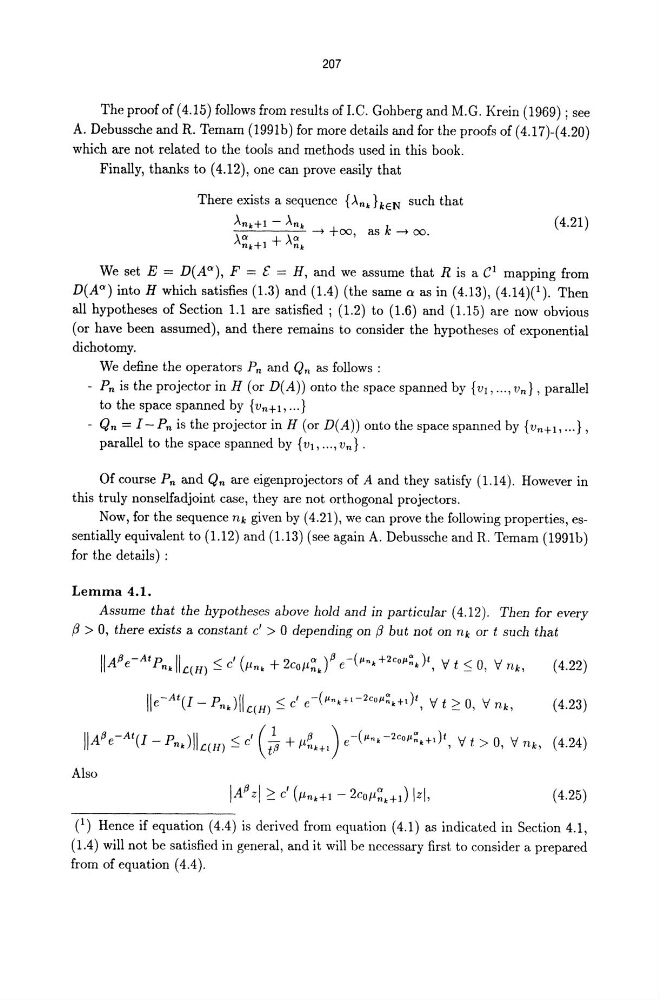
II APe-Atp II < C' (II + 2CQ'L a )p e-(Jln.+2COJl~.)t V t < 0 V nk
(4.22)
n. C(H) - "n. I n.
' -, ,
Il e-At(l - P )11
< c' e-(Jln.+1-2cOJl~.+1)t V t > 0 V nk
(4.23)
n. qH) -
,
- ,
,
Also
( 4.25)
e) Hence if equation (4.4) is derived from equation (4.1) as indicated in Section 4.1,
(1.4) will not be satisfied in general, and it will be necessary first to consider a prepared
from of equation (4.4).
The proof of (4.15) follows from results of I.e. Gohberg and M.G. Krein (1969) ; see
A. Debussche and R. Temam (1991b) for more details and for the proofs of (4.17)-(4.20)
which are not related to the tools and methods used in this book.
Finally, thanks to (4.12), one can prove easily that
There exists a sequence {An.} kEN such that
An.+1 - An.
k
-"-'---=- -+ +00, as -+ 00.
A~dI + A~.
(4.21 )
We set E == D(Aa), F == E == H, and we assume that R is a (1 mapping from
D(Aa) into H which satisfies (1.3) and (1.4) (the same 0: as in (4.13), (4.14)(1). Then
all hypotheses of Section 1.1 are satisfied; (1.2) to (1.6) and (1.15) are now obvious
(or have been assumed), and there remains to consider the hypotheses of exponential
dichotomy.
We define the operators Pn and Qn as follows:
- Pn is the projector in H (or D( A)) onto the space spanned by {VI, ... , vn } , parallel
to the space spanned by {Vn+ 1, ... }
- Qn == I - Pn is the projector in H (or D(A)) onto the space spanned by {Vn+I' ... } ,
parallel to the space spanned by {VI, ... , V n } .
Of course Pn and Qn are eigenprojectors of A and they satisfy (1.14). However in
this truly nonselfadjoint case, they are not orthogonal projectors.
Now, for the sequence nk given by (4.21), we can prove the following properties, essenti ally equivalent to (1.12) and (1.13) (see again A. Debussche and R. Temam (1991b)
for the details) :
Lemma 4.1.
Assume that the hypotheses above hold and in particular (4.12). Then for every
(3 > 0, there exists a constant c' > 0 depending on (3 but not on nk or t such that
II APe-Atp II < C' (II + 2CQ'L a )p e-(Jln.+2COJl~.)t V t < 0 V nk
(4.22)
n. C(H) - "n. I n.
' -, ,
Il e-At(l - P )11
< c' e-(Jln.+1-2cOJl~.+1)t V t > 0 V nk
(4.23)
n. qH) -
,
- ,
,
Also
( 4.25)
e) Hence if equation (4.4) is derived from equation (4.1) as indicated in Section 4.1,
(1.4) will not be satisfied in general, and it will be necessary first to consider a prepared
from of equation (4.4).