

205
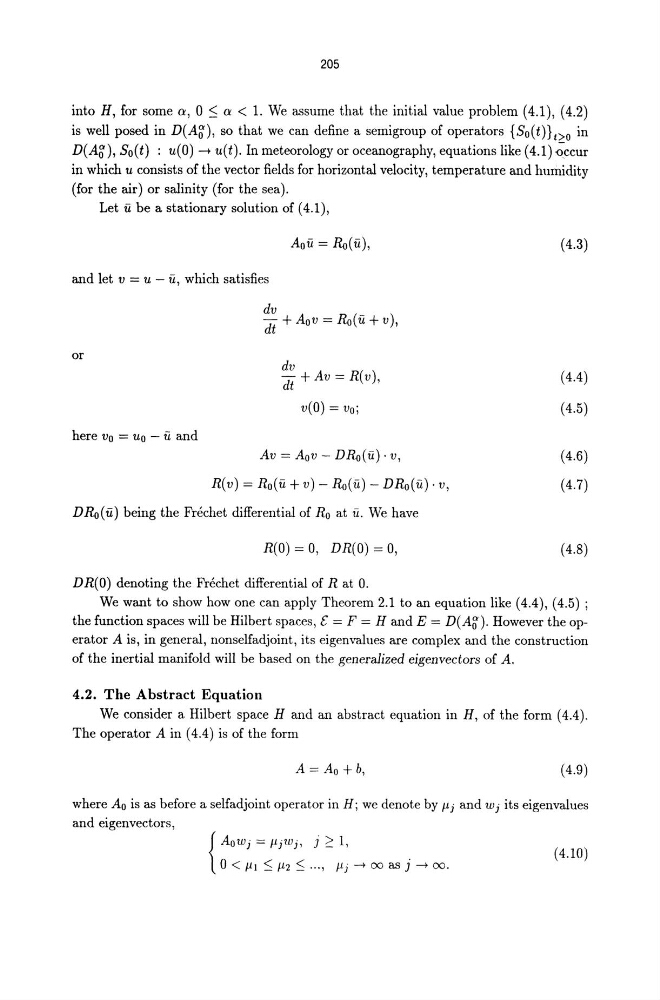
into H, for some CI', 0 :s CI' < 1. We assume that the initial value problem (4.1), (4.2)
is well posed in D(A~), so that we can define a semigroup of operators {So(t)}t>o in
D(A~), So(t) : u(O) -> u(t). In meteorology or oceanography, equations like (4.1) ;ccur
in which u consists of the vector fields for horizontal velocity, temperature and humidity
(for the air) or salinity (for the sea).
Let u be a stationary solution of (4.1),
Aou = Ro(u),
and let v = u - u, which satisfies
dv
dt +Aov=Ro(u+v),
or
dv
dt + Av = R(v),
v(O) = Vo;
here Vo = Uo - u and
Av = Aov - DRo(u) . v,
R(v) = Ro(u + v) - Ro(u) - DRo(u). v,
DRo(u) being the Frechet differential of Ro at u. We have
R(O) = 0, DR(O) = 0,
DR(O) denoting the Frechet differential of Rat o.
( 4.3)
( 4.4)
( 4.5)
( 4.6)
( 4.7)
( 4.8)
We want to show how one can apply Theorem 2.1 to an equation like (4.4), (4.5) ;
the function spaces will be Hilbert spaces, £ = F = Hand E = D(Ag). However the operator A is, in general, nonselfadjoint, its eigenvalues are complex and the construction
of the inertial manifold will be based on the generalized eigenvectors of A.
4.2. The Abstract Equation
We consider a Hilbert space H and an abstract equation in H, of the form (4.4).
The operator A in (4.4) is of the form
A = Ao + b,
( 4.9)
where Ao is as before a selfadjoint operator in H; we denote by {lj and Wj its eigenvalues
and eigenvectors,
{
Aowj = {ljWj, j 2:: 1,
o < {l1 ::; {l2 ::; ... , {l j -> 00 as J -> 00.
(4.10)
into H, for some CI', 0 :s CI' < 1. We assume that the initial value problem (4.1), (4.2)
is well posed in D(A~), so that we can define a semigroup of operators {So(t)}t>o in
D(A~), So(t) : u(O) -> u(t). In meteorology or oceanography, equations like (4.1) ;ccur
in which u consists of the vector fields for horizontal velocity, temperature and humidity
(for the air) or salinity (for the sea).
Let u be a stationary solution of (4.1),
Aou = Ro(u),
and let v = u - u, which satisfies
dv
dt +Aov=Ro(u+v),
or
dv
dt + Av = R(v),
v(O) = Vo;
here Vo = Uo - u and
Av = Aov - DRo(u) . v,
R(v) = Ro(u + v) - Ro(u) - DRo(u). v,
DRo(u) being the Frechet differential of Ro at u. We have
R(O) = 0, DR(O) = 0,
DR(O) denoting the Frechet differential of Rat o.
( 4.3)
( 4.4)
( 4.5)
( 4.6)
( 4.7)
( 4.8)
We want to show how one can apply Theorem 2.1 to an equation like (4.4), (4.5) ;
the function spaces will be Hilbert spaces, £ = F = Hand E = D(Ag). However the operator A is, in general, nonselfadjoint, its eigenvalues are complex and the construction
of the inertial manifold will be based on the generalized eigenvectors of A.
4.2. The Abstract Equation
We consider a Hilbert space H and an abstract equation in H, of the form (4.4).
The operator A in (4.4) is of the form
A = Ao + b,
( 4.9)
where Ao is as before a selfadjoint operator in H; we denote by {lj and Wj its eigenvalues
and eigenvectors,
{
Aowj = {ljWj, j 2:: 1,
o < {l1 ::; {l2 ::; ... , {l j -> 00 as J -> 00.
(4.10)