

190
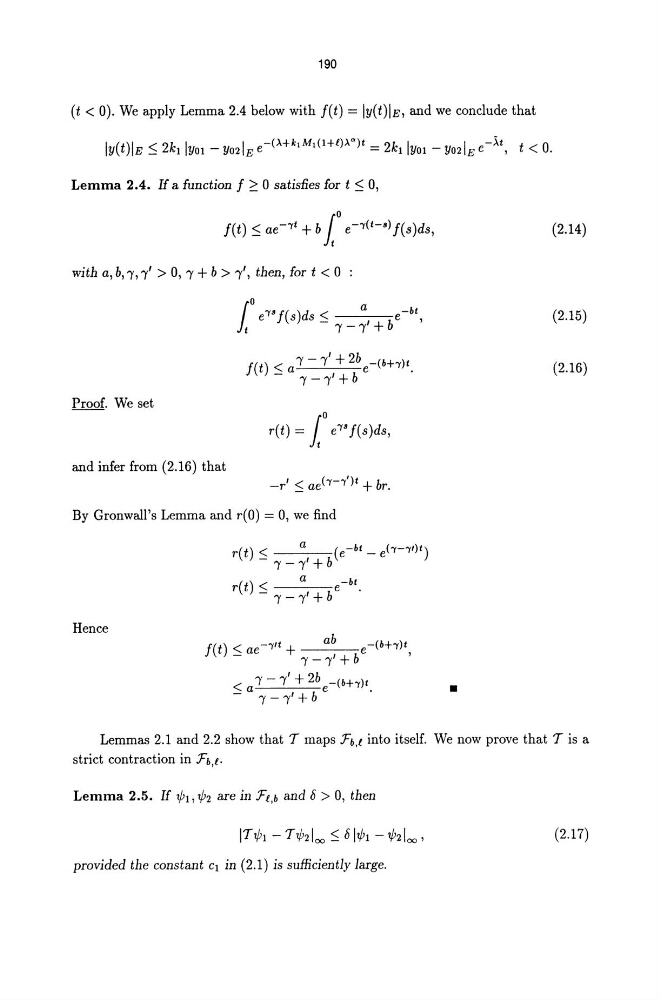
(t < 0). We apply Lemma 2.4 below with J(t) = ly(t)IE, and we conclude that
Lemma 2.4. If a function J ~ 0 satisfies for t ~ 0,
J(t) ~ ae--r t + b 1° e--r(t-.) J(s)ds,
with a, b", " > 0, ,+ b > ,', then, for t < 0
Proof. We set
and infer from (2.16) that
J(t) < a , - , ' + 2b e-(b+-r)t.
- ,-,'+b
ret) = 1° e-r· J(s)ds,
-r' ~ aeh--r')t + br.
By Gronwall's Lemma and reO) = 0, we find
ret) ::;
a
(e- bt _ eh--r,)t)
,-,' + b
ret) <
a
e- bt .
- ,-,'+b
Hence
J(t) < ae--r't +
ab
e-(b+-r)t
-
,-,' + b
'
< a , - , ' + 2b e-(b+-r)t
- ,-,' + b
•
(2.14)
(2.15)
(2.16)
Lemmas 2.1 and 2.2 show that T maps Fb,i into itself. We now prove that T is a
strict contraction in Fb,(.
Lemma 2.5. If 1/;1, 1/;2 are in F(,b and 8 > 0, then
(2.17)
provided the constant Cl in (2.1) is sufficiently large.
(t < 0). We apply Lemma 2.4 below with J(t) = ly(t)IE, and we conclude that
Lemma 2.4. If a function J ~ 0 satisfies for t ~ 0,
J(t) ~ ae--r t + b 1° e--r(t-.) J(s)ds,
with a, b", " > 0, ,+ b > ,', then, for t < 0
Proof. We set
and infer from (2.16) that
J(t) < a , - , ' + 2b e-(b+-r)t.
- ,-,'+b
ret) = 1° e-r· J(s)ds,
-r' ~ aeh--r')t + br.
By Gronwall's Lemma and reO) = 0, we find
ret) ::;
a
(e- bt _ eh--r,)t)
,-,' + b
ret) <
a
e- bt .
- ,-,'+b
Hence
J(t) < ae--r't +
ab
e-(b+-r)t
-
,-,' + b
'
< a , - , ' + 2b e-(b+-r)t
- ,-,' + b
•
(2.14)
(2.15)
(2.16)
Lemmas 2.1 and 2.2 show that T maps Fb,i into itself. We now prove that T is a
strict contraction in Fb,(.
Lemma 2.5. If 1/;1, 1/;2 are in F(,b and 8 > 0, then
(2.17)
provided the constant Cl in (2.1) is sufficiently large.