

183
defines a strongly continuous linear semigroup {e- At } t~O on £ such that
e-AtF C E, for all t > O.
(1.6)
The eigenprojectors Pn, Qn.
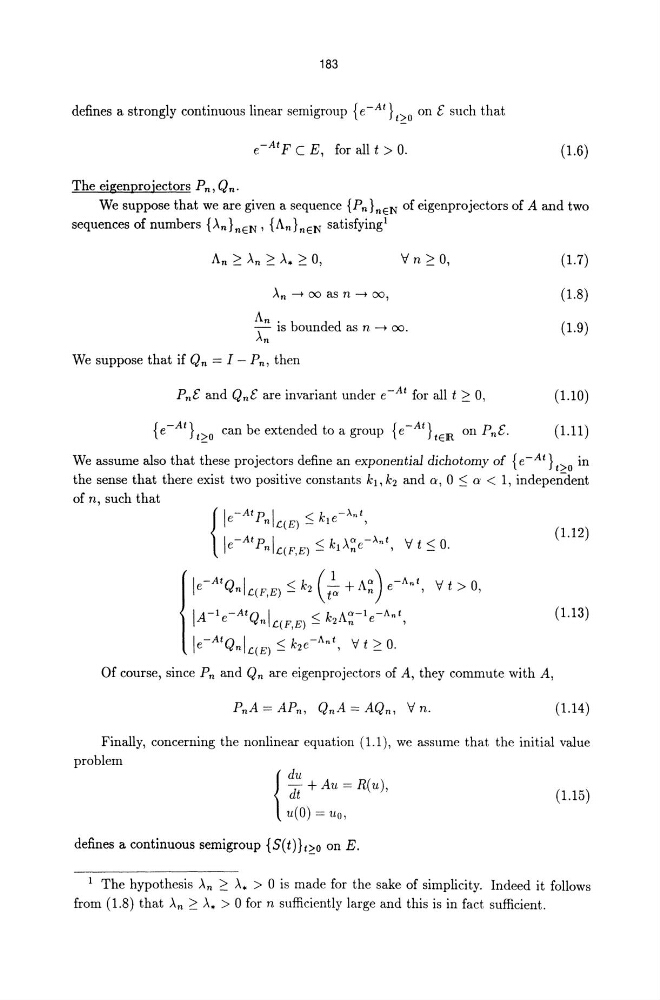
We suppose that we are given a sequence {Pn}nEN of eigenprojectors of A and two
sequences of numbers {An} nEN , {An} nEN satisfying l
Vn 2' : 0,
An -+ 00 as n -+ 00,
~: is bounded as n -+ 00.
We suppose that if Qn = 1- Pn, then
Pnt: and Qnt: are invariant under e- At for all t 2' : 0,
{e- At } t~O can be extended to a group {e- At } tER on Pn£.
(1.7)
(1.8)
(1.9)
(1.10)
(1.11)
We assume also that these projectors define an exponential dichotomy of {e- At } t>o in
the sense that there exist two positive constants kl , k2 and 0:, 0 ::; 0: < 1, indepen-dent
of n, such that
{
le-AtQnlC(F,E) ::; k2 C: + A~) e- Ant , V t > 0,
I A-Ie-AtQ I
< k AO-Ie-Ant
n C.(F,E) - 2 n
,
le-AtQnlC(E) ::; k2e- Ant , V t 2' : O.
Of course, since Pn and Qn are eigenprojectors of A, they commute with A,
(1.12)
(1.13)
(1.14)
Finally, concerning the nonlinear equation (1.1), we assume that the initial value
problem
{
du
dt + Au = R(u),
u(O) = Uo,
(1.15)
defines a continuous semigroup {S(t)}t~O on E.
I The hypothesis An 2' : A* > 0 is made for the sake of simplicity. Indeed it follows
from (1.8) that An 2' : A* > 0 for n sufficiently large and this is in fact sufficient.
defines a strongly continuous linear semigroup {e- At } t~O on £ such that
e-AtF C E, for all t > O.
(1.6)
The eigenprojectors Pn, Qn.
We suppose that we are given a sequence {Pn}nEN of eigenprojectors of A and two
sequences of numbers {An} nEN , {An} nEN satisfying l
Vn 2' : 0,
An -+ 00 as n -+ 00,
~: is bounded as n -+ 00.
We suppose that if Qn = 1- Pn, then
Pnt: and Qnt: are invariant under e- At for all t 2' : 0,
{e- At } t~O can be extended to a group {e- At } tER on Pn£.
(1.7)
(1.8)
(1.9)
(1.10)
(1.11)
We assume also that these projectors define an exponential dichotomy of {e- At } t>o in
the sense that there exist two positive constants kl , k2 and 0:, 0 ::; 0: < 1, indepen-dent
of n, such that
{
le-AtQnlC(F,E) ::; k2 C: + A~) e- Ant , V t > 0,
I A-Ie-AtQ I
< k AO-Ie-Ant
n C.(F,E) - 2 n
,
le-AtQnlC(E) ::; k2e- Ant , V t 2' : O.
Of course, since Pn and Qn are eigenprojectors of A, they commute with A,
(1.12)
(1.13)
(1.14)
Finally, concerning the nonlinear equation (1.1), we assume that the initial value
problem
{
du
dt + Au = R(u),
u(O) = Uo,
(1.15)
defines a continuous semigroup {S(t)}t~O on E.
I The hypothesis An 2' : A* > 0 is made for the sake of simplicity. Indeed it follows
from (1.8) that An 2' : A* > 0 for n sufficiently large and this is in fact sufficient.