

171
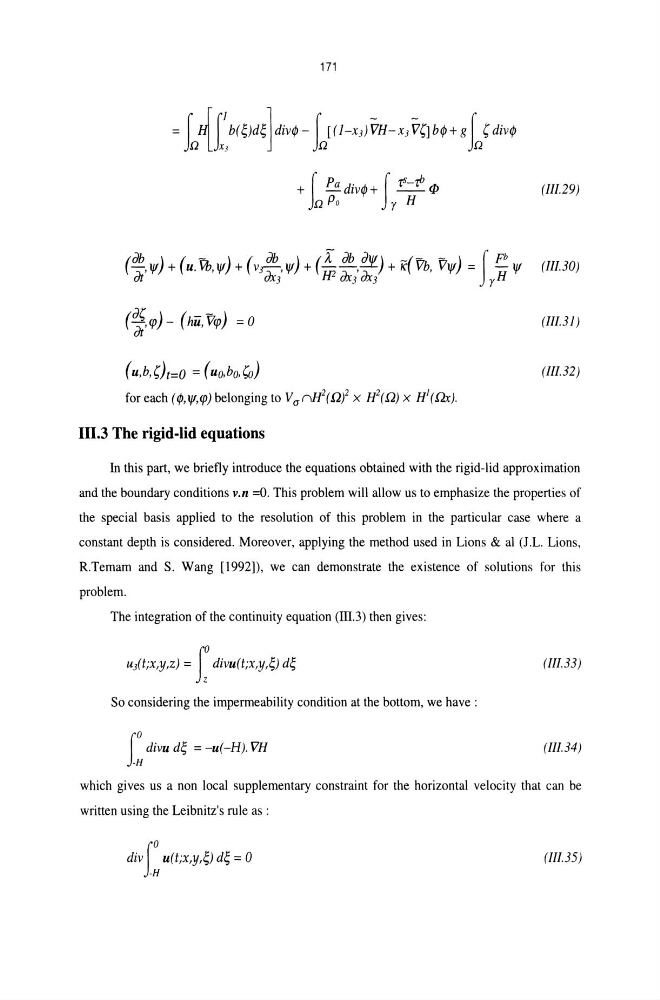
+ ( Pa divtjJ + f f5-# C[J
(1Il.29)
J.Q Po
y H
( db ) ( - ) ( db ) (X db~) -::./- - ) - f Fh (111.30)
at' lfI + u.~, lfI + vr;);; lfI + ][2 dx3' dx3 + 1\.\ Vb, VlfI - yH lfI
(~cp)- (hii,Vcp) =0
(lll.3J)
(u,b,S)t=O = (uo,bo, so)
(1Il.32)
for each (tjJ,lfI,CP) belonging to V a nH 2 (Qf x H2(Q) x H1(Qx).
111.3 The rigid-lid equations
In this part, we briefly introduce the equations obtained with the rigid-lid approximation
and the boundary conditions v.n =0. This problem will allow us to emphasize the properties of
the special basis applied to the resolution of this problem in the particular case where a
constant depth is considered. Moreover, applying the method used in Lions & al (lL. Lions,
R.Temam and S. Wang [1992]), we can demonstrate the existence of solutions for this
problem.
The integration of the continuity equation (III.3) then gives:
ult;x,y,z) = [ divu(t;x,y,;) d;
So considering the impermeability condition at the bottom, we have:
ro divu d; = -u(-H). VH
JH
(1Il.33 )
(lll.34)
which gives us a non local supplementary constraint for the horizontal velocity that can be
written using the Leibnitz's rule as :
diVfo u(t;x,y,;) d; = 0
-H
(1Il.35)
+ ( Pa divtjJ + f f5-# C[J
(1Il.29)
J.Q Po
y H
( db ) ( - ) ( db ) (X db~) -::./- - ) - f Fh (111.30)
at' lfI + u.~, lfI + vr;);; lfI + ][2 dx3' dx3 + 1\.\ Vb, VlfI - yH lfI
(~cp)- (hii,Vcp) =0
(lll.3J)
(u,b,S)t=O = (uo,bo, so)
(1Il.32)
for each (tjJ,lfI,CP) belonging to V a nH 2 (Qf x H2(Q) x H1(Qx).
111.3 The rigid-lid equations
In this part, we briefly introduce the equations obtained with the rigid-lid approximation
and the boundary conditions v.n =0. This problem will allow us to emphasize the properties of
the special basis applied to the resolution of this problem in the particular case where a
constant depth is considered. Moreover, applying the method used in Lions & al (lL. Lions,
R.Temam and S. Wang [1992]), we can demonstrate the existence of solutions for this
problem.
The integration of the continuity equation (III.3) then gives:
ult;x,y,z) = [ divu(t;x,y,;) d;
So considering the impermeability condition at the bottom, we have:
ro divu d; = -u(-H). VH
JH
(1Il.33 )
(lll.34)
which gives us a non local supplementary constraint for the horizontal velocity that can be
written using the Leibnitz's rule as :
diVfo u(t;x,y,;) d; = 0
-H
(1Il.35)