

161
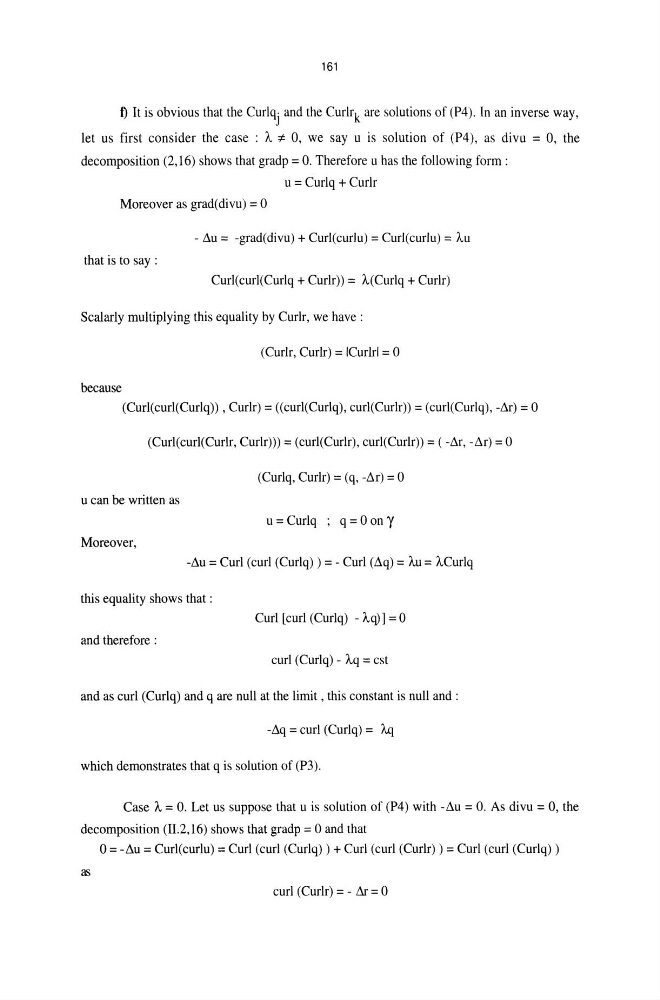
t) It is obvious that the Curlqj and the Curlrk are solutions of CP4). In an inverse way,
let us first consider the case: f... ;f:. 0, we say u is solution of CP4), as divu = 0, the
decomposition (2,16) shows that gradp = O. Therefore u has the following form:
u = Curlq + Curlr
Moreover as grad(divu) = 0
- ~u = -grad(divu) + Curl(curlu) = Curl(curlu) = AU
that is to say :
Curl(curl(Curlq + Curlr» = 'f...(Curlq + Curlr)
Scalarly multiplying this equality by Curlr, we have:
(Curlr, Curlr) = ICurirl = 0
because
(Curl(curl(Curlq» , Curlr) = «curl(Curlq), curl(Curlr» = (curl(Curlq), -ru) = 0
(Curl(curl(Curlr, Curlr») = (curl(Curlr), curl(Curlr» = ( -ru, -M) = 0
(Curlq, Curir) = (q, -M) = 0
u can be written as
u = Curlq ; q = 0 on y
Moreover,
-~u = Curl (curl (Curlq) ) = - Curl (~q) = AU = ACurlq
this equality shows that:
Curl [curl (Curlq) - ' f...q) ] = 0
and therefore :
curl (Curlq) - ' f...q = cst
and as curl (Curlq) and q are null at the limit, this constant is null and :
-~q = curl (Curlq) = f...q
which demonstrates that q is solution of (P3).
Case ' f... = O. Let us suppose that u is solution of (P4) with -~u = O. As divu = 0, the
decomposition (11.2, 16) shows that gradp = 0 and that
o = -~u = Curl(curlu) = Curl (curl (Curlq) ) + Curl (curl (Curlr) ) = Curl (curl (Curlq) )
as
curl (Curlr) = - ru = 0
t) It is obvious that the Curlqj and the Curlrk are solutions of CP4). In an inverse way,
let us first consider the case: f... ;f:. 0, we say u is solution of CP4), as divu = 0, the
decomposition (2,16) shows that gradp = O. Therefore u has the following form:
u = Curlq + Curlr
Moreover as grad(divu) = 0
- ~u = -grad(divu) + Curl(curlu) = Curl(curlu) = AU
that is to say :
Curl(curl(Curlq + Curlr» = 'f...(Curlq + Curlr)
Scalarly multiplying this equality by Curlr, we have:
(Curlr, Curlr) = ICurirl = 0
because
(Curl(curl(Curlq» , Curlr) = «curl(Curlq), curl(Curlr» = (curl(Curlq), -ru) = 0
(Curl(curl(Curlr, Curlr») = (curl(Curlr), curl(Curlr» = ( -ru, -M) = 0
(Curlq, Curir) = (q, -M) = 0
u can be written as
u = Curlq ; q = 0 on y
Moreover,
-~u = Curl (curl (Curlq) ) = - Curl (~q) = AU = ACurlq
this equality shows that:
Curl [curl (Curlq) - ' f...q) ] = 0
and therefore :
curl (Curlq) - ' f...q = cst
and as curl (Curlq) and q are null at the limit, this constant is null and :
-~q = curl (Curlq) = f...q
which demonstrates that q is solution of (P3).
Case ' f... = O. Let us suppose that u is solution of (P4) with -~u = O. As divu = 0, the
decomposition (11.2, 16) shows that gradp = 0 and that
o = -~u = Curl(curlu) = Curl (curl (Curlq) ) + Curl (curl (Curlr) ) = Curl (curl (Curlq) )
as
curl (Curlr) = - ru = 0