

152
• The next relation is shown by introducing operators ( -.6. + 1)2 and ( -.6. + I) -2 which
are resp. required for decrease the regularity of v~ 4> where 4> E D(n) and increase the
regularity of hn• We pass to the limit using the Aubin's theorem.
• Then the result is obtained by introducing the function v~. Passing to the limit is done
with n --+ 00 and after 6 --+ 00.
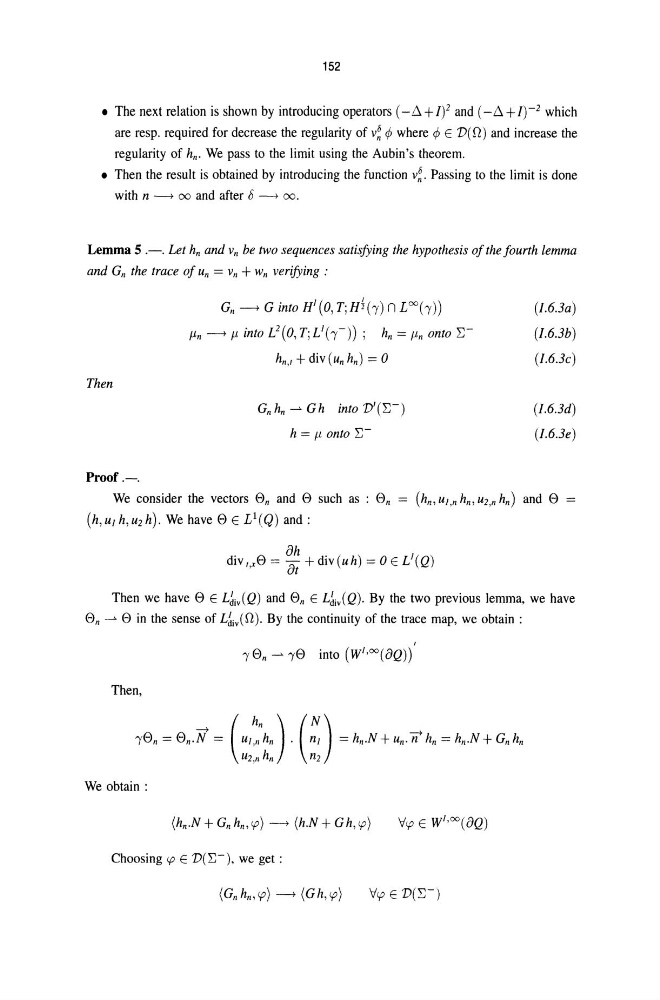
Lemma 5.-. Let hn and Vn be two sequences satisfying the hypothesis of the fourth lemma
and Gn the trace of Un = Vn + Wn verifying:
Then
Proof.-.
Gn --+ G into HI (0, T;H~("'/) n L""(",/))
li-n--+li-intoL 2 (0,T;L I (",!-)); hn=li-nonto~hn,t + div(unhn) = °
Gnhn ~ Gh into D/(~-)
h = Ii- onto~We consider the vectors en and e such as : en
(h, UI h, u2h). We have e E L1(Q) and:
div/xe= ~~ +div(uh)=OEL'(Q)
(1.6.3a)
(1.6.3b)
(1.6.3c)
(I.6.3d)
(I.6.3e)
Then we have e E L~iv(Q) and en E L~iv(Q). By the two previous lemma, we have
en ~ e in the sense of L~iV(n). By the continuity of the trace map, we obtain:
Then,
We obtain:
(hn.N + Gnhn,tp) --+ (h.N + Gh,tp)
Choosing tp E D(~-). we get:
• The next relation is shown by introducing operators ( -.6. + 1)2 and ( -.6. + I) -2 which
are resp. required for decrease the regularity of v~ 4> where 4> E D(n) and increase the
regularity of hn• We pass to the limit using the Aubin's theorem.
• Then the result is obtained by introducing the function v~. Passing to the limit is done
with n --+ 00 and after 6 --+ 00.
Lemma 5.-. Let hn and Vn be two sequences satisfying the hypothesis of the fourth lemma
and Gn the trace of Un = Vn + Wn verifying:
Then
Proof.-.
Gn --+ G into HI (0, T;H~("'/) n L""(",/))
li-n--+li-intoL 2 (0,T;L I (",!-)); hn=li-nonto~hn,t + div(unhn) = °
Gnhn ~ Gh into D/(~-)
h = Ii- onto~We consider the vectors en and e such as : en
(h, UI h, u2h). We have e E L1(Q) and:
div/xe= ~~ +div(uh)=OEL'(Q)
(1.6.3a)
(1.6.3b)
(1.6.3c)
(I.6.3d)
(I.6.3e)
Then we have e E L~iv(Q) and en E L~iv(Q). By the two previous lemma, we have
en ~ e in the sense of L~iV(n). By the continuity of the trace map, we obtain:
Then,
We obtain:
(hn.N + Gnhn,tp) --+ (h.N + Gh,tp)
Choosing tp E D(~-). we get: