

144
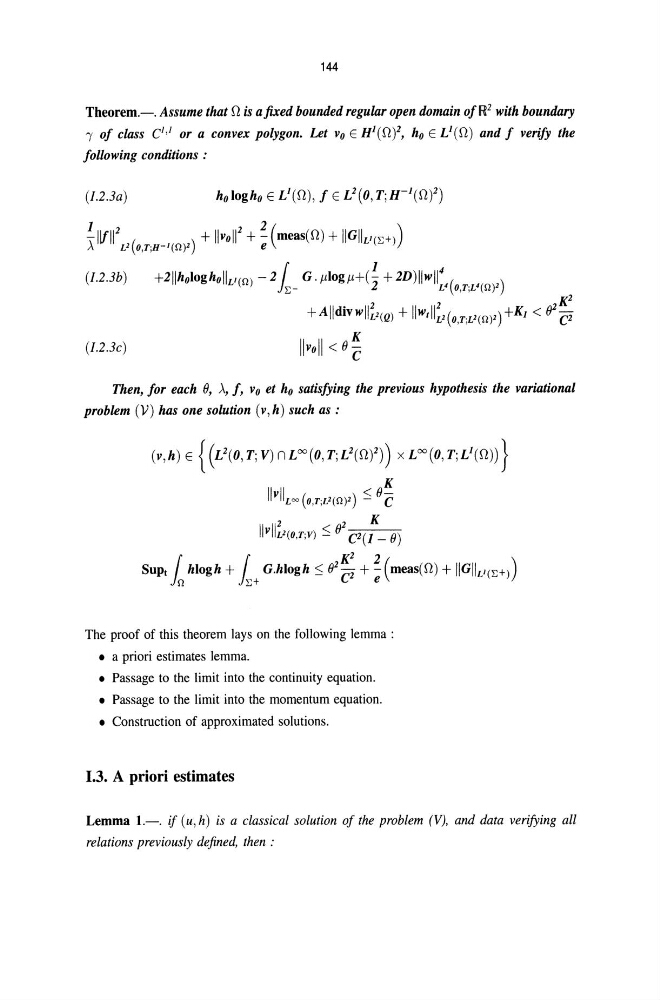
Theorem.-. Assume that 0 is a fixed bounded regular open domain of R2 with boundary
I of class c/,/ or a convex polygon. Let Vo E Hl(0)2, ho E Ll(rl) and f verify the
following conditions:
(I.2.3a)
1
2
2
2(
)
,Iltll (
) + Ilvoll + - meas(O) + IIGIILI(E+)
A
L2 O,T;H-/(fl)2
e
(I.2.3b)
(I.2.3c)
i
1
4
+21IhologhoIIL1 (fl)· - 2
G. ;.tlog;.t+( - + 2D)llwll (
)
E2
L4 O,T;L4(fl)2
+Alldivwll~2(Q) + Ilwtll~2(O,T;L2(fl)2)+Kl < 02~;
K
Ilvoll < 0 e
Then, for each 0, A, f, Vo et ho satisfying the previous hypothesis the variational
problem (V) has one solution (v, h) such as :
(v,h) E { (L2(o,T; V) ilL OO (O,T;L 2 (0)2)) x LOO(O, T;L 1 (0))}
K
IlvlIL= (O,T;L2(fl)2) ::; °e
Ilvll~2(O,T;V) ::; 0
2
C2(JK_ 0)
f
f
K2 2
SUPt Jfl hlogh + JEt G.hlogh ::; 0 2 C2 + e (meas(O) + IIGIILI(Et))
The proof of this theorem lays on the following lemma:
• a priori estimates lemma.
• Passage to the limit into the continuity equation.
• Passage to the limit into the momentum equation.
• Construction of approximated solutions.
1.3. A priori estimates
Lemma 1.-. if (u, h) is a classical solution of the problem (V). and data verifying all
relations previously defined. then:
Theorem.-. Assume that 0 is a fixed bounded regular open domain of R2 with boundary
I of class c/,/ or a convex polygon. Let Vo E Hl(0)2, ho E Ll(rl) and f verify the
following conditions:
(I.2.3a)
1
2
2
2(
)
,Iltll (
) + Ilvoll + - meas(O) + IIGIILI(E+)
A
L2 O,T;H-/(fl)2
e
(I.2.3b)
(I.2.3c)
i
1
4
+21IhologhoIIL1 (fl)· - 2
G. ;.tlog;.t+( - + 2D)llwll (
)
E2
L4 O,T;L4(fl)2
+Alldivwll~2(Q) + Ilwtll~2(O,T;L2(fl)2)+Kl < 02~;
K
Ilvoll < 0 e
Then, for each 0, A, f, Vo et ho satisfying the previous hypothesis the variational
problem (V) has one solution (v, h) such as :
(v,h) E { (L2(o,T; V) ilL OO (O,T;L 2 (0)2)) x LOO(O, T;L 1 (0))}
K
IlvlIL= (O,T;L2(fl)2) ::; °e
Ilvll~2(O,T;V) ::; 0
2
C2(JK_ 0)
f
f
K2 2
SUPt Jfl hlogh + JEt G.hlogh ::; 0 2 C2 + e (meas(O) + IIGIILI(Et))
The proof of this theorem lays on the following lemma:
• a priori estimates lemma.
• Passage to the limit into the continuity equation.
• Passage to the limit into the momentum equation.
• Construction of approximated solutions.
1.3. A priori estimates
Lemma 1.-. if (u, h) is a classical solution of the problem (V). and data verifying all
relations previously defined. then: