

142
1.2. An existence theorem
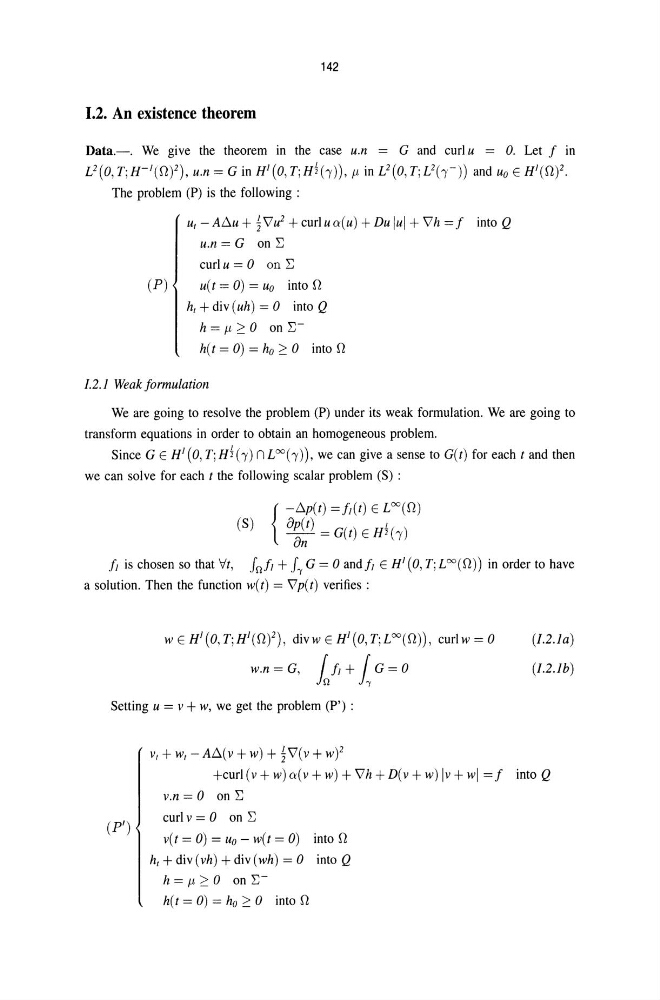
Data.-. We give the theorem in the case u.n = G and curl u = O. Let f in
L2(0, T;H-/(fI/), u.n = G in HI (0, T;H1(-y)), J-t in L2(0, T;L 2 ('Y-)) and Uo E HI(flY
The problem (P) is the following:
u, - A~u + ~\7u2 + curlua(u) + Du lui + \7h = f into Q
u.n = G on ~
curlu = 0 on ~
(P)
u(t = 0) = Uo into n
ht+div(uh)=O intoQ
h = J-t ~ 0 on~h(t = 0) = ho ~ 0 into n
1.2.1 Weak formulation
We are going to resolve the problem (P) under its weak formulation. We are going to
transform equations in order to obtain an homogeneous problem.
Since G E HI (0, T; H1 ('Y) n L OO ( 'Y))' we can give a sense to G(t) for each t and then
we can solve for each t the following scalar problem (S) :
{
-~p(t) =i./(t) E LOO(n)
(S)
ap(t) = G(t) E H1(-y)
an
tI is chosen so that 'it, lotI + 1.' 1 G = 0 and fl E HI (0, T; L OO( n)) in order to have
a solution. Then the function w(t) = \7p(t) verifies:
wE HI (0, T; HI(nf), divw E HI (0, T;LOO(n)), curl w = 0
w.n = G, 10 tI + l G = 0
(I.2.la)
(I.2.1b)
Setting u = v + w, we get the problem (P') :
(PI)
vt + W, - A~(v + w) + ~ \7(v + W)2
+curl(v+w)a(v+w) + \7h+D(v+w) Iv+wl =f into Q
v.n = 0 on ~
curl v = 0 on ~
v(t = 0) = Uo - w(t = 0) into n
ht + div(vh) + div (wh) = 0 into Q
h = J-t ~ 0 on~h(t = 0) = ho ~ 0 into n
1.2. An existence theorem
Data.-. We give the theorem in the case u.n = G and curl u = O. Let f in
L2(0, T;H-/(fI/), u.n = G in HI (0, T;H1(-y)), J-t in L2(0, T;L 2 ('Y-)) and Uo E HI(flY
The problem (P) is the following:
u, - A~u + ~\7u2 + curlua(u) + Du lui + \7h = f into Q
u.n = G on ~
curlu = 0 on ~
(P)
u(t = 0) = Uo into n
ht+div(uh)=O intoQ
h = J-t ~ 0 on~h(t = 0) = ho ~ 0 into n
1.2.1 Weak formulation
We are going to resolve the problem (P) under its weak formulation. We are going to
transform equations in order to obtain an homogeneous problem.
Since G E HI (0, T; H1 ('Y) n L OO ( 'Y))' we can give a sense to G(t) for each t and then
we can solve for each t the following scalar problem (S) :
{
-~p(t) =i./(t) E LOO(n)
(S)
ap(t) = G(t) E H1(-y)
an
tI is chosen so that 'it, lotI + 1.' 1 G = 0 and fl E HI (0, T; L OO( n)) in order to have
a solution. Then the function w(t) = \7p(t) verifies:
wE HI (0, T; HI(nf), divw E HI (0, T;LOO(n)), curl w = 0
w.n = G, 10 tI + l G = 0
(I.2.la)
(I.2.1b)
Setting u = v + w, we get the problem (P') :
(PI)
vt + W, - A~(v + w) + ~ \7(v + W)2
+curl(v+w)a(v+w) + \7h+D(v+w) Iv+wl =f into Q
v.n = 0 on ~
curl v = 0 on ~
v(t = 0) = Uo - w(t = 0) into n
ht + div(vh) + div (wh) = 0 into Q
h = J-t ~ 0 on~h(t = 0) = ho ~ 0 into n