

138
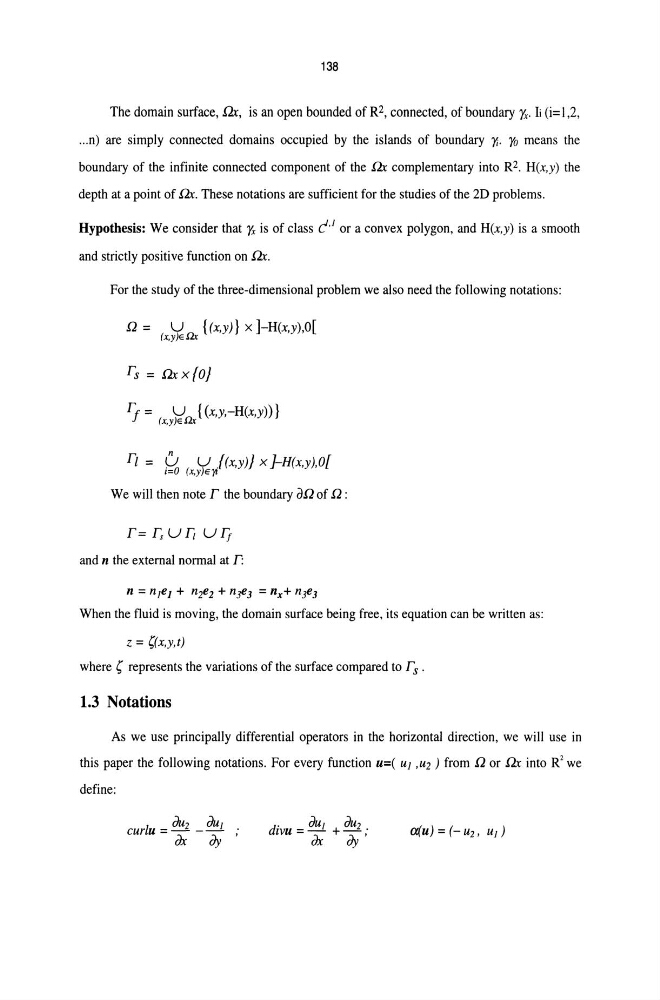
The domain surface,.ax, is an open bounded of R2, connected, of boundary rx. Ii (i=l ,2,
... n) are simply connected domains occupied by the islands of boundary Yi, ' )1J means the
boundary of the infinite connected component of the .ax complementary into R2. H(x,y) the
depth at a point of .ax. These notations are sufficient for the studies of the 2D problems.
Hypothesis: We consider that rx is of class c!,J or a convex polygon, and H(x,y) is a smooth
and strictly positive function on .ax.
For the study of the three-dimensional problem we also need the following notations:
Q = U {(x,yJ) x ]-H(x,y),O[
(x,y)enx
rs=.axx{oj
r f = (X,y~nx{ (x,y,-H(x,y))}
Tz = (j u l(x,y)j x ]-H(x,y),O[
1=0 (X,yJEjt
We will then note r the boundary aQ of Q :
r= r. UI{ UIf
and n the external normal at r:
n = nIel + n2e2 + n3e3 = nx+ n~3
When the fluid is moving, the domain surface being free, its equation can be written as:
z = ,(x,y,t)
where , represents the variations of the surface compared to rs '
1.3 Notations
As we use principally differential operators in the horizontal direction, we will use in
this paper the following notations. For every function u=( UI ,U2 ) from Q or .ax into R' we
define:
curlu = du2 _ duJ
dx ()y
a(u) = (- U2, uJ)
The domain surface,.ax, is an open bounded of R2, connected, of boundary rx. Ii (i=l ,2,
... n) are simply connected domains occupied by the islands of boundary Yi, ' )1J means the
boundary of the infinite connected component of the .ax complementary into R2. H(x,y) the
depth at a point of .ax. These notations are sufficient for the studies of the 2D problems.
Hypothesis: We consider that rx is of class c!,J or a convex polygon, and H(x,y) is a smooth
and strictly positive function on .ax.
For the study of the three-dimensional problem we also need the following notations:
Q = U {(x,yJ) x ]-H(x,y),O[
(x,y)enx
rs=.axx{oj
r f = (X,y~nx{ (x,y,-H(x,y))}
Tz = (j u l(x,y)j x ]-H(x,y),O[
1=0 (X,yJEjt
We will then note r the boundary aQ of Q :
r= r. UI{ UIf
and n the external normal at r:
n = nIel + n2e2 + n3e3 = nx+ n~3
When the fluid is moving, the domain surface being free, its equation can be written as:
z = ,(x,y,t)
where , represents the variations of the surface compared to rs '
1.3 Notations
As we use principally differential operators in the horizontal direction, we will use in
this paper the following notations. For every function u=( UI ,U2 ) from Q or .ax into R' we
define:
curlu = du2 _ duJ
dx ()y
a(u) = (- U2, uJ)