

,,\/.---Q- - -
/
\"
/ \
123
_----t.. .. IOO ~I'I'I----_
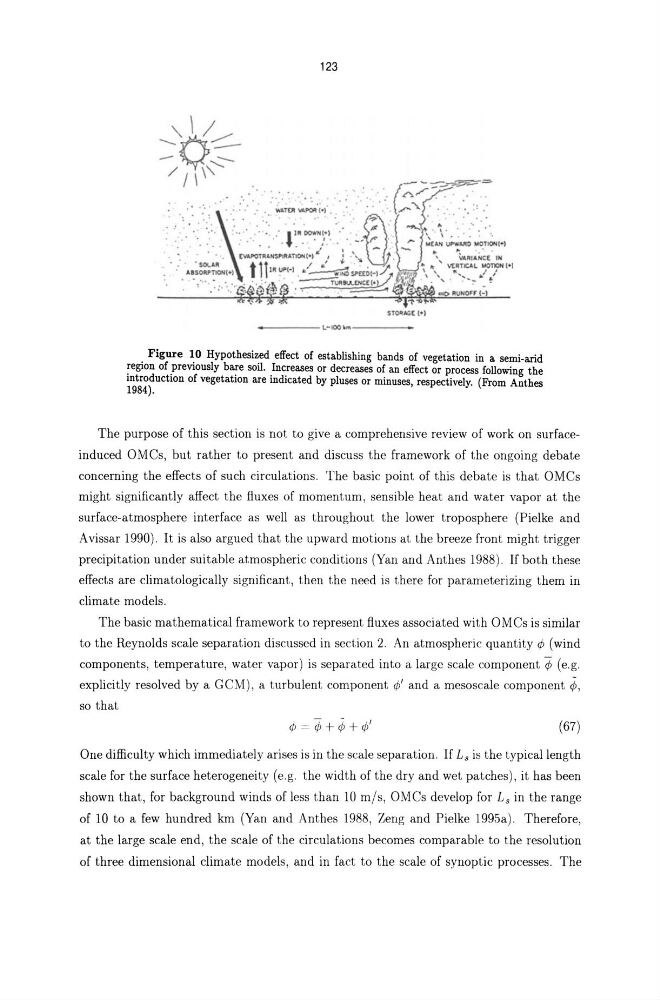
Figure 10 Hypothesized effect of establishing bands of vegetation in a semi-arid
~egion of previously ba~e soil. In~reases or decreases of an effect or process following the
mtroductlOn of vegetatIOn are mdlcated by pluses or minuses respectively. (From Anthes
1984).
'
The purpose of this section is not to give a comprehensive review of work on surfaceinduced OMCs, but rather to present and discuss the framework of the ongoing debate
concerning the effects of such circulations. The basic point of this debate is t hat OMes
might significantly affect the fluxes of momentum , sensible heat and water vapor at the
surface-atmosphere interface as well as t hroughout the lower troposphere (Pielke and
Avissar 1990). It is also argued that the upward mo tions at the breeze front might trigger
precipitation under suitable atmospheric conditions (Yan and Anthes 1988). If both these
effects are climatologically significant, then the need is there for parameterizing them in
climate models.
The basic mathematical framework to represent fluxes associated wi th OMes is similar
to the Reynolds scale separation discussed in section 2. An atmospheric quantity ¢ (wind
components, temperature, water vapor) is separated into a large scale component ¢ (e.g.
explicitly resolved by a GCM ), a t urbulent component if/ and a mesoscale component ;p,
so that
(67)
One difficulty which immediately arises is in the scale separat ion. If Ls is the typical length
scale for the surface heterogeneity (e.g. the width of the dry and wet patches ), it has been
shown that, for background winds of less than 10 mis, OMes develop for Ls in the range
of 10 to a few hundred km (Yan and Anthes 1988, Zeng and Pielke 1995a). Therefore,
at the large scale end, the scale of the circulations becomes comparable to the resolution
of three dimensional climate models , and in fact to the scale of synoptic processes. The
/
\"
/ \
123
_----t.. .. IOO ~I'I'I----_
Figure 10 Hypothesized effect of establishing bands of vegetation in a semi-arid
~egion of previously ba~e soil. In~reases or decreases of an effect or process following the
mtroductlOn of vegetatIOn are mdlcated by pluses or minuses respectively. (From Anthes
1984).
'
The purpose of this section is not to give a comprehensive review of work on surfaceinduced OMCs, but rather to present and discuss the framework of the ongoing debate
concerning the effects of such circulations. The basic point of this debate is t hat OMes
might significantly affect the fluxes of momentum , sensible heat and water vapor at the
surface-atmosphere interface as well as t hroughout the lower troposphere (Pielke and
Avissar 1990). It is also argued that the upward mo tions at the breeze front might trigger
precipitation under suitable atmospheric conditions (Yan and Anthes 1988). If both these
effects are climatologically significant, then the need is there for parameterizing them in
climate models.
The basic mathematical framework to represent fluxes associated wi th OMes is similar
to the Reynolds scale separation discussed in section 2. An atmospheric quantity ¢ (wind
components, temperature, water vapor) is separated into a large scale component ¢ (e.g.
explicitly resolved by a GCM ), a t urbulent component if/ and a mesoscale component ;p,
so that
(67)
One difficulty which immediately arises is in the scale separat ion. If Ls is the typical length
scale for the surface heterogeneity (e.g. the width of the dry and wet patches ), it has been
shown that, for background winds of less than 10 mis, OMes develop for Ls in the range
of 10 to a few hundred km (Yan and Anthes 1988, Zeng and Pielke 1995a). Therefore,
at the large scale end, the scale of the circulations becomes comparable to the resolution
of three dimensional climate models , and in fact to the scale of synoptic processes. The