

120
with the only unknown Tf, the canopy foliage temperature (assumed to be equal to the
surface soil temperature). The coefficients a - d in Eq . (64) include all terms linked to
the appropriate power of T f . The surface fluxes are then calculated with the following
procedure: i) the PDF fpdf(r s) is divided in a number of intervals I ; ii) for each interval i,
the value of r! is used to calculate TJ by solving Eq. (64) via Newton-Raphson iteration;
iii) the individual fluxes are computed by numerically calculating the appropriate integrals
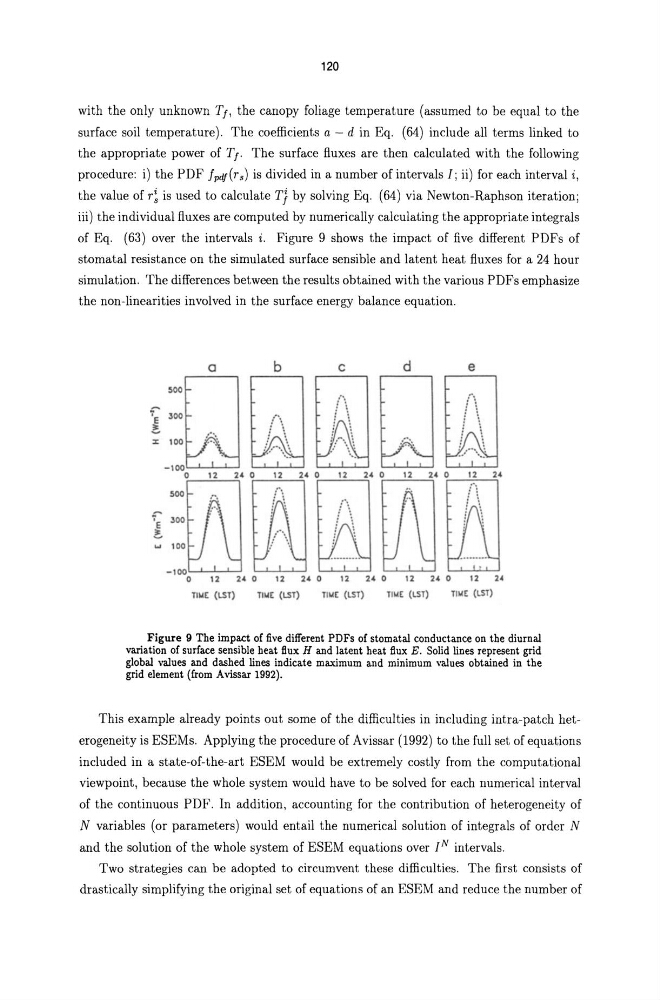
of Eq. (63) over the intervals i. Figure 9 shows the impact of five different PDFs of
stomatal resistance on the simulated surface sensible and latent heat fluxes for a 24 hour
simulation. The differences between the results obtained with the various PDFs emphasize
the non-linearities involved in the surface energy balance equation.
a
b e d
e
~OOQ
[ill /\ CJ [rur\
~:: ' ;>
/... . .\
. . . . . .
/\
... '~:.
.. .
:.:~ " ' .. :
-100
~ ::' ' , : , . '~l \ 24 0lljJ;' \ "fI\1' rm'
jl
L: VJJ ~
-100 L-I........L--'-- '
o
12
24 0
'2
24 0
12
24 0
'2
24 0
12
24
TlIoI£ (LST)
lllj. (LSl)
nlolc (LST)
nlol£ (LST)
TillE (LST)
Figure 9 The impact of five different PDFs of stomatal conductance on the diurnal
variation of surface sensible heat Bux H and latent heat Bux E. Solid lines represent grid
global values and dashed lines indicate maximum and minimum values obtained in the
grid element (from Avissar 1992).
This example already points out some of the difficulties in including intra-patch heterogeneity is ESEMs. Applying the procedure of Avissar (1992) to the full set of equations
included in a state-of-the-art ESEM would be extremely costly from the computational
viewpoint, because the whole system would have to be solved for each numerical interval
of the continuous PDF. In addition, accounting for the contribution of heterogeneity of
N variables (or parameters) would entail the numerical solution of integrals of order N
and the solution of the whole system of ESEM equations over IN int.ervals.
Two strategies can be adopted to circumvent these difficulties. The first consists of
drastically simplifying the original set of equations of an ESEM and reduce the number of
with the only unknown Tf, the canopy foliage temperature (assumed to be equal to the
surface soil temperature). The coefficients a - d in Eq . (64) include all terms linked to
the appropriate power of T f . The surface fluxes are then calculated with the following
procedure: i) the PDF fpdf(r s) is divided in a number of intervals I ; ii) for each interval i,
the value of r! is used to calculate TJ by solving Eq. (64) via Newton-Raphson iteration;
iii) the individual fluxes are computed by numerically calculating the appropriate integrals
of Eq. (63) over the intervals i. Figure 9 shows the impact of five different PDFs of
stomatal resistance on the simulated surface sensible and latent heat fluxes for a 24 hour
simulation. The differences between the results obtained with the various PDFs emphasize
the non-linearities involved in the surface energy balance equation.
a
b e d
e
~OOQ
[ill /\ CJ [rur\
~:: ' ;>
/... . .\
. . . . . .
/\
... '~:.
.. .
:.:~ " ' .. :
-100
~ ::' ' , : , . '~l \ 24 0lljJ;' \ "fI\1' rm'
jl
L: VJJ ~
-100 L-I........L--'-- '
o
12
24 0
'2
24 0
12
24 0
'2
24 0
12
24
TlIoI£ (LST)
lllj. (LSl)
nlolc (LST)
nlol£ (LST)
TillE (LST)
Figure 9 The impact of five different PDFs of stomatal conductance on the diurnal
variation of surface sensible heat Bux H and latent heat Bux E. Solid lines represent grid
global values and dashed lines indicate maximum and minimum values obtained in the
grid element (from Avissar 1992).
This example already points out some of the difficulties in including intra-patch heterogeneity is ESEMs. Applying the procedure of Avissar (1992) to the full set of equations
included in a state-of-the-art ESEM would be extremely costly from the computational
viewpoint, because the whole system would have to be solved for each numerical interval
of the continuous PDF. In addition, accounting for the contribution of heterogeneity of
N variables (or parameters) would entail the numerical solution of integrals of order N
and the solution of the whole system of ESEM equations over IN int.ervals.
Two strategies can be adopted to circumvent these difficulties. The first consists of
drastically simplifying the original set of equations of an ESEM and reduce the number of