

101
3.2.1. Soil sub-component
The main purpose of an ESEM soil sub-component is to provide vertical profiles of
temperature and soil water content within a soil column of a few meters depth. This is
generally considered as the soil zone where biophysical processes (e.g. evapotranspiration)
are important, but it can extend a few meters below the depth of the rooting zone. In
the absence of strongly sloping surfaces, such as it occurs for the smoothed topographies
of climate models, vertical energy and water transfer processes in the top few meters of
soil dominate over horizontal transfer. The advent of increasingly powerful computing
systems for climate modeling allows today to use explicit vertical layer discretization to
numerically solve the equations for the heat and water transport throughout the soil.
As illustrative example, we take here the soil component of the Land Surface Exchange
scheme (LSX) of Pollard and Thompson (1995).
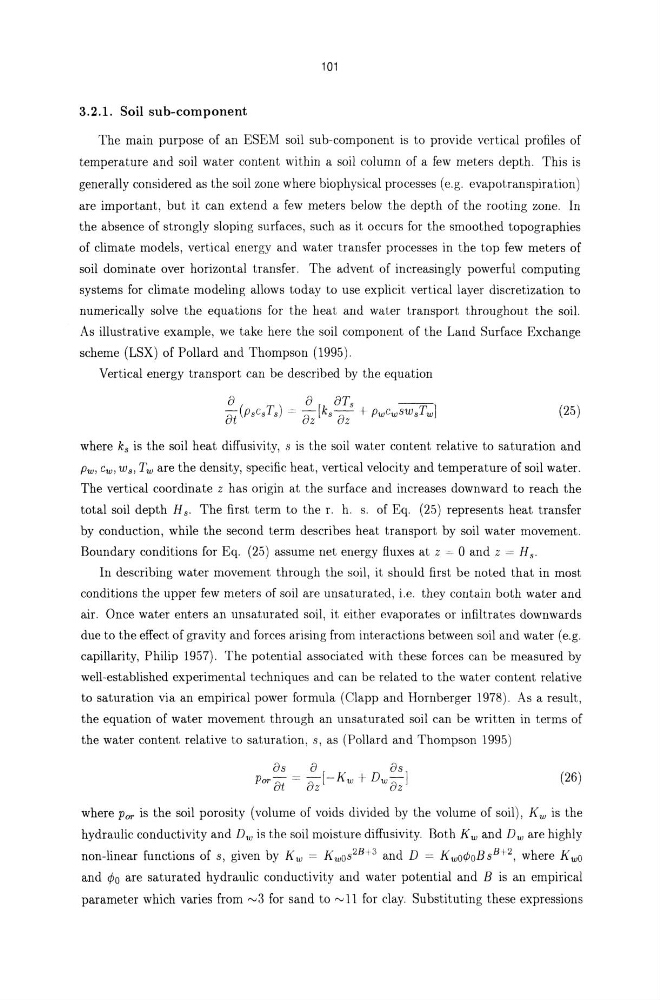
Vertical energy transport can be described by the equation
(25)
where ks is the soil heat diffusivity, s is the soil water content relative to saturation and
Pw, ew, w., Tw are the density, specific heat, vertical velocity and temperature of soil water.
The vertical coordinate z has origin at the surface and increases downward to reach the
total soil depth H s. The first term to the r. h. s. of Eq. (25) represents heat transfer
by conduction, while the second term describes heat transport by soil water movement.
Boundary conditions for Eq. (25) assume net energy fluxes at z = 0 and z = H s.
In describing water movement through the soil, it should first be noted that in most
conditions the upper few meters of soil are unsaturated, i.e. they contain both water and
air. Once water enters an unsaturated soil, it either evaporates or infiltrates downwards
due to the effect of gravity and forces arising from interactions between soil and water (e.g.
capillarity, Philip 1957). The potential associated with these forces can be measured by
well-established experimental techniques and can be related to the water content relative
to saturation via an empirical power formula (Clapp and Hornberger 1978). As a result,
the equation of water movement through an unsaturated soil can be written in terms of
the water content relative to saturation, s, as (Pollard and Thompson 1995)
(26)
where Par is the soil porosity (volume of voids divided by the volume of soil), Kw is the
hydraulic conductivity and Dw is the soil moisture diffusivity. Both Kw and Dw are highly
non-linear functions of s, given by Kw = Kwos2B+3 and D = KworPoBsB+2, where Kwo
and rPo are saturated hydraulic conductivity and water potential and B is an empirical
parameter which varies from ",3 for sand to '" 11 for clay. Substituting these expressions
3.2.1. Soil sub-component
The main purpose of an ESEM soil sub-component is to provide vertical profiles of
temperature and soil water content within a soil column of a few meters depth. This is
generally considered as the soil zone where biophysical processes (e.g. evapotranspiration)
are important, but it can extend a few meters below the depth of the rooting zone. In
the absence of strongly sloping surfaces, such as it occurs for the smoothed topographies
of climate models, vertical energy and water transfer processes in the top few meters of
soil dominate over horizontal transfer. The advent of increasingly powerful computing
systems for climate modeling allows today to use explicit vertical layer discretization to
numerically solve the equations for the heat and water transport throughout the soil.
As illustrative example, we take here the soil component of the Land Surface Exchange
scheme (LSX) of Pollard and Thompson (1995).
Vertical energy transport can be described by the equation
(25)
where ks is the soil heat diffusivity, s is the soil water content relative to saturation and
Pw, ew, w., Tw are the density, specific heat, vertical velocity and temperature of soil water.
The vertical coordinate z has origin at the surface and increases downward to reach the
total soil depth H s. The first term to the r. h. s. of Eq. (25) represents heat transfer
by conduction, while the second term describes heat transport by soil water movement.
Boundary conditions for Eq. (25) assume net energy fluxes at z = 0 and z = H s.
In describing water movement through the soil, it should first be noted that in most
conditions the upper few meters of soil are unsaturated, i.e. they contain both water and
air. Once water enters an unsaturated soil, it either evaporates or infiltrates downwards
due to the effect of gravity and forces arising from interactions between soil and water (e.g.
capillarity, Philip 1957). The potential associated with these forces can be measured by
well-established experimental techniques and can be related to the water content relative
to saturation via an empirical power formula (Clapp and Hornberger 1978). As a result,
the equation of water movement through an unsaturated soil can be written in terms of
the water content relative to saturation, s, as (Pollard and Thompson 1995)
(26)
where Par is the soil porosity (volume of voids divided by the volume of soil), Kw is the
hydraulic conductivity and Dw is the soil moisture diffusivity. Both Kw and Dw are highly
non-linear functions of s, given by Kw = Kwos2B+3 and D = KworPoBsB+2, where Kwo
and rPo are saturated hydraulic conductivity and water potential and B is an empirical
parameter which varies from ",3 for sand to '" 11 for clay. Substituting these expressions