

and the cysteine needed for disulfide bonds are preserved in fixed locations in the
ORF. In the upper 5′ region, a transcription factor binding region and enhancer
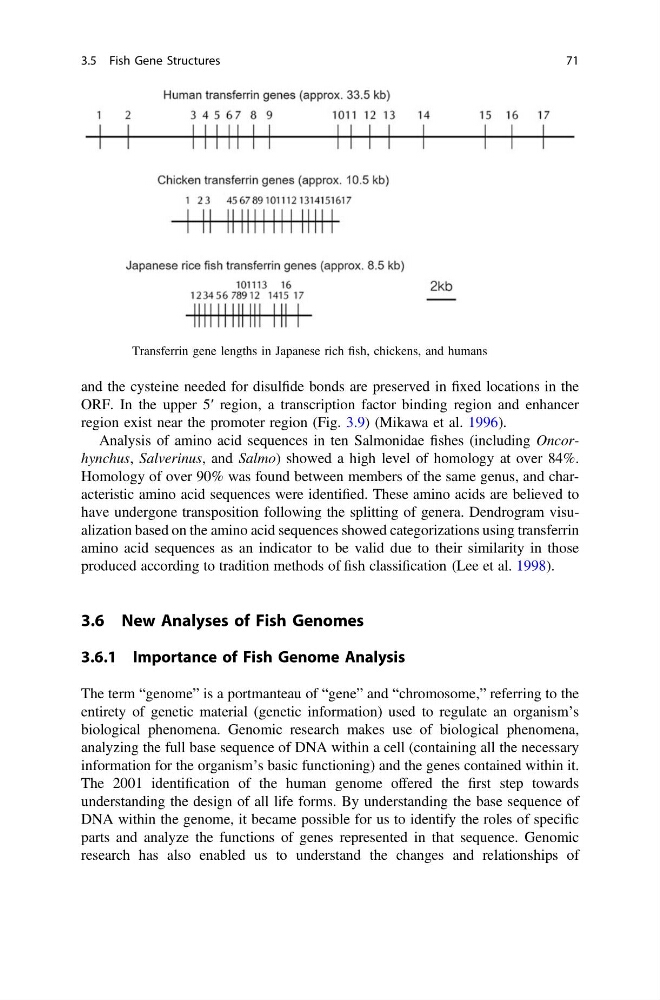
region exist near the promoter region (Fig. 3.9) (Mikawa et al. 1996).
Analysis of amino acid sequences in ten Salmonidae fishes (including Oncorhynchus, Salverinus, and Salmo) showed a high level of homology at over 84%.
Homology of over 90% was found between members of the same genus, and characteristic amino acid sequences were identified. These amino acids are believed to
have undergone transposition following the splitting of genera. Dendrogram visualization based on the amino acid sequences showed categorizations using transferrin
amino acid sequences as an indicator to be valid due to their similarity in those
produced according to tradition methods of fish classification (Lee et al. 1998).
3.6 New Analyses of Fish Genomes
3.6.1 Importance of Fish Genome Analysis
The term “genome” is a portmanteau of “gene” and “chromosome,” referring to the
entirety of genetic material (genetic information) used to regulate an organism’s
biological phenomena. Genomic research makes use of biological phenomena,
analyzing the full base sequence of DNA within a cell (containing all the necessary
information for the organism’s basic functioning) and the genes contained within it.
The 2001 identification of the human genome offered the first step towards
understanding the design of all life forms. By understanding the base sequence of
DNA within the genome, it became possible for us to identify the roles of specific
parts and analyze the functions of genes represented in that sequence. Genomic
research has also enabled us to understand the changes and relationships of
Fig. 3.9 Transferrin gene lengths in Japanese rich fish, chickens, and humans
3.5 Fish Gene Structures
71
ORF. In the upper 5′ region, a transcription factor binding region and enhancer
region exist near the promoter region (Fig. 3.9) (Mikawa et al. 1996).
Analysis of amino acid sequences in ten Salmonidae fishes (including Oncorhynchus, Salverinus, and Salmo) showed a high level of homology at over 84%.
Homology of over 90% was found between members of the same genus, and characteristic amino acid sequences were identified. These amino acids are believed to
have undergone transposition following the splitting of genera. Dendrogram visualization based on the amino acid sequences showed categorizations using transferrin
amino acid sequences as an indicator to be valid due to their similarity in those
produced according to tradition methods of fish classification (Lee et al. 1998).
3.6 New Analyses of Fish Genomes
3.6.1 Importance of Fish Genome Analysis
The term “genome” is a portmanteau of “gene” and “chromosome,” referring to the
entirety of genetic material (genetic information) used to regulate an organism’s
biological phenomena. Genomic research makes use of biological phenomena,
analyzing the full base sequence of DNA within a cell (containing all the necessary
information for the organism’s basic functioning) and the genes contained within it.
The 2001 identification of the human genome offered the first step towards
understanding the design of all life forms. By understanding the base sequence of
DNA within the genome, it became possible for us to identify the roles of specific
parts and analyze the functions of genes represented in that sequence. Genomic
research has also enabled us to understand the changes and relationships of
Fig. 3.9 Transferrin gene lengths in Japanese rich fish, chickens, and humans
3.5 Fish Gene Structures
71