

possible to artificially raise the incidence of mutations by hundreds of times. It is a
method currently used in research in microbiology and various other areas.
• For the purpose of convenience, the number of chromosomes has been set a
2n = 2 (the actual value for pea plants is 2n = 14; see Fig. 2.2).
2.3 Genes and Phenotypic Expression
As described above, genetic research has consisted chiefly of hybridization and
cytological approaches concerning the position of genes on the chromosome for
various traits. The question of how genes actually function to express traits has
proven more difficult, however. A breakthrough finally came in the 1940s through
research by Biddle and Tatum using the red bread mold Neurospora crassa.
Wild strains of N. crassa grow in minimal media containing mineral salts,
sugars, and vitamins. Arginine auxotrophs, however, cannot grow without addition
of the amino acid arginine to the minimal medium. Because the wild strains contain
all the enzymes needed for amino acid synthesis, they are capable of absorbing the
material supplied by the minimal medium to produce any amino acid. The arginine
auxotrophs lack enzymes from the arginine synthesis pathway and are therefore
incapable of synthesis on their own, so that they are unable to grow without an
arginine supply.
Inorganic salts and sugars absorbed from the medium do not transform immediately into arginine. They first form glutamic acid as a raw material, passing
through the seven types of intermediate materials listed here before arginine is
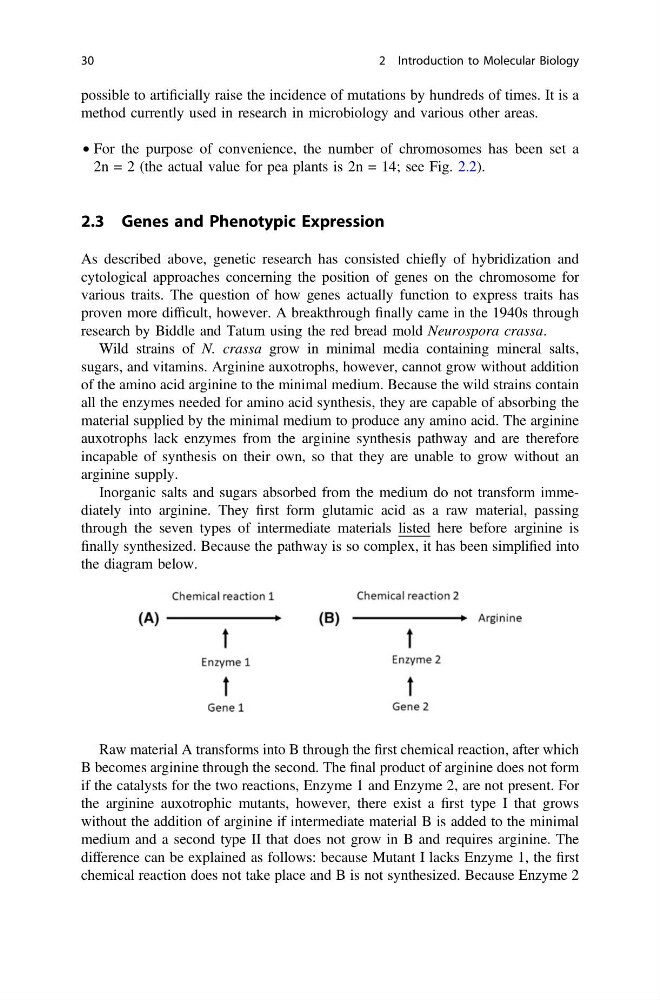
finally synthesized. Because the pathway is so complex, it has been simplified into
the diagram below.
Raw material A transforms into B through the first chemical reaction, after which
B becomes arginine through the second. The final product of arginine does not form
if the catalysts for the two reactions, Enzyme 1 and Enzyme 2, are not present. For
the arginine auxotrophic mutants, however, there exist a first type I that grows
without the addition of arginine if intermediate material B is added to the minimal
medium and a second type II that does not grow in B and requires arginine. The
difference can be explained as follows: because Mutant I lacks Enzyme 1, the first
chemical reaction does not take place and B is not synthesized. Because Enzyme 2
30
2 Introduction to Molecular Biology
method currently used in research in microbiology and various other areas.
• For the purpose of convenience, the number of chromosomes has been set a
2n = 2 (the actual value for pea plants is 2n = 14; see Fig. 2.2).
2.3 Genes and Phenotypic Expression
As described above, genetic research has consisted chiefly of hybridization and
cytological approaches concerning the position of genes on the chromosome for
various traits. The question of how genes actually function to express traits has
proven more difficult, however. A breakthrough finally came in the 1940s through
research by Biddle and Tatum using the red bread mold Neurospora crassa.
Wild strains of N. crassa grow in minimal media containing mineral salts,
sugars, and vitamins. Arginine auxotrophs, however, cannot grow without addition
of the amino acid arginine to the minimal medium. Because the wild strains contain
all the enzymes needed for amino acid synthesis, they are capable of absorbing the
material supplied by the minimal medium to produce any amino acid. The arginine
auxotrophs lack enzymes from the arginine synthesis pathway and are therefore
incapable of synthesis on their own, so that they are unable to grow without an
arginine supply.
Inorganic salts and sugars absorbed from the medium do not transform immediately into arginine. They first form glutamic acid as a raw material, passing
through the seven types of intermediate materials listed here before arginine is
finally synthesized. Because the pathway is so complex, it has been simplified into
the diagram below.
Raw material A transforms into B through the first chemical reaction, after which
B becomes arginine through the second. The final product of arginine does not form
if the catalysts for the two reactions, Enzyme 1 and Enzyme 2, are not present. For
the arginine auxotrophic mutants, however, there exist a first type I that grows
without the addition of arginine if intermediate material B is added to the minimal
medium and a second type II that does not grow in B and requires arginine. The
difference can be explained as follows: because Mutant I lacks Enzyme 1, the first
chemical reaction does not take place and B is not synthesized. Because Enzyme 2
30
2 Introduction to Molecular Biology