

it is a high-novelty enzyme with a primary structure quite different from that of
previously known bacterial esterases (Fig. 11.7).
Esterases are useful enzymes for industry, as with their selective decomposition
of position isomers in acyl ester compounds. EstHE1 and EstF are regarded as
leading examples in the search for enzymes from marine metagenomes. As more
efficient screening techniques develop for different enzymes in the future, an even
greater variety of enzyme genes may yet be discovered in marine-derived metagenomes (Gao et al. 2016).
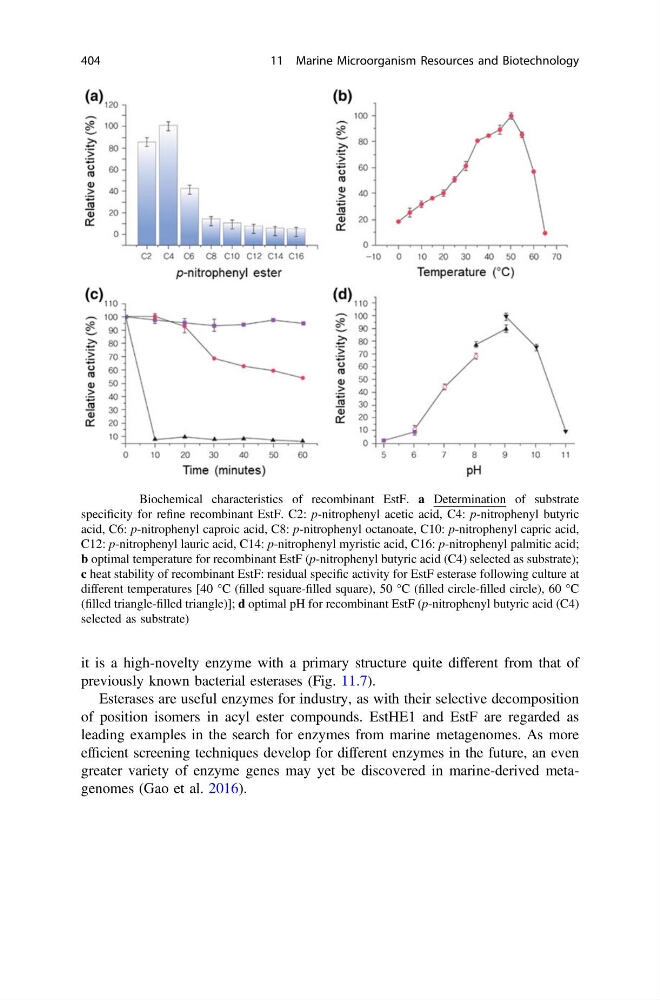
Fig. 11.7 Biochemical characteristics of recombinant EstF. a Determination of substrate
specificity for refine recombinant EstF. C2: p-nitrophenyl acetic acid, C4: p-nitrophenyl butyric
acid, C6: p-nitrophenyl caproic acid, C8: p-nitrophenyl octanoate, C10: p-nitrophenyl capric acid,
C12: p-nitrophenyl lauric acid, C14: p-nitrophenyl myristic acid, C16: p-nitrophenyl palmitic acid;
b optimal temperature for recombinant EstF (p-nitrophenyl butyric acid (C4) selected as substrate);
c heat stability of recombinant EstF: residual specific activity for EstF esterase following culture at
different temperatures [40 °C (filled square-filled square), 50 °C (filled circle-filled circle), 60 °C
(filled triangle-filled triangle)]; d optimal pH for recombinant EstF (p-nitrophenyl butyric acid (C4)
selected as substrate)
404
11 Marine Microorganism Resources and Biotechnology
previously known bacterial esterases (Fig. 11.7).
Esterases are useful enzymes for industry, as with their selective decomposition
of position isomers in acyl ester compounds. EstHE1 and EstF are regarded as
leading examples in the search for enzymes from marine metagenomes. As more
efficient screening techniques develop for different enzymes in the future, an even
greater variety of enzyme genes may yet be discovered in marine-derived metagenomes (Gao et al. 2016).
Fig. 11.7 Biochemical characteristics of recombinant EstF. a Determination of substrate
specificity for refine recombinant EstF. C2: p-nitrophenyl acetic acid, C4: p-nitrophenyl butyric
acid, C6: p-nitrophenyl caproic acid, C8: p-nitrophenyl octanoate, C10: p-nitrophenyl capric acid,
C12: p-nitrophenyl lauric acid, C14: p-nitrophenyl myristic acid, C16: p-nitrophenyl palmitic acid;
b optimal temperature for recombinant EstF (p-nitrophenyl butyric acid (C4) selected as substrate);
c heat stability of recombinant EstF: residual specific activity for EstF esterase following culture at
different temperatures [40 °C (filled square-filled square), 50 °C (filled circle-filled circle), 60 °C
(filled triangle-filled triangle)]; d optimal pH for recombinant EstF (p-nitrophenyl butyric acid (C4)
selected as substrate)
404
11 Marine Microorganism Resources and Biotechnology