

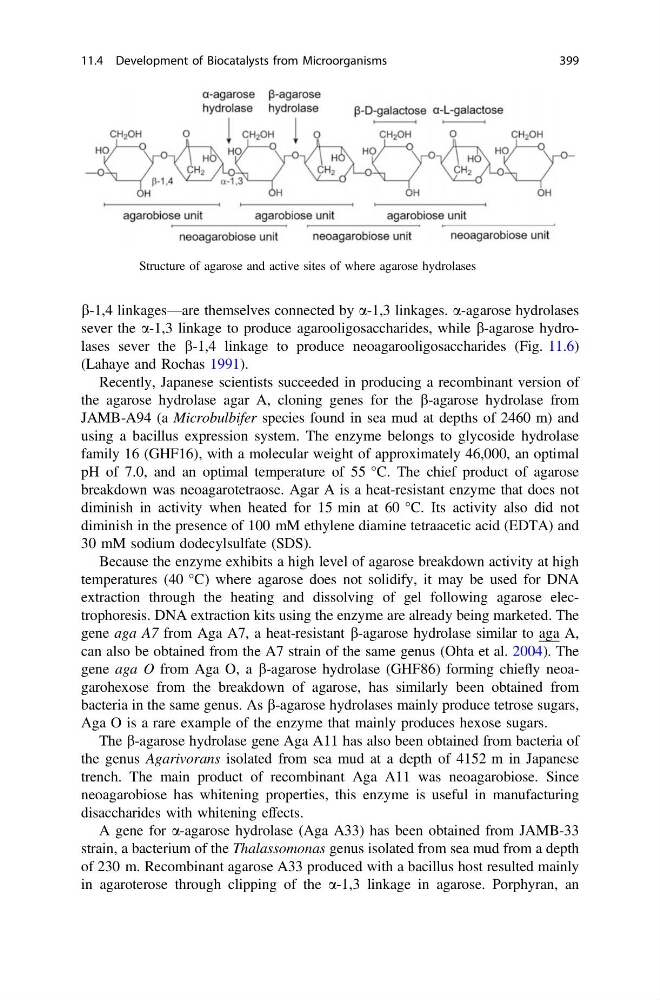
b-1,4 linkages—are themselves connected by a-1,3 linkages. a-agarose hydrolases
sever the a-1,3 linkage to produce agarooligosaccharides, while b-agarose hydrolases sever the b-1,4 linkage to produce neoagarooligosaccharides (Fig. 11.6)
(Lahaye and Rochas 1991).
Recently, Japanese scientists succeeded in producing a recombinant version of
the agarose hydrolase agar A, cloning genes for the b-agarose hydrolase from
JAMB-A94 (a Microbulbifer species found in sea mud at depths of 2460 m) and
using a bacillus expression system. The enzyme belongs to glycoside hydrolase
family 16 (GHF16), with a molecular weight of approximately 46,000, an optimal
pH of 7.0, and an optimal temperature of 55 °C. The chief product of agarose
breakdown was neoagarotetraose. Agar A is a heat-resistant enzyme that does not
diminish in activity when heated for 15 min at 60 °C. Its activity also did not
diminish in the presence of 100 mM ethylene diamine tetraacetic acid (EDTA) and
30 mM sodium dodecylsulfate (SDS).
Because the enzyme exhibits a high level of agarose breakdown activity at high
temperatures (40 °C) where agarose does not solidify, it may be used for DNA
extraction through the heating and dissolving of gel following agarose electrophoresis. DNA extraction kits using the enzyme are already being marketed. The
gene aga A7 from Aga A7, a heat-resistant b-agarose hydrolase similar to aga A,
can also be obtained from the A7 strain of the same genus (Ohta et al. 2004). The
gene aga O from Aga O, a b-agarose hydrolase (GHF86) forming chiefly neoagarohexose from the breakdown of agarose, has similarly been obtained from
bacteria in the same genus. As b-agarose hydrolases mainly produce tetrose sugars,
Aga O is a rare example of the enzyme that mainly produces hexose sugars.
The b-agarose hydrolase gene Aga A11 has also been obtained from bacteria of
the genus Agarivorans isolated from sea mud at a depth of 4152 m in Japanese
trench. The main product of recombinant Aga A11 was neoagarobiose. Since
neoagarobiose has whitening properties, this enzyme is useful in manufacturing
disaccharides with whitening effects.
A gene for a-agarose hydrolase (Aga A33) has been obtained from JAMB-33
strain, a bacterium of the Thalassomonas genus isolated from sea mud from a depth
of 230 m. Recombinant agarose A33 produced with a bacillus host resulted mainly
in agaroterose through clipping of the a-1,3 linkage in agarose. Porphyran, an
Fig. 11.6 Structure of agarose and active sites of where agarose hydrolases
11.4 Development of Biocatalysts from Microorganisms
399
sever the a-1,3 linkage to produce agarooligosaccharides, while b-agarose hydrolases sever the b-1,4 linkage to produce neoagarooligosaccharides (Fig. 11.6)
(Lahaye and Rochas 1991).
Recently, Japanese scientists succeeded in producing a recombinant version of
the agarose hydrolase agar A, cloning genes for the b-agarose hydrolase from
JAMB-A94 (a Microbulbifer species found in sea mud at depths of 2460 m) and
using a bacillus expression system. The enzyme belongs to glycoside hydrolase
family 16 (GHF16), with a molecular weight of approximately 46,000, an optimal
pH of 7.0, and an optimal temperature of 55 °C. The chief product of agarose
breakdown was neoagarotetraose. Agar A is a heat-resistant enzyme that does not
diminish in activity when heated for 15 min at 60 °C. Its activity also did not
diminish in the presence of 100 mM ethylene diamine tetraacetic acid (EDTA) and
30 mM sodium dodecylsulfate (SDS).
Because the enzyme exhibits a high level of agarose breakdown activity at high
temperatures (40 °C) where agarose does not solidify, it may be used for DNA
extraction through the heating and dissolving of gel following agarose electrophoresis. DNA extraction kits using the enzyme are already being marketed. The
gene aga A7 from Aga A7, a heat-resistant b-agarose hydrolase similar to aga A,
can also be obtained from the A7 strain of the same genus (Ohta et al. 2004). The
gene aga O from Aga O, a b-agarose hydrolase (GHF86) forming chiefly neoagarohexose from the breakdown of agarose, has similarly been obtained from
bacteria in the same genus. As b-agarose hydrolases mainly produce tetrose sugars,
Aga O is a rare example of the enzyme that mainly produces hexose sugars.
The b-agarose hydrolase gene Aga A11 has also been obtained from bacteria of
the genus Agarivorans isolated from sea mud at a depth of 4152 m in Japanese
trench. The main product of recombinant Aga A11 was neoagarobiose. Since
neoagarobiose has whitening properties, this enzyme is useful in manufacturing
disaccharides with whitening effects.
A gene for a-agarose hydrolase (Aga A33) has been obtained from JAMB-33
strain, a bacterium of the Thalassomonas genus isolated from sea mud from a depth
of 230 m. Recombinant agarose A33 produced with a bacillus host resulted mainly
in agaroterose through clipping of the a-1,3 linkage in agarose. Porphyran, an
Fig. 11.6 Structure of agarose and active sites of where agarose hydrolases
11.4 Development of Biocatalysts from Microorganisms
399