

beneficial effects, but active oxygen is created in the process. Active oxygen refers
to oxygen existing in an unstable state, which has negative effects on the bodies of
animals. Eliminating active oxygen is thus key to preventing cell oxidation, and
thus cell aging. Typically, alkaloids and compounds with conjugated double bonds,
phenyl structures, and –SH groups are known to exhibit antioxidation activity.
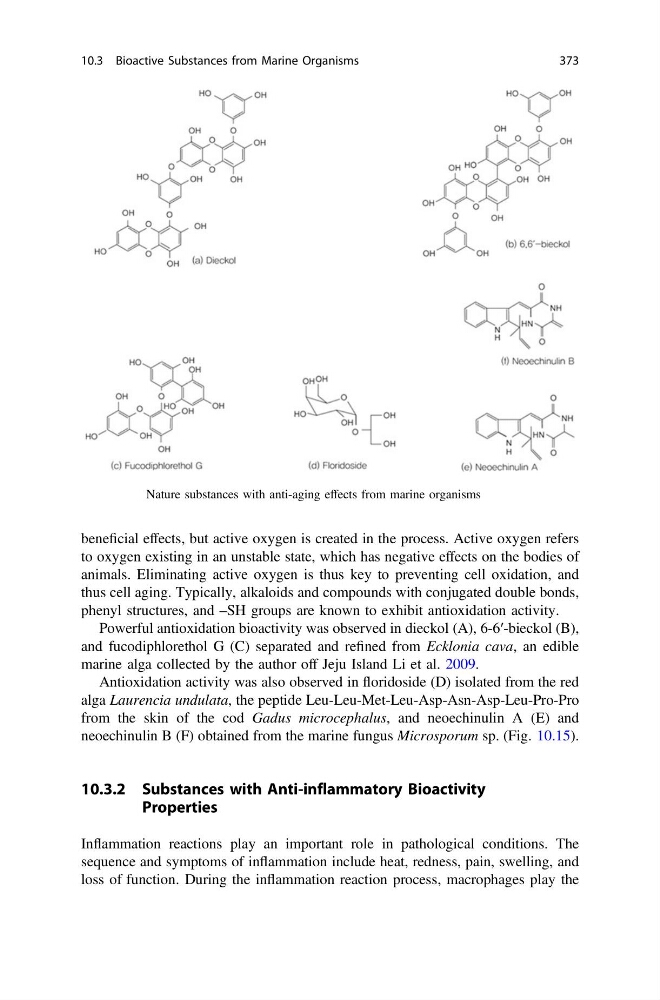
Powerful antioxidation bioactivity was observed in dieckol (A), 6-6′-bieckol (B),
and fucodiphlorethol G (C) separated and refined from Ecklonia cava, an edible
marine alga collected by the author off Jeju Island Li et al. 2009.
Antioxidation activity was also observed in floridoside (D) isolated from the red
alga Laurencia undulata, the peptide Leu-Leu-Met-Leu-Asp-Asn-Asp-Leu-Pro-Pro
from the skin of the cod Gadus microcephalus, and neoechinulin A (E) and
neoechinulin B (F) obtained from the marine fungus Microsporum sp. (Fig. 10.15).
10.3.2 Substances with Anti-inflammatory Bioactivity
Properties
Inflammation reactions play an important role in pathological conditions. The
sequence and symptoms of inflammation include heat, redness, pain, swelling, and
loss of function. During the inflammation reaction process, macrophages play the
Fig. 10.15 Nature substances with anti-aging effects from marine organisms
10.3 Bioactive Substances from Marine Organisms
373
to oxygen existing in an unstable state, which has negative effects on the bodies of
animals. Eliminating active oxygen is thus key to preventing cell oxidation, and
thus cell aging. Typically, alkaloids and compounds with conjugated double bonds,
phenyl structures, and –SH groups are known to exhibit antioxidation activity.
Powerful antioxidation bioactivity was observed in dieckol (A), 6-6′-bieckol (B),
and fucodiphlorethol G (C) separated and refined from Ecklonia cava, an edible
marine alga collected by the author off Jeju Island Li et al. 2009.
Antioxidation activity was also observed in floridoside (D) isolated from the red
alga Laurencia undulata, the peptide Leu-Leu-Met-Leu-Asp-Asn-Asp-Leu-Pro-Pro
from the skin of the cod Gadus microcephalus, and neoechinulin A (E) and
neoechinulin B (F) obtained from the marine fungus Microsporum sp. (Fig. 10.15).
10.3.2 Substances with Anti-inflammatory Bioactivity
Properties
Inflammation reactions play an important role in pathological conditions. The
sequence and symptoms of inflammation include heat, redness, pain, swelling, and
loss of function. During the inflammation reaction process, macrophages play the
Fig. 10.15 Nature substances with anti-aging effects from marine organisms
10.3 Bioactive Substances from Marine Organisms
373