

A. UV-Visible Spectrophotometer
The intensity of light passing through a substance is altered by factors such as
reflection, refraction, scattering, and absorption. The amount of light absorbed is
expressed by the ratio of the intensity of light applied to a specimen to the intensity
of light emerging after passing through it. The amount of light absorbed is proportion to the concentration of absorbent compounds in the specimen and the light
pass length (Skoog et al. 2017).
Beer demonstrated that reduction rate in light energy applied to a specimen was
proportional to the concentration of absorbent substances in it, while Lambert
showed that absorbance at particular concentrations was proportional to light pass
length. These two principles were combined into the Beer-Lambert formula, which
has become a basic approach to quantitative calculation for measurements using
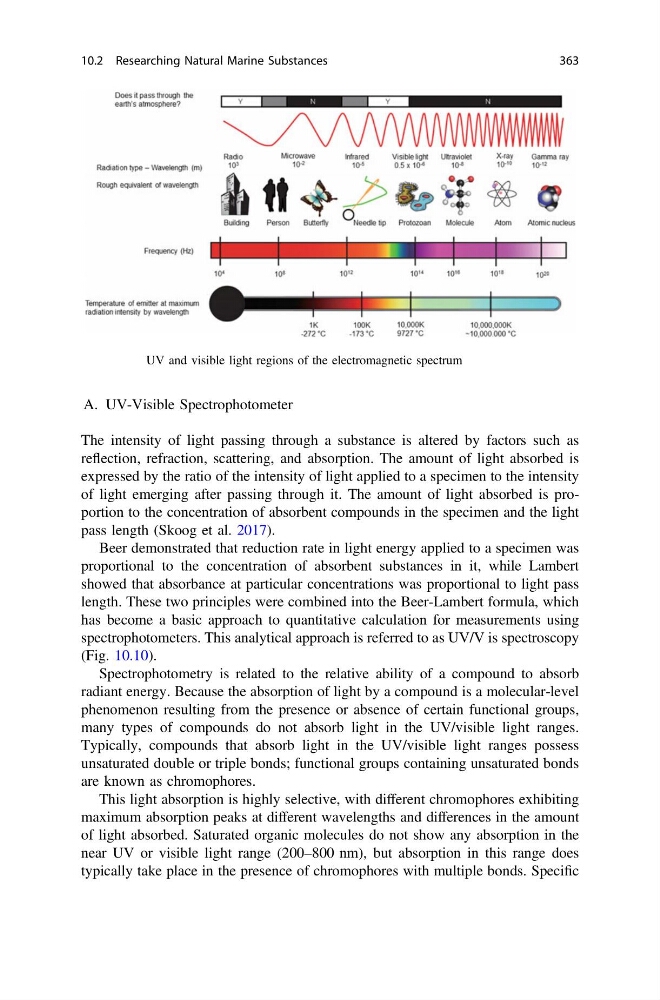
spectrophotometers. This analytical approach is referred to as UV/V is spectroscopy
(Fig. 10.10).
Spectrophotometry is related to the relative ability of a compound to absorb
radiant energy. Because the absorption of light by a compound is a molecular-level
phenomenon resulting from the presence or absence of certain functional groups,
many types of compounds do not absorb light in the UV/visible light ranges.
Typically, compounds that absorb light in the UV/visible light ranges possess
unsaturated double or triple bonds; functional groups containing unsaturated bonds
are known as chromophores.
This light absorption is highly selective, with different chromophores exhibiting
maximum absorption peaks at different wavelengths and differences in the amount
of light absorbed. Saturated organic molecules do not show any absorption in the
near UV or visible light range (200–800 nm), but absorption in this range does
typically take place in the presence of chromophores with multiple bonds. Specific
Fig. 10.10 UV and visible light regions of the electromagnetic spectrum
10.2 Researching Natural Marine Substances
363
The intensity of light passing through a substance is altered by factors such as
reflection, refraction, scattering, and absorption. The amount of light absorbed is
expressed by the ratio of the intensity of light applied to a specimen to the intensity
of light emerging after passing through it. The amount of light absorbed is proportion to the concentration of absorbent compounds in the specimen and the light
pass length (Skoog et al. 2017).
Beer demonstrated that reduction rate in light energy applied to a specimen was
proportional to the concentration of absorbent substances in it, while Lambert
showed that absorbance at particular concentrations was proportional to light pass
length. These two principles were combined into the Beer-Lambert formula, which
has become a basic approach to quantitative calculation for measurements using
spectrophotometers. This analytical approach is referred to as UV/V is spectroscopy
(Fig. 10.10).
Spectrophotometry is related to the relative ability of a compound to absorb
radiant energy. Because the absorption of light by a compound is a molecular-level
phenomenon resulting from the presence or absence of certain functional groups,
many types of compounds do not absorb light in the UV/visible light ranges.
Typically, compounds that absorb light in the UV/visible light ranges possess
unsaturated double or triple bonds; functional groups containing unsaturated bonds
are known as chromophores.
This light absorption is highly selective, with different chromophores exhibiting
maximum absorption peaks at different wavelengths and differences in the amount
of light absorbed. Saturated organic molecules do not show any absorption in the
near UV or visible light range (200–800 nm), but absorption in this range does
typically take place in the presence of chromophores with multiple bonds. Specific
Fig. 10.10 UV and visible light regions of the electromagnetic spectrum
10.2 Researching Natural Marine Substances
363