

adsorbent such as silica gel or alumina. TLC provides an important means of
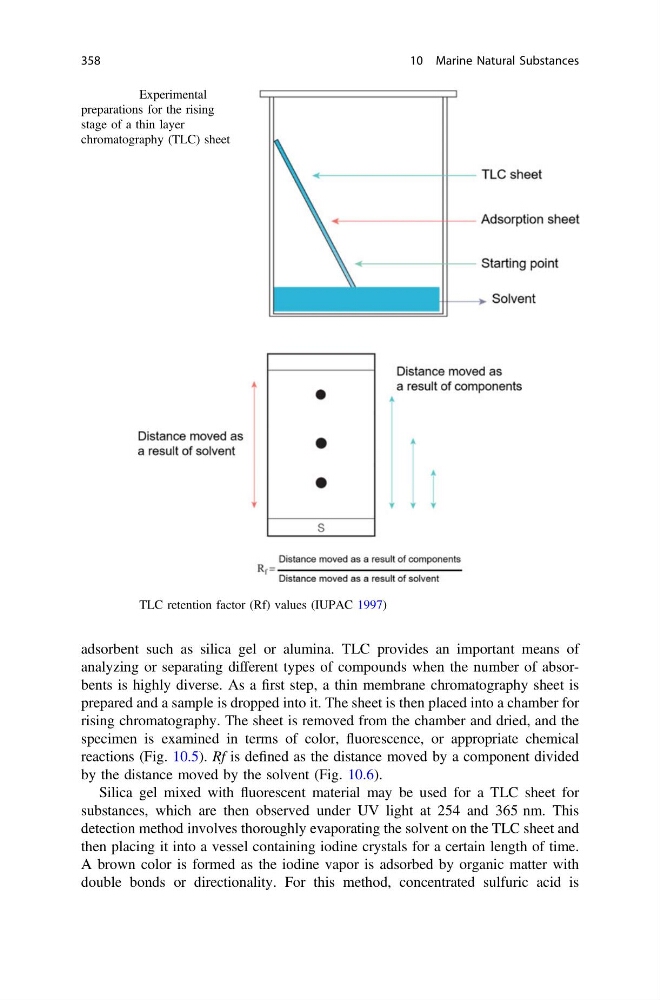
analyzing or separating different types of compounds when the number of absorbents is highly diverse. As a first step, a thin membrane chromatography sheet is
prepared and a sample is dropped into it. The sheet is then placed into a chamber for
rising chromatography. The sheet is removed from the chamber and dried, and the
specimen is examined in terms of color, fluorescence, or appropriate chemical
reactions (Fig. 10.5). Rf is defined as the distance moved by a component divided
by the distance moved by the solvent (Fig. 10.6).
Silica gel mixed with fluorescent material may be used for a TLC sheet for
substances, which are then observed under UV light at 254 and 365 nm. This
detection method involves thoroughly evaporating the solvent on the TLC sheet and
then placing it into a vessel containing iodine crystals for a certain length of time.
A brown color is formed as the iodine vapor is adsorbed by organic matter with
double bonds or directionality. For this method, concentrated sulfuric acid is
Fig. 10.5 Experimental
preparations for the rising
stage of a thin layer
chromatography (TLC) sheet
Fig. 10.6 TLC retention factor (Rf) values (IUPAC 1997)
358
10 Marine Natural Substances
analyzing or separating different types of compounds when the number of absorbents is highly diverse. As a first step, a thin membrane chromatography sheet is
prepared and a sample is dropped into it. The sheet is then placed into a chamber for
rising chromatography. The sheet is removed from the chamber and dried, and the
specimen is examined in terms of color, fluorescence, or appropriate chemical
reactions (Fig. 10.5). Rf is defined as the distance moved by a component divided
by the distance moved by the solvent (Fig. 10.6).
Silica gel mixed with fluorescent material may be used for a TLC sheet for
substances, which are then observed under UV light at 254 and 365 nm. This
detection method involves thoroughly evaporating the solvent on the TLC sheet and
then placing it into a vessel containing iodine crystals for a certain length of time.
A brown color is formed as the iodine vapor is adsorbed by organic matter with
double bonds or directionality. For this method, concentrated sulfuric acid is
Fig. 10.5 Experimental
preparations for the rising
stage of a thin layer
chromatography (TLC) sheet
Fig. 10.6 TLC retention factor (Rf) values (IUPAC 1997)
358
10 Marine Natural Substances