

9. Chaetognatha
Chaetognatha is a phylum of small, transparent, floating animals. Although
the most representative type is the arrow worm, around 50 species are
known to exist (Fig. 10.10). Their bodies consist of three sections: a head,
midsection, and tail. The head possesses a pair of eyes and stiff bristles,
while the midsection and tail have fins, giving a shape similar to an arrow.
Organisms typically range between one and 2 cm in size and are
hermaphroditic.
10. Echinodermata
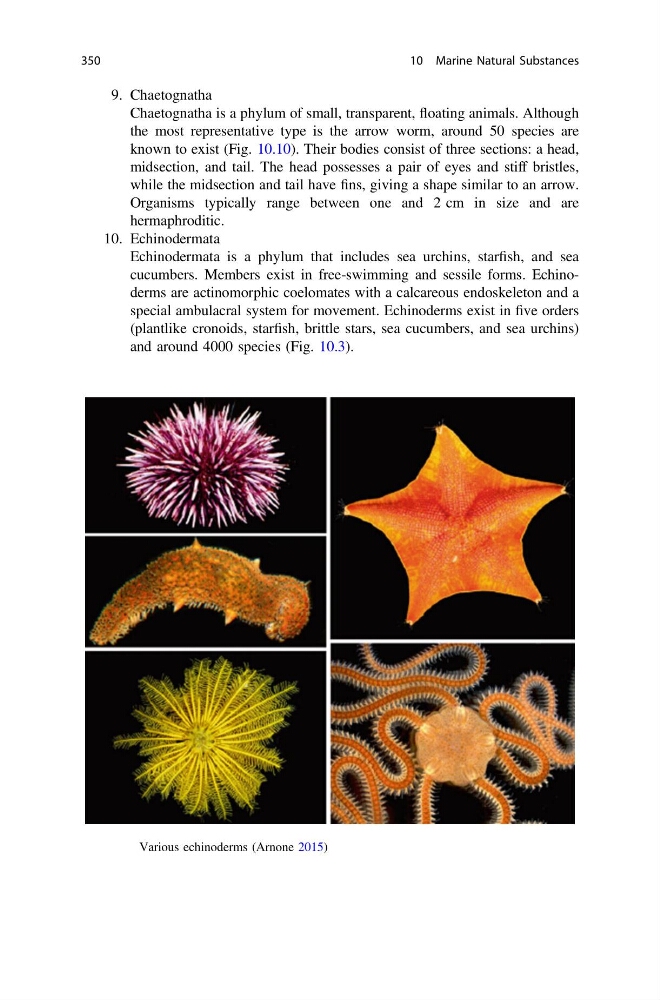
Echinodermata is a phylum that includes sea urchins, starfish, and sea
cucumbers. Members exist in free-swimming and sessile forms. Echinoderms are actinomorphic coelomates with a calcareous endoskeleton and a
special ambulacral system for movement. Echinoderms exist in five orders
(plantlike cronoids, starfish, brittle stars, sea cucumbers, and sea urchins)
and around 4000 species (Fig. 10.3).
Fig. 10.3 Various echinoderms (Arnone 2015)
350
10 Marine Natural Substances
Chaetognatha is a phylum of small, transparent, floating animals. Although
the most representative type is the arrow worm, around 50 species are
known to exist (Fig. 10.10). Their bodies consist of three sections: a head,
midsection, and tail. The head possesses a pair of eyes and stiff bristles,
while the midsection and tail have fins, giving a shape similar to an arrow.
Organisms typically range between one and 2 cm in size and are
hermaphroditic.
10. Echinodermata
Echinodermata is a phylum that includes sea urchins, starfish, and sea
cucumbers. Members exist in free-swimming and sessile forms. Echinoderms are actinomorphic coelomates with a calcareous endoskeleton and a
special ambulacral system for movement. Echinoderms exist in five orders
(plantlike cronoids, starfish, brittle stars, sea cucumbers, and sea urchins)
and around 4000 species (Fig. 10.3).
Fig. 10.3 Various echinoderms (Arnone 2015)
350
10 Marine Natural Substances