

Anaerobic bacteria generally have faster production rates and higher yields than
facultative anaerobic bacteria, but their breeding and growth are reduced in the
presence of oxygen, and the production rate and yields are significantly impacted.
In contrast, facultative anaerobic bacteria exhibit low rates and yields, but can breed
with oxygen when it is present or produce hydrogen through fermentation when it is
absent, offering the advantage of easier handling when using bacteria for industrial
hydrogen production.
Production rates are relatively low for bacteria capable of growing at high
temperatures of 60 °C or more, but these are theoretically capable of generating the
highest hydrogen yields (Tanisho and Ishiwata 1994).
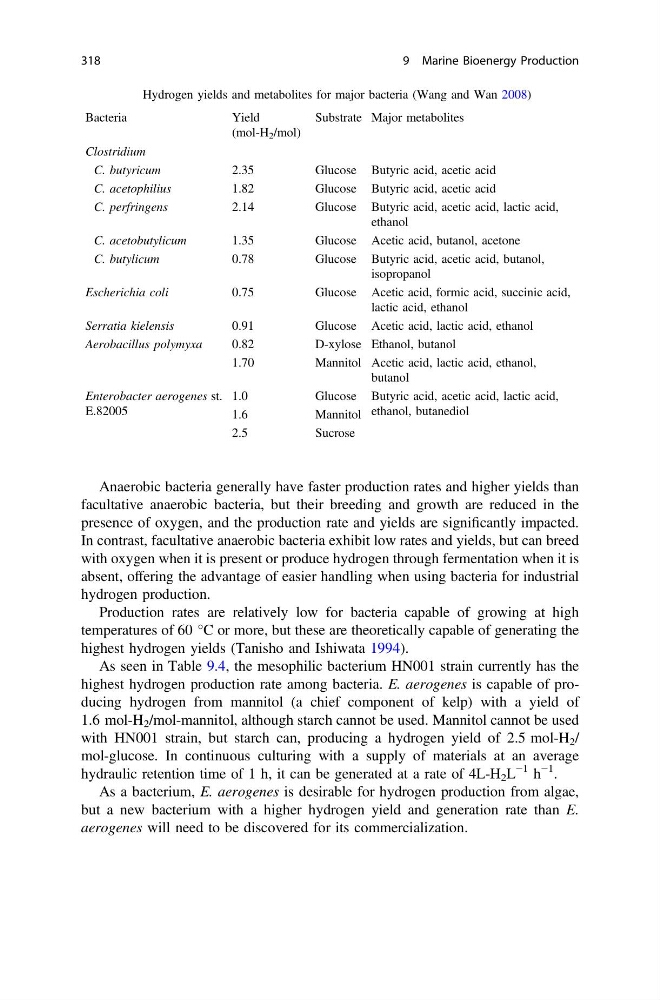
As seen in Table 9.4, the mesophilic bacterium HN001 strain currently has the
highest hydrogen production rate among bacteria. E. aerogenes is capable of producing hydrogen from mannitol (a chief component of kelp) with a yield of
1.6 mol-H 2 /mol-mannitol, although starch cannot be used. Mannitol cannot be used
with HN001 strain, but starch can, producing a hydrogen yield of 2.5 mol-H 2 /
mol-glucose. In continuous culturing with a supply of materials at an average
hydraulic retention time of 1 h, it can be generated at a rate of 4L-H 2 L
−1 h
−1 .
As a bacterium, E. aerogenes is desirable for hydrogen production from algae,
but a new bacterium with a higher hydrogen yield and generation rate than E.
aerogenes will need to be discovered for its commercialization.
Table 9.3 Hydrogen yields and metabolites for major bacteria (Wang and Wan 2008)
Bacteria
Yield
(mol-H 2 /mol)
Substrate Major metabolites
Clostridium
C. butyricum
2.35
Glucose Butyric acid, acetic acid
C. acetophilius
1.82
Glucose Butyric acid, acetic acid
C. perfringens
2.14
Glucose Butyric acid, acetic acid, lactic acid,
ethanol
C. acetobutylicum
1.35
Glucose Acetic acid, butanol, acetone
C. butylicum
0.78
Glucose Butyric acid, acetic acid, butanol,
isopropanol
Escherichia coli
0.75
Glucose Acetic acid, formic acid, succinic acid,
lactic acid, ethanol
Serratia kielensis
0.91
Glucose Acetic acid, lactic acid, ethanol
Aerobacillus polymyxa
0.82
D-xylose Ethanol, butanol
1.70
Mannitol Acetic acid, lactic acid, ethanol,
butanol
Enterobacter aerogenes st.
E.82005
1.0
Glucose Butyric acid, acetic acid, lactic acid,
ethanol, butanediol
1.6
Mannitol
2.5
Sucrose
318
9 Marine Bioenergy Production
facultative anaerobic bacteria, but their breeding and growth are reduced in the
presence of oxygen, and the production rate and yields are significantly impacted.
In contrast, facultative anaerobic bacteria exhibit low rates and yields, but can breed
with oxygen when it is present or produce hydrogen through fermentation when it is
absent, offering the advantage of easier handling when using bacteria for industrial
hydrogen production.
Production rates are relatively low for bacteria capable of growing at high
temperatures of 60 °C or more, but these are theoretically capable of generating the
highest hydrogen yields (Tanisho and Ishiwata 1994).
As seen in Table 9.4, the mesophilic bacterium HN001 strain currently has the
highest hydrogen production rate among bacteria. E. aerogenes is capable of producing hydrogen from mannitol (a chief component of kelp) with a yield of
1.6 mol-H 2 /mol-mannitol, although starch cannot be used. Mannitol cannot be used
with HN001 strain, but starch can, producing a hydrogen yield of 2.5 mol-H 2 /
mol-glucose. In continuous culturing with a supply of materials at an average
hydraulic retention time of 1 h, it can be generated at a rate of 4L-H 2 L
−1 h
−1 .
As a bacterium, E. aerogenes is desirable for hydrogen production from algae,
but a new bacterium with a higher hydrogen yield and generation rate than E.
aerogenes will need to be discovered for its commercialization.
Table 9.3 Hydrogen yields and metabolites for major bacteria (Wang and Wan 2008)
Bacteria
Yield
(mol-H 2 /mol)
Substrate Major metabolites
Clostridium
C. butyricum
2.35
Glucose Butyric acid, acetic acid
C. acetophilius
1.82
Glucose Butyric acid, acetic acid
C. perfringens
2.14
Glucose Butyric acid, acetic acid, lactic acid,
ethanol
C. acetobutylicum
1.35
Glucose Acetic acid, butanol, acetone
C. butylicum
0.78
Glucose Butyric acid, acetic acid, butanol,
isopropanol
Escherichia coli
0.75
Glucose Acetic acid, formic acid, succinic acid,
lactic acid, ethanol
Serratia kielensis
0.91
Glucose Acetic acid, lactic acid, ethanol
Aerobacillus polymyxa
0.82
D-xylose Ethanol, butanol
1.70
Mannitol Acetic acid, lactic acid, ethanol,
butanol
Enterobacter aerogenes st.
E.82005
1.0
Glucose Butyric acid, acetic acid, lactic acid,
ethanol, butanediol
1.6
Mannitol
2.5
Sucrose
318
9 Marine Bioenergy Production