

anaerobic decomposition of algae biomass. As mentioned previously, a long sludge
retention time is necessary to obtain high methane yields from algae. In a completely mixed fermentation tank, an identical hydraulic retention time is also necessary for a longer sludge retention time. This necessitates the use of a large
fermentation tank, which is not practical when recovering energy from the seas.
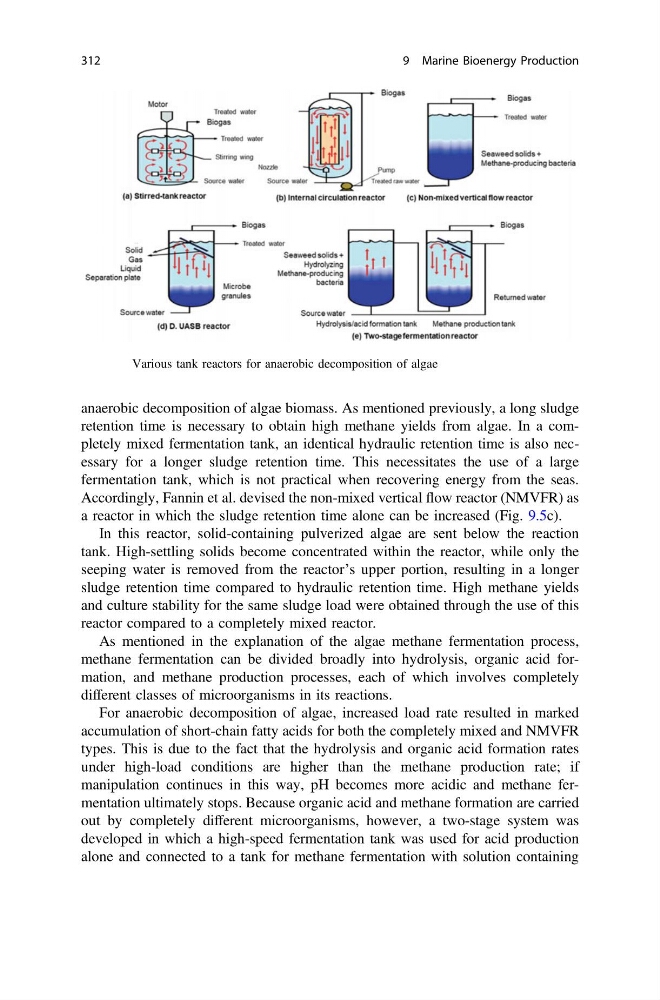
Accordingly, Fannin et al. devised the non-mixed vertical flow reactor (NMVFR) as
a reactor in which the sludge retention time alone can be increased (Fig. 9.5c).
In this reactor, solid-containing pulverized algae are sent below the reaction
tank. High-settling solids become concentrated within the reactor, while only the
seeping water is removed from the reactor’s upper portion, resulting in a longer
sludge retention time compared to hydraulic retention time. High methane yields
and culture stability for the same sludge load were obtained through the use of this
reactor compared to a completely mixed reactor.
As mentioned in the explanation of the algae methane fermentation process,
methane fermentation can be divided broadly into hydrolysis, organic acid formation, and methane production processes, each of which involves completely
different classes of microorganisms in its reactions.
For anaerobic decomposition of algae, increased load rate resulted in marked
accumulation of short-chain fatty acids for both the completely mixed and NMVFR
types. This is due to the fact that the hydrolysis and organic acid formation rates
under high-load conditions are higher than the methane production rate; if
manipulation continues in this way, pH becomes more acidic and methane fermentation ultimately stops. Because organic acid and methane formation are carried
out by completely different microorganisms, however, a two-stage system was
developed in which a high-speed fermentation tank was used for acid production
alone and connected to a tank for methane fermentation with solution containing
Fig. 9.5 Various tank reactors for anaerobic decomposition of algae
312
9 Marine Bioenergy Production
retention time is necessary to obtain high methane yields from algae. In a completely mixed fermentation tank, an identical hydraulic retention time is also necessary for a longer sludge retention time. This necessitates the use of a large
fermentation tank, which is not practical when recovering energy from the seas.
Accordingly, Fannin et al. devised the non-mixed vertical flow reactor (NMVFR) as
a reactor in which the sludge retention time alone can be increased (Fig. 9.5c).
In this reactor, solid-containing pulverized algae are sent below the reaction
tank. High-settling solids become concentrated within the reactor, while only the
seeping water is removed from the reactor’s upper portion, resulting in a longer
sludge retention time compared to hydraulic retention time. High methane yields
and culture stability for the same sludge load were obtained through the use of this
reactor compared to a completely mixed reactor.
As mentioned in the explanation of the algae methane fermentation process,
methane fermentation can be divided broadly into hydrolysis, organic acid formation, and methane production processes, each of which involves completely
different classes of microorganisms in its reactions.
For anaerobic decomposition of algae, increased load rate resulted in marked
accumulation of short-chain fatty acids for both the completely mixed and NMVFR
types. This is due to the fact that the hydrolysis and organic acid formation rates
under high-load conditions are higher than the methane production rate; if
manipulation continues in this way, pH becomes more acidic and methane fermentation ultimately stops. Because organic acid and methane formation are carried
out by completely different microorganisms, however, a two-stage system was
developed in which a high-speed fermentation tank was used for acid production
alone and connected to a tank for methane fermentation with solution containing
Fig. 9.5 Various tank reactors for anaerobic decomposition of algae
312
9 Marine Bioenergy Production