

to dry weight, the lignin content of sea lettuce (Ulva sp.) is just 2.7%w/w. As a
result, algae can be fermented through simply pulverization treatment (Ventura and
Castanon 1998).
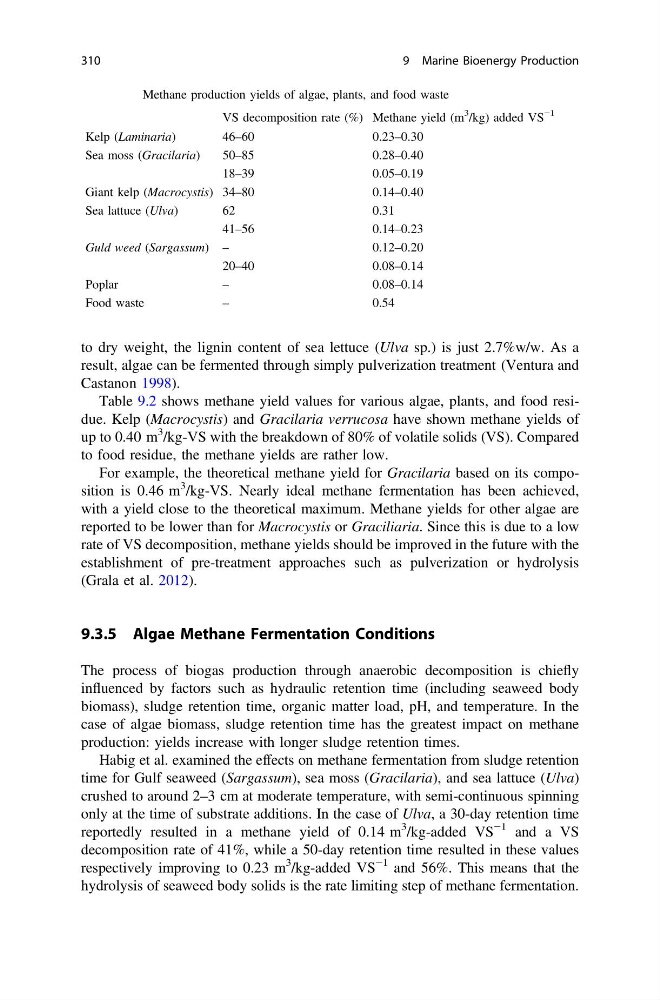
Table 9.2 shows methane yield values for various algae, plants, and food residue. Kelp (Macrocystis) and Gracilaria verrucosa have shown methane yields of
up to 0.40 m
3 /kg-VS with the breakdown of 80% of volatile solids (VS). Compared
to food residue, the methane yields are rather low.
For example, the theoretical methane yield for Gracilaria based on its composition is 0.46 m
3 /kg-VS. Nearly ideal methane fermentation has been achieved,
with a yield close to the theoretical maximum. Methane yields for other algae are
reported to be lower than for Macrocystis or Graciliaria. Since this is due to a low
rate of VS decomposition, methane yields should be improved in the future with the
establishment of pre-treatment approaches such as pulverization or hydrolysis
(Grala et al. 2012).
9.3.5 Algae Methane Fermentation Conditions
The process of biogas production through anaerobic decomposition is chiefly
influenced by factors such as hydraulic retention time (including seaweed body
biomass), sludge retention time, organic matter load, pH, and temperature. In the
case of algae biomass, sludge retention time has the greatest impact on methane
production: yields increase with longer sludge retention times.
Habig et al. examined the effects on methane fermentation from sludge retention
time for Gulf seaweed (Sargassum), sea moss (Gracilaria), and sea lattuce (Ulva)
crushed to around 2–3 cm at moderate temperature, with semi-continuous spinning
only at the time of substrate additions. In the case of Ulva, a 30-day retention time
reportedly resulted in a methane yield of 0.14 m
3 /kg-added VS
−1 and a VS
decomposition rate of 41%, while a 50-day retention time resulted in these values
respectively improving to 0.23 m
3 /kg-added VS
−1 and 56%. This means that the
hydrolysis of seaweed body solids is the rate limiting step of methane fermentation.
Table 9.2 Methane production yields of algae, plants, and food waste
VS decomposition rate (%) Methane yield (m
3
/kg) added VS
−1
Kelp (Laminaria)
4 6 –60
0.23–0.30
Sea moss (Gracilaria)
50–85
0.28–0.40
18–39
0.05–0.19
Giant kelp (Macrocystis) 34–80
0.14–0.40
Sea lattuce (Ulva)
62
0.31
41–56
0.14–0.23
Guld weed (Sargassum) –
0.12–0.20
20–40
0.08–0.14
Poplar
–
0.08–0.14
Food waste
–
0.54
310
9 Marine Bioenergy Production
result, algae can be fermented through simply pulverization treatment (Ventura and
Castanon 1998).
Table 9.2 shows methane yield values for various algae, plants, and food residue. Kelp (Macrocystis) and Gracilaria verrucosa have shown methane yields of
up to 0.40 m
3 /kg-VS with the breakdown of 80% of volatile solids (VS). Compared
to food residue, the methane yields are rather low.
For example, the theoretical methane yield for Gracilaria based on its composition is 0.46 m
3 /kg-VS. Nearly ideal methane fermentation has been achieved,
with a yield close to the theoretical maximum. Methane yields for other algae are
reported to be lower than for Macrocystis or Graciliaria. Since this is due to a low
rate of VS decomposition, methane yields should be improved in the future with the
establishment of pre-treatment approaches such as pulverization or hydrolysis
(Grala et al. 2012).
9.3.5 Algae Methane Fermentation Conditions
The process of biogas production through anaerobic decomposition is chiefly
influenced by factors such as hydraulic retention time (including seaweed body
biomass), sludge retention time, organic matter load, pH, and temperature. In the
case of algae biomass, sludge retention time has the greatest impact on methane
production: yields increase with longer sludge retention times.
Habig et al. examined the effects on methane fermentation from sludge retention
time for Gulf seaweed (Sargassum), sea moss (Gracilaria), and sea lattuce (Ulva)
crushed to around 2–3 cm at moderate temperature, with semi-continuous spinning
only at the time of substrate additions. In the case of Ulva, a 30-day retention time
reportedly resulted in a methane yield of 0.14 m
3 /kg-added VS
−1 and a VS
decomposition rate of 41%, while a 50-day retention time resulted in these values
respectively improving to 0.23 m
3 /kg-added VS
−1 and 56%. This means that the
hydrolysis of seaweed body solids is the rate limiting step of methane fermentation.
Table 9.2 Methane production yields of algae, plants, and food waste
VS decomposition rate (%) Methane yield (m
3
/kg) added VS
−1
Kelp (Laminaria)
4 6 –60
0.23–0.30
Sea moss (Gracilaria)
50–85
0.28–0.40
18–39
0.05–0.19
Giant kelp (Macrocystis) 34–80
0.14–0.40
Sea lattuce (Ulva)
62
0.31
41–56
0.14–0.23
Guld weed (Sargassum) –
0.12–0.20
20–40
0.08–0.14
Poplar
–
0.08–0.14
Food waste
–
0.54
310
9 Marine Bioenergy Production