

reacted to with relative specificity, ④ stabilization is achieved with stomach acidity
and enzymes in the stomach region, and ⑤ prices remain affordable.
Alginic acid, an important polysaccharide in brown algae, has been examined as
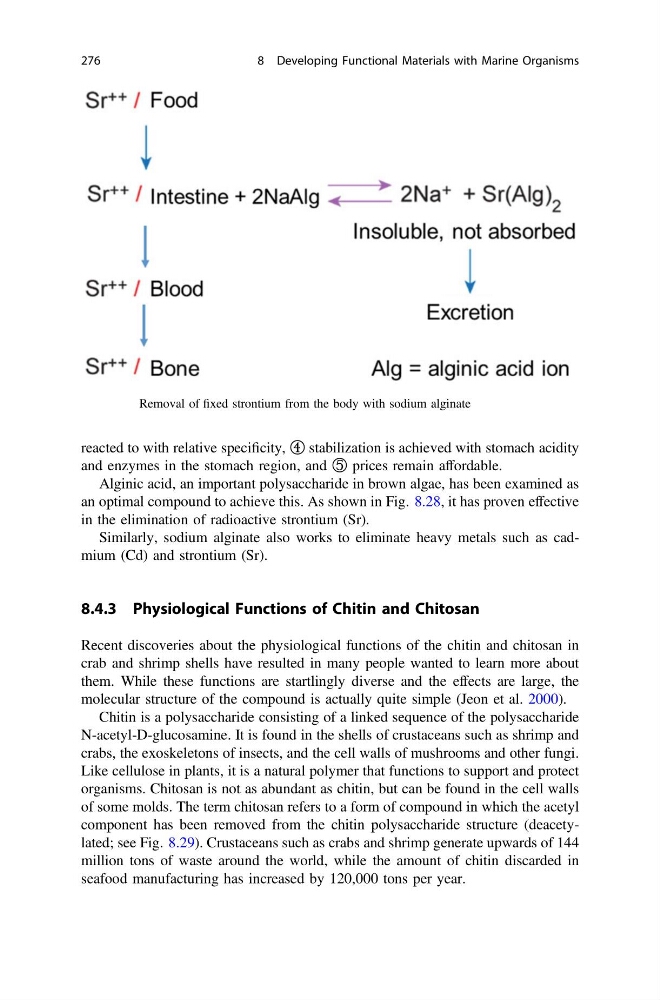
an optimal compound to achieve this. As shown in Fig. 8.28, it has proven effective
in the elimination of radioactive strontium (Sr).
Similarly, sodium alginate also works to eliminate heavy metals such as cadmium (Cd) and strontium (Sr).
8.4.3 Physiological Functions of Chitin and Chitosan
Recent discoveries about the physiological functions of the chitin and chitosan in
crab and shrimp shells have resulted in many people wanted to learn more about
them. While these functions are startlingly diverse and the effects are large, the
molecular structure of the compound is actually quite simple (Jeon et al. 2000).
Chitin is a polysaccharide consisting of a linked sequence of the polysaccharide
N-acetyl-D-glucosamine. It is found in the shells of crustaceans such as shrimp and
crabs, the exoskeletons of insects, and the cell walls of mushrooms and other fungi.
Like cellulose in plants, it is a natural polymer that functions to support and protect
organisms. Chitosan is not as abundant as chitin, but can be found in the cell walls
of some molds. The term chitosan refers to a form of compound in which the acetyl
component has been removed from the chitin polysaccharide structure (deacetylated; see Fig. 8.29). Crustaceans such as crabs and shrimp generate upwards of 144
million tons of waste around the world, while the amount of chitin discarded in
seafood manufacturing has increased by 120,000 tons per year.
Fig. 8.28 Removal of fixed strontium from the body with sodium alginate
276
8 Developing Functional Materials with Marine Organisms
and enzymes in the stomach region, and ⑤ prices remain affordable.
Alginic acid, an important polysaccharide in brown algae, has been examined as
an optimal compound to achieve this. As shown in Fig. 8.28, it has proven effective
in the elimination of radioactive strontium (Sr).
Similarly, sodium alginate also works to eliminate heavy metals such as cadmium (Cd) and strontium (Sr).
8.4.3 Physiological Functions of Chitin and Chitosan
Recent discoveries about the physiological functions of the chitin and chitosan in
crab and shrimp shells have resulted in many people wanted to learn more about
them. While these functions are startlingly diverse and the effects are large, the
molecular structure of the compound is actually quite simple (Jeon et al. 2000).
Chitin is a polysaccharide consisting of a linked sequence of the polysaccharide
N-acetyl-D-glucosamine. It is found in the shells of crustaceans such as shrimp and
crabs, the exoskeletons of insects, and the cell walls of mushrooms and other fungi.
Like cellulose in plants, it is a natural polymer that functions to support and protect
organisms. Chitosan is not as abundant as chitin, but can be found in the cell walls
of some molds. The term chitosan refers to a form of compound in which the acetyl
component has been removed from the chitin polysaccharide structure (deacetylated; see Fig. 8.29). Crustaceans such as crabs and shrimp generate upwards of 144
million tons of waste around the world, while the amount of chitin discarded in
seafood manufacturing has increased by 120,000 tons per year.
Fig. 8.28 Removal of fixed strontium from the body with sodium alginate
276
8 Developing Functional Materials with Marine Organisms