

proven useful in preventing various diseases, closer consideration will need to be
extended to these preventive effectives.
Prevention may be thought of as falling into two categories. One is prevention in
the sense of preventing a disease from causing death. In other words, if a patient
with a particular disease is administered DHA or another functional substance and
that patient’s condition improves, this may be regarded as “prevention of death.”
Another form of prevention involves preventing disease from occurring in the first
place. This prevention of the very contraction of a disease can be understood
ultimately as the same thing as delaying the onset of disease past the patient’s
lifespan.
The aforementioned epidemiological studies have predicted that people who eat
large amounts of fish live longer and have a lower morbidity rate from disease. If
animal testing shows DHA consumption to result in cancer not occurring prior to
the animal’s death, that animal cannot be said to have contracted cancer. Ultimately,
it is an instance of prevention of disease. This is an approach that should be
considered not only with cancer but also with arteriosclerosis, allergies, senile
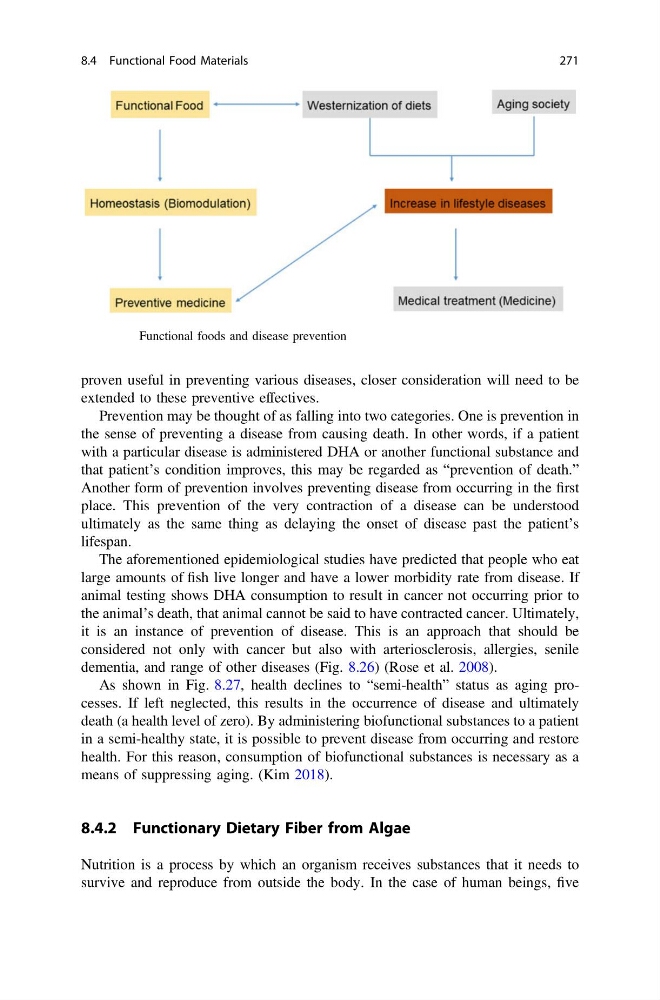
dementia, and range of other diseases (Fig. 8.26) (Rose et al. 2008).
As shown in Fig. 8.27, health declines to “semi-health” status as aging processes. If left neglected, this results in the occurrence of disease and ultimately
death (a health level of zero). By administering biofunctional substances to a patient
in a semi-healthy state, it is possible to prevent disease from occurring and restore
health. For this reason, consumption of biofunctional substances is necessary as a
means of suppressing aging. (Kim 2018).
8.4.2 Functionary Dietary Fiber from Algae
Nutrition is a process by which an organism receives substances that it needs to
survive and reproduce from outside the body. In the case of human beings, five
Fig. 8.26 Functional foods and disease prevention
8.4 Functional Food Materials
271
extended to these preventive effectives.
Prevention may be thought of as falling into two categories. One is prevention in
the sense of preventing a disease from causing death. In other words, if a patient
with a particular disease is administered DHA or another functional substance and
that patient’s condition improves, this may be regarded as “prevention of death.”
Another form of prevention involves preventing disease from occurring in the first
place. This prevention of the very contraction of a disease can be understood
ultimately as the same thing as delaying the onset of disease past the patient’s
lifespan.
The aforementioned epidemiological studies have predicted that people who eat
large amounts of fish live longer and have a lower morbidity rate from disease. If
animal testing shows DHA consumption to result in cancer not occurring prior to
the animal’s death, that animal cannot be said to have contracted cancer. Ultimately,
it is an instance of prevention of disease. This is an approach that should be
considered not only with cancer but also with arteriosclerosis, allergies, senile
dementia, and range of other diseases (Fig. 8.26) (Rose et al. 2008).
As shown in Fig. 8.27, health declines to “semi-health” status as aging processes. If left neglected, this results in the occurrence of disease and ultimately
death (a health level of zero). By administering biofunctional substances to a patient
in a semi-healthy state, it is possible to prevent disease from occurring and restore
health. For this reason, consumption of biofunctional substances is necessary as a
means of suppressing aging. (Kim 2018).
8.4.2 Functionary Dietary Fiber from Algae
Nutrition is a process by which an organism receives substances that it needs to
survive and reproduce from outside the body. In the case of human beings, five
Fig. 8.26 Functional foods and disease prevention
8.4 Functional Food Materials
271