

be viewed as an effective nutrient for preventing various diseases and a functional
health food with preventive medical characteristics (so-called “third functions”).
A fundamental distinction between DHA and EPA is that the former is able to pass
through the blood-brain barrier. It is thus DHA and not EPA that contributes to
nervous functioning and memory and learning effects.
Over the years, a large base of data has been assembled from in vitro (test tube)
and in vivo (animal) studies on the pharmacological functioning of DHA and its
ability to “improve intelligence” in a broad sense. As yet, however, research on its
mechanism and studies with human subjects remain insufficient. Much has been
learned about DHA’s mechanism, and improvements in patients with senile
dementia have been reported in clinic studies with human subjects. In addition to
proven improvements in atopic dermatitis, other important pharmacological functions include prevention of cancer and mutation, lowering of blood cholesterol, and
suppression of increases in blood pressure. Rapid advancements have recently been
made in the development of health food containing oils with large amounts of
DHA, which have grown to become a very large market (Jun et al. 2004).
That market is expected to grow further in the future as advancements are made
in DHA’s antioxidant properties, stability, and techniques for pulverization and
emulsification.
South Korea’s total tuna production stood at 254,000 tons in 2011. Of that
amount, 54,000 tons were used for processing of canned tuna, accounting for
around 65% of the 82,000 tons in total canned production. Tens of thousands of
tons of tuna parts are discarded during processing, including heads, viscera, and
bones. Hopefully, functional materials can be developed in the near future to use
these parts to prevent various diseases.
D. Improvements in Senile Dementia
The term “dementia” comes from the Latin meaning “to be out of one’s mind.” In
the past, it has been regarded as a natural physiological phenomenon of aging.
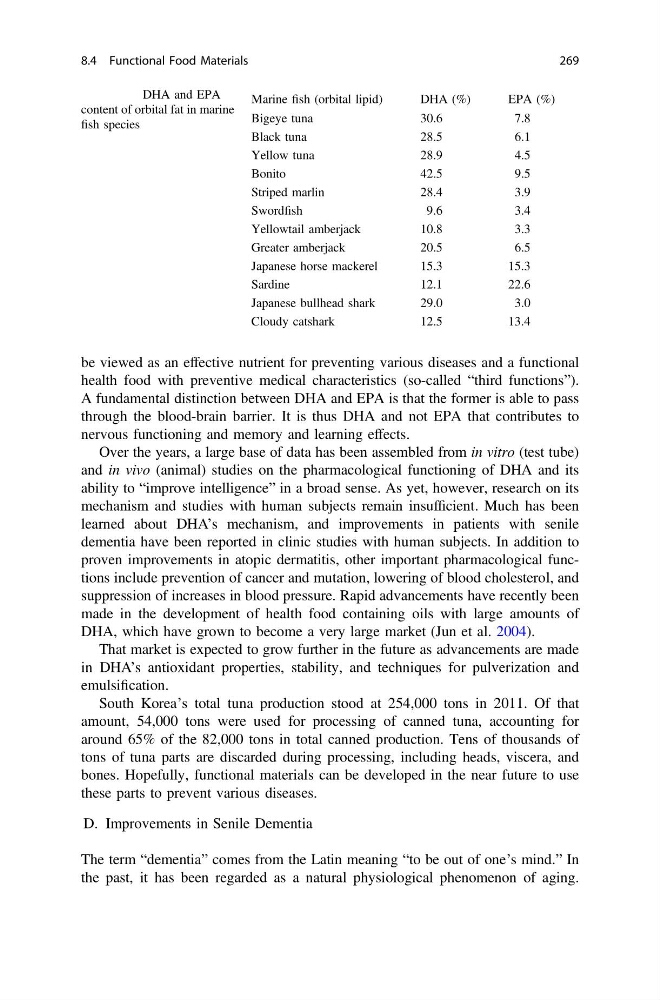
Table 8.5 DHA and EPA
content of orbital fat in marine
fish species
Marine fish (orbital lipid)
DHA (%)
EPA (%)
Bigeye tuna
30.6
7.8
Black tuna
28.5
6.1
Yellow tuna
28.9
4.5
Bonito
42.5
9.5
Striped marlin
28.4
3.9
Swordfish
9.6
3.4
Yellowtail amberjack
10.8
3.3
Greater amberjack
20.5
6.5
Japanese horse mackerel
15.3
15.3
Sardine
12.1
22.6
Japanese bullhead shark
29.0
3.0
Cloudy catshark
12.5
13.4
8.4 Functional Food Materials
269
health food with preventive medical characteristics (so-called “third functions”).
A fundamental distinction between DHA and EPA is that the former is able to pass
through the blood-brain barrier. It is thus DHA and not EPA that contributes to
nervous functioning and memory and learning effects.
Over the years, a large base of data has been assembled from in vitro (test tube)
and in vivo (animal) studies on the pharmacological functioning of DHA and its
ability to “improve intelligence” in a broad sense. As yet, however, research on its
mechanism and studies with human subjects remain insufficient. Much has been
learned about DHA’s mechanism, and improvements in patients with senile
dementia have been reported in clinic studies with human subjects. In addition to
proven improvements in atopic dermatitis, other important pharmacological functions include prevention of cancer and mutation, lowering of blood cholesterol, and
suppression of increases in blood pressure. Rapid advancements have recently been
made in the development of health food containing oils with large amounts of
DHA, which have grown to become a very large market (Jun et al. 2004).
That market is expected to grow further in the future as advancements are made
in DHA’s antioxidant properties, stability, and techniques for pulverization and
emulsification.
South Korea’s total tuna production stood at 254,000 tons in 2011. Of that
amount, 54,000 tons were used for processing of canned tuna, accounting for
around 65% of the 82,000 tons in total canned production. Tens of thousands of
tons of tuna parts are discarded during processing, including heads, viscera, and
bones. Hopefully, functional materials can be developed in the near future to use
these parts to prevent various diseases.
D. Improvements in Senile Dementia
The term “dementia” comes from the Latin meaning “to be out of one’s mind.” In
the past, it has been regarded as a natural physiological phenomenon of aging.
Table 8.5 DHA and EPA
content of orbital fat in marine
fish species
Marine fish (orbital lipid)
DHA (%)
EPA (%)
Bigeye tuna
30.6
7.8
Black tuna
28.5
6.1
Yellow tuna
28.9
4.5
Bonito
42.5
9.5
Striped marlin
28.4
3.9
Swordfish
9.6
3.4
Yellowtail amberjack
10.8
3.3
Greater amberjack
20.5
6.5
Japanese horse mackerel
15.3
15.3
Sardine
12.1
22.6
Japanese bullhead shark
29.0
3.0
Cloudy catshark
12.5
13.4
8.4 Functional Food Materials
269