

EPA and only a small percentage of DHA, here the situation is the exact reverse.
Moreover, fish heads have traditionally been treated as seafood waste products,
with only a small portion used for feed or fertilizer. Fatty oils have been used as
boiler fuel in place of heavy oils. For this reason, orbital fat from tuna and skipjack
tuna appears to offer a rather good potential source of DHA (Shahidi 2006).
Highly pure (over 99%) DHA, which is used as a reagent, is extremely
expensive, costing around US$220 for 100 mg. This has prevented its use in animal
experiments. DHA has had to be extracted from orbital lipid, and its purification has
allowed access to large quantities of inexpensive, highly pure DHA, ushering in
rapid advancements in DHA research. Because this orbital lipid is fresh and
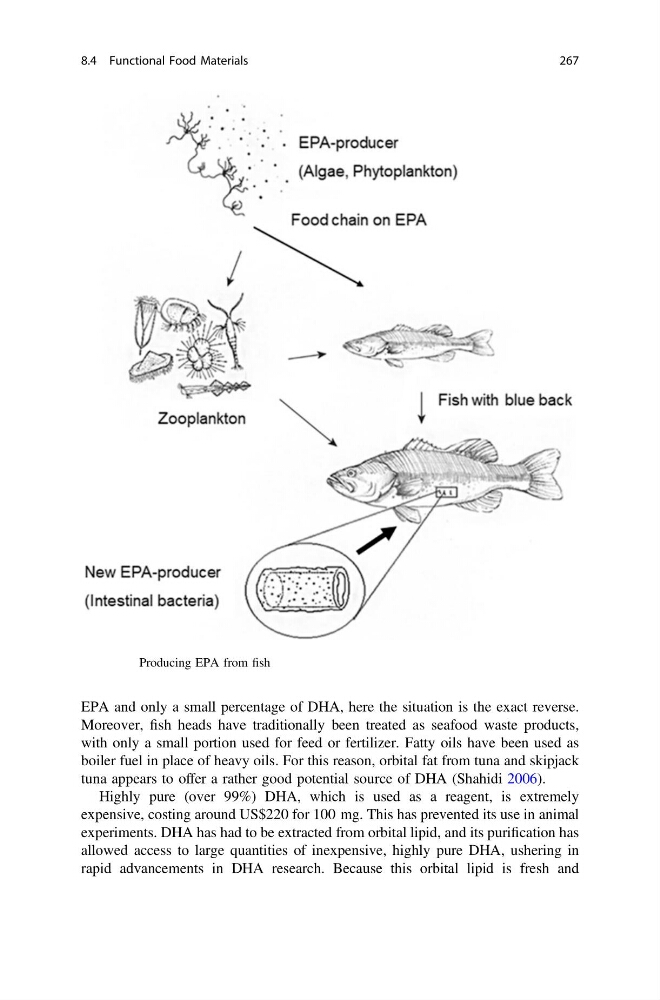
Fig. 8.24 Producing EPA from fish
8.4 Functional Food Materials
267
Moreover, fish heads have traditionally been treated as seafood waste products,
with only a small portion used for feed or fertilizer. Fatty oils have been used as
boiler fuel in place of heavy oils. For this reason, orbital fat from tuna and skipjack
tuna appears to offer a rather good potential source of DHA (Shahidi 2006).
Highly pure (over 99%) DHA, which is used as a reagent, is extremely
expensive, costing around US$220 for 100 mg. This has prevented its use in animal
experiments. DHA has had to be extracted from orbital lipid, and its purification has
allowed access to large quantities of inexpensive, highly pure DHA, ushering in
rapid advancements in DHA research. Because this orbital lipid is fresh and
Fig. 8.24 Producing EPA from fish
8.4 Functional Food Materials
267