

8.4 Functional Food Materials
8.4.1 Fish Fats and Disease Prevention
Unlike other island countries, Japan is a place where cold and warm currents come
together. Its waters are some of the most hospitable to formation of plankton, which
are primary producers in the ocean food chain. It may thus be described as a country
ringed by a sea with abundant stores of marine living resources. The Japanese
people themselves have unwittingly enjoyed many benefits from this sea and its rich
marine resources—a fact attested to by Japan’s lifespans, which are the longest in
the world. A 17-year cancer prevention institute survey of the nutritional habits of
265,000 Japanese people found their lifespans to increase with greater frequency of
fish consumption. It was also found that increases in the morbidity rate and death
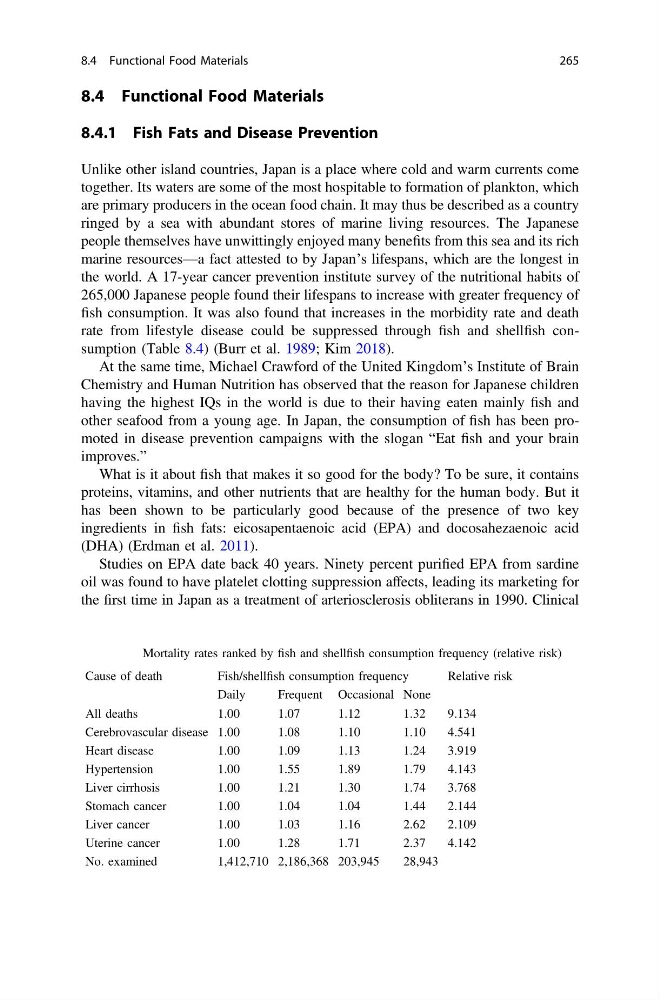
rate from lifestyle disease could be suppressed through fish and shellfish consumption (Table 8.4) (Burr et al. 1989; Kim 2018).
At the same time, Michael Crawford of the United Kingdom’s Institute of Brain
Chemistry and Human Nutrition has observed that the reason for Japanese children
having the highest IQs in the world is due to their having eaten mainly fish and
other seafood from a young age. In Japan, the consumption of fish has been promoted in disease prevention campaigns with the slogan “Eat fish and your brain
improves.”
What is it about fish that makes it so good for the body? To be sure, it contains
proteins, vitamins, and other nutrients that are healthy for the human body. But it
has been shown to be particularly good because of the presence of two key
ingredients in fish fats: eicosapentaenoic acid (EPA) and docosahezaenoic acid
(DHA) (Erdman et al. 2011).
Studies on EPA date back 40 years. Ninety percent purified EPA from sardine
oil was found to have platelet clotting suppression affects, leading its marketing for
the first time in Japan as a treatment of arteriosclerosis obliterans in 1990. Clinical
Table 8.4 Mortality rates ranked by fish and shellfish consumption frequency (relative risk)
Cause of death
Fish/shellfish consumption frequency
Relative risk
Daily
Frequent Occasional None
All deaths
1.00
1.07
1.12
1.32
9.134
Cerebrovascular disease 1.00
1.08
1.10
1.10
4.541
Heart disease
1.00
1.09
1.13
1.24
3.919
Hypertension
1.00
1.55
1.89
1.79
4.143
Liver cirrhosis
1.00
1.21
1.30
1.74
3.768
Stomach cancer
1.00
1.04
1.04
1.44
2.144
Liver cancer
1.00
1.03
1.16
2.62
2.109
Uterine cancer
1.00
1.28
1.71
2.37
4.142
No. examined
1,412,710 2,186,368 203,945
28,943
8.4 Functional Food Materials
265
8.4.1 Fish Fats and Disease Prevention
Unlike other island countries, Japan is a place where cold and warm currents come
together. Its waters are some of the most hospitable to formation of plankton, which
are primary producers in the ocean food chain. It may thus be described as a country
ringed by a sea with abundant stores of marine living resources. The Japanese
people themselves have unwittingly enjoyed many benefits from this sea and its rich
marine resources—a fact attested to by Japan’s lifespans, which are the longest in
the world. A 17-year cancer prevention institute survey of the nutritional habits of
265,000 Japanese people found their lifespans to increase with greater frequency of
fish consumption. It was also found that increases in the morbidity rate and death
rate from lifestyle disease could be suppressed through fish and shellfish consumption (Table 8.4) (Burr et al. 1989; Kim 2018).
At the same time, Michael Crawford of the United Kingdom’s Institute of Brain
Chemistry and Human Nutrition has observed that the reason for Japanese children
having the highest IQs in the world is due to their having eaten mainly fish and
other seafood from a young age. In Japan, the consumption of fish has been promoted in disease prevention campaigns with the slogan “Eat fish and your brain
improves.”
What is it about fish that makes it so good for the body? To be sure, it contains
proteins, vitamins, and other nutrients that are healthy for the human body. But it
has been shown to be particularly good because of the presence of two key
ingredients in fish fats: eicosapentaenoic acid (EPA) and docosahezaenoic acid
(DHA) (Erdman et al. 2011).
Studies on EPA date back 40 years. Ninety percent purified EPA from sardine
oil was found to have platelet clotting suppression affects, leading its marketing for
the first time in Japan as a treatment of arteriosclerosis obliterans in 1990. Clinical
Table 8.4 Mortality rates ranked by fish and shellfish consumption frequency (relative risk)
Cause of death
Fish/shellfish consumption frequency
Relative risk
Daily
Frequent Occasional None
All deaths
1.00
1.07
1.12
1.32
9.134
Cerebrovascular disease 1.00
1.08
1.10
1.10
4.541
Heart disease
1.00
1.09
1.13
1.24
3.919
Hypertension
1.00
1.55
1.89
1.79
4.143
Liver cirrhosis
1.00
1.21
1.30
1.74
3.768
Stomach cancer
1.00
1.04
1.04
1.44
2.144
Liver cancer
1.00
1.03
1.16
2.62
2.109
Uterine cancer
1.00
1.28
1.71
2.37
4.142
No. examined
1,412,710 2,186,368 203,945
28,943
8.4 Functional Food Materials
265