

also differs as a result of nutritional condition, irregularities in endocrine, and
intestinal or skin disease. The skin consists of an outermost epidermis, an internal
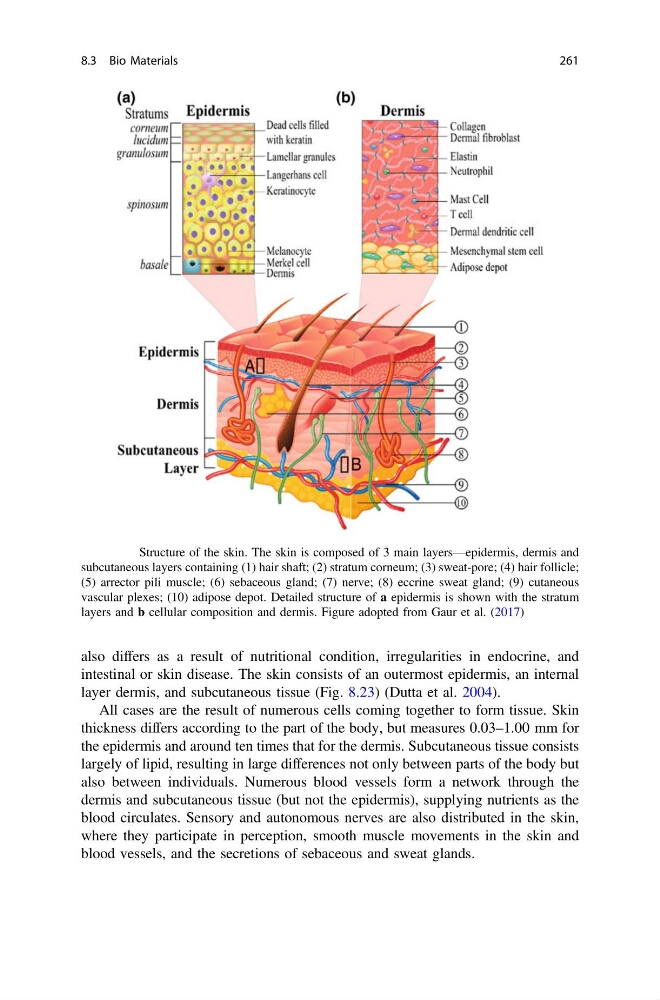
layer dermis, and subcutaneous tissue (Fig. 8.23) (Dutta et al. 2004).
All cases are the result of numerous cells coming together to form tissue. Skin
thickness differs according to the part of the body, but measures 0.03–1.00 mm for
the epidermis and around ten times that for the dermis. Subcutaneous tissue consists
largely of lipid, resulting in large differences not only between parts of the body but
also between individuals. Numerous blood vessels form a network through the
dermis and subcutaneous tissue (but not the epidermis), supplying nutrients as the
blood circulates. Sensory and autonomous nerves are also distributed in the skin,
where they participate in perception, smooth muscle movements in the skin and
blood vessels, and the secretions of sebaceous and sweat glands.
Fig. 8.23 Structure of the skin. The skin is composed of 3 main layers—epidermis, dermis and
subcutaneous layers containing (1) hair shaft; (2) stratum corneum; (3) sweat-pore; (4) hair follicle;
(5) arrector pili muscle; (6) sebaceous gland; (7) nerve; (8) eccrine sweat gland; (9) cutaneous
vascular plexes; (10) adipose depot. Detailed structure of a epidermis is shown with the stratum
layers and b cellular composition and dermis. Figure adopted from Gaur et al. (2017)
8.3 Bio Materials
261
intestinal or skin disease. The skin consists of an outermost epidermis, an internal
layer dermis, and subcutaneous tissue (Fig. 8.23) (Dutta et al. 2004).
All cases are the result of numerous cells coming together to form tissue. Skin
thickness differs according to the part of the body, but measures 0.03–1.00 mm for
the epidermis and around ten times that for the dermis. Subcutaneous tissue consists
largely of lipid, resulting in large differences not only between parts of the body but
also between individuals. Numerous blood vessels form a network through the
dermis and subcutaneous tissue (but not the epidermis), supplying nutrients as the
blood circulates. Sensory and autonomous nerves are also distributed in the skin,
where they participate in perception, smooth muscle movements in the skin and
blood vessels, and the secretions of sebaceous and sweat glands.
Fig. 8.23 Structure of the skin. The skin is composed of 3 main layers—epidermis, dermis and
subcutaneous layers containing (1) hair shaft; (2) stratum corneum; (3) sweat-pore; (4) hair follicle;
(5) arrector pili muscle; (6) sebaceous gland; (7) nerve; (8) eccrine sweat gland; (9) cutaneous
vascular plexes; (10) adipose depot. Detailed structure of a epidermis is shown with the stratum
layers and b cellular composition and dermis. Figure adopted from Gaur et al. (2017)
8.3 Bio Materials
261