

organic matter in the alginic wire is broken down, and the weight falls to roughly
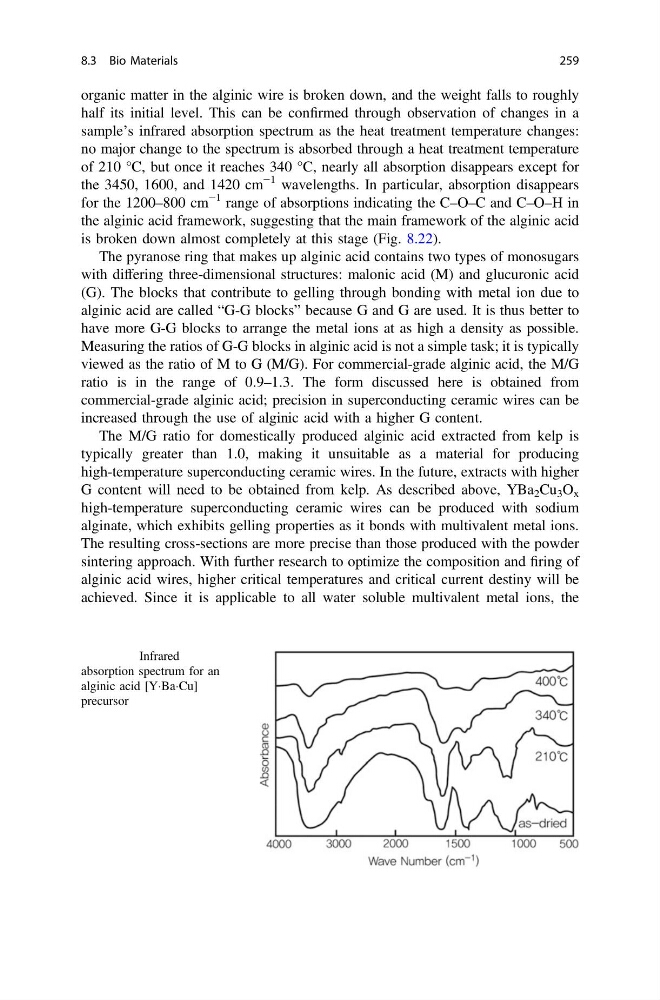
half its initial level. This can be confirmed through observation of changes in a
sample’s infrared absorption spectrum as the heat treatment temperature changes:
no major change to the spectrum is absorbed through a heat treatment temperature
of 210 °C, but once it reaches 340 °C, nearly all absorption disappears except for
the 3450, 1600, and 1420 cm
−1 wavelengths. In particular, absorption disappears
for the 1200–800 cm
−1 range of absorptions indicating the C–O–C and C–O–H in
the alginic acid framework, suggesting that the main framework of the alginic acid
is broken down almost completely at this stage (Fig. 8.22).
The pyranose ring that makes up alginic acid contains two types of monosugars
with differing three-dimensional structures: malonic acid (M) and glucuronic acid
(G). The blocks that contribute to gelling through bonding with metal ion due to
alginic acid are called “G-G blocks” because G and G are used. It is thus better to
have more G-G blocks to arrange the metal ions at as high a density as possible.
Measuring the ratios of G-G blocks in alginic acid is not a simple task; it is typically
viewed as the ratio of M to G (M/G). For commercial-grade alginic acid, the M/G
ratio is in the range of 0.9–1.3. The form discussed here is obtained from
commercial-grade alginic acid; precision in superconducting ceramic wires can be
increased through the use of alginic acid with a higher G content.
The M/G ratio for domestically produced alginic acid extracted from kelp is
typically greater than 1.0, making it unsuitable as a material for producing
high-temperature superconducting ceramic wires. In the future, extracts with higher
G content will need to be obtained from kelp. As described above, YBa 2 Cu 3 O x
high-temperature superconducting ceramic wires can be produced with sodium
alginate, which exhibits gelling properties as it bonds with multivalent metal ions.
The resulting cross-sections are more precise than those produced with the powder
sintering approach. With further research to optimize the composition and firing of
alginic acid wires, higher critical temperatures and critical current destiny will be
achieved. Since it is applicable to all water soluble multivalent metal ions, the
Fig. 8.22 Infrared
absorption spectrum for an
alginic acid [YÁBaÁCu]
precursor
8.3 Bio Materials
259
half its initial level. This can be confirmed through observation of changes in a
sample’s infrared absorption spectrum as the heat treatment temperature changes:
no major change to the spectrum is absorbed through a heat treatment temperature
of 210 °C, but once it reaches 340 °C, nearly all absorption disappears except for
the 3450, 1600, and 1420 cm
−1 wavelengths. In particular, absorption disappears
for the 1200–800 cm
−1 range of absorptions indicating the C–O–C and C–O–H in
the alginic acid framework, suggesting that the main framework of the alginic acid
is broken down almost completely at this stage (Fig. 8.22).
The pyranose ring that makes up alginic acid contains two types of monosugars
with differing three-dimensional structures: malonic acid (M) and glucuronic acid
(G). The blocks that contribute to gelling through bonding with metal ion due to
alginic acid are called “G-G blocks” because G and G are used. It is thus better to
have more G-G blocks to arrange the metal ions at as high a density as possible.
Measuring the ratios of G-G blocks in alginic acid is not a simple task; it is typically
viewed as the ratio of M to G (M/G). For commercial-grade alginic acid, the M/G
ratio is in the range of 0.9–1.3. The form discussed here is obtained from
commercial-grade alginic acid; precision in superconducting ceramic wires can be
increased through the use of alginic acid with a higher G content.
The M/G ratio for domestically produced alginic acid extracted from kelp is
typically greater than 1.0, making it unsuitable as a material for producing
high-temperature superconducting ceramic wires. In the future, extracts with higher
G content will need to be obtained from kelp. As described above, YBa 2 Cu 3 O x
high-temperature superconducting ceramic wires can be produced with sodium
alginate, which exhibits gelling properties as it bonds with multivalent metal ions.
The resulting cross-sections are more precise than those produced with the powder
sintering approach. With further research to optimize the composition and firing of
alginic acid wires, higher critical temperatures and critical current destiny will be
achieved. Since it is applicable to all water soluble multivalent metal ions, the
Fig. 8.22 Infrared
absorption spectrum for an
alginic acid [YÁBaÁCu]
precursor
8.3 Bio Materials
259