

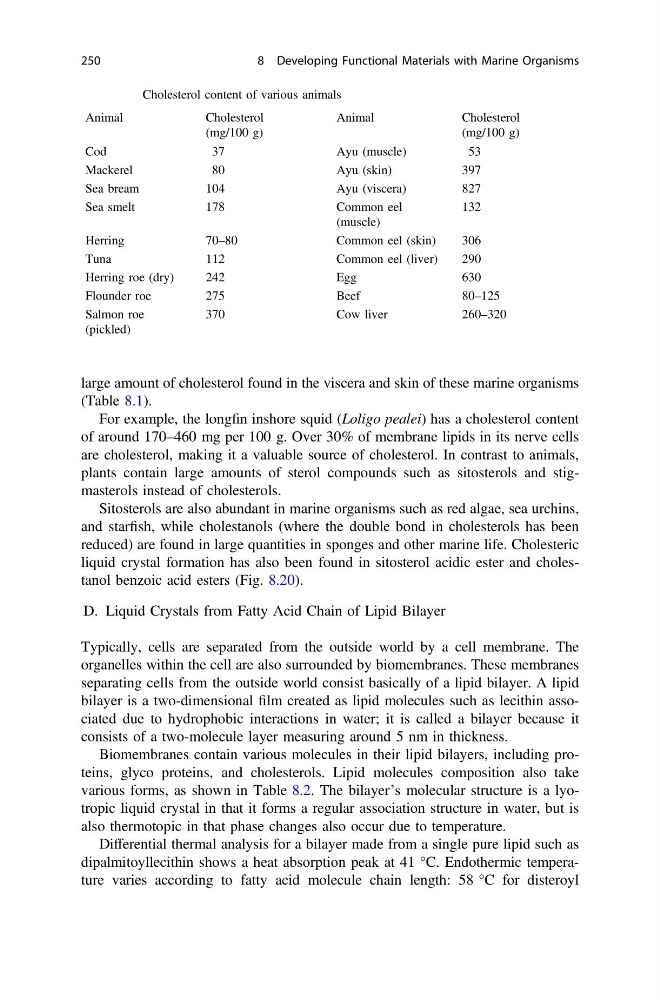
large amount of cholesterol found in the viscera and skin of these marine organisms
(Table 8.1).
For example, the longfin inshore squid (Loligo pealei) has a cholesterol content
of around 170–460 mg per 100 g. Over 30% of membrane lipids in its nerve cells
are cholesterol, making it a valuable source of cholesterol. In contrast to animals,
plants contain large amounts of sterol compounds such as sitosterols and stigmasterols instead of cholesterols.
Sitosterols are also abundant in marine organisms such as red algae, sea urchins,
and starfish, while cholestanols (where the double bond in cholesterols has been
reduced) are found in large quantities in sponges and other marine life. Cholesteric
liquid crystal formation has also been found in sitosterol acidic ester and cholestanol benzoic acid esters (Fig. 8.20).
D. Liquid Crystals from Fatty Acid Chain of Lipid Bilayer
Typically, cells are separated from the outside world by a cell membrane. The
organelles within the cell are also surrounded by biomembranes. These membranes
separating cells from the outside world consist basically of a lipid bilayer. A lipid
bilayer is a two-dimensional film created as lipid molecules such as lecithin associated due to hydrophobic interactions in water; it is called a bilayer because it
consists of a two-molecule layer measuring around 5 nm in thickness.
Biomembranes contain various molecules in their lipid bilayers, including proteins, glyco proteins, and cholesterols. Lipid molecules composition also take
various forms, as shown in Table 8.2. The bilayer’s molecular structure is a lyotropic liquid crystal in that it forms a regular association structure in water, but is
also thermotopic in that phase changes also occur due to temperature.
Differential thermal analysis for a bilayer made from a single pure lipid such as
dipalmitoyllecithin shows a heat absorption peak at 41 °C. Endothermic temperature varies according to fatty acid molecule chain length: 58 °C for disteroyl
Table 8.1 Cholesterol content of various animals
Animal
Cholesterol
(mg/100 g)
Animal
Cholesterol
(mg/100 g)
Cod
37
Ayu (muscle)
53
Mackerel
80
Ayu (skin)
397
Sea bream
104
Ayu (viscera)
827
Sea smelt
178
Common eel
(muscle)
132
Herring
70–80
Common eel (skin)
306
Tuna
112
Common eel (liver)
290
Herring roe (dry)
242
Egg
630
Flounder roe
275
Beef
80–125
Salmon roe
(pickled)
370
Cow liver
260–320
250
8 Developing Functional Materials with Marine Organisms
(Table 8.1).
For example, the longfin inshore squid (Loligo pealei) has a cholesterol content
of around 170–460 mg per 100 g. Over 30% of membrane lipids in its nerve cells
are cholesterol, making it a valuable source of cholesterol. In contrast to animals,
plants contain large amounts of sterol compounds such as sitosterols and stigmasterols instead of cholesterols.
Sitosterols are also abundant in marine organisms such as red algae, sea urchins,
and starfish, while cholestanols (where the double bond in cholesterols has been
reduced) are found in large quantities in sponges and other marine life. Cholesteric
liquid crystal formation has also been found in sitosterol acidic ester and cholestanol benzoic acid esters (Fig. 8.20).
D. Liquid Crystals from Fatty Acid Chain of Lipid Bilayer
Typically, cells are separated from the outside world by a cell membrane. The
organelles within the cell are also surrounded by biomembranes. These membranes
separating cells from the outside world consist basically of a lipid bilayer. A lipid
bilayer is a two-dimensional film created as lipid molecules such as lecithin associated due to hydrophobic interactions in water; it is called a bilayer because it
consists of a two-molecule layer measuring around 5 nm in thickness.
Biomembranes contain various molecules in their lipid bilayers, including proteins, glyco proteins, and cholesterols. Lipid molecules composition also take
various forms, as shown in Table 8.2. The bilayer’s molecular structure is a lyotropic liquid crystal in that it forms a regular association structure in water, but is
also thermotopic in that phase changes also occur due to temperature.
Differential thermal analysis for a bilayer made from a single pure lipid such as
dipalmitoyllecithin shows a heat absorption peak at 41 °C. Endothermic temperature varies according to fatty acid molecule chain length: 58 °C for disteroyl
Table 8.1 Cholesterol content of various animals
Animal
Cholesterol
(mg/100 g)
Animal
Cholesterol
(mg/100 g)
Cod
37
Ayu (muscle)
53
Mackerel
80
Ayu (skin)
397
Sea bream
104
Ayu (viscera)
827
Sea smelt
178
Common eel
(muscle)
132
Herring
70–80
Common eel (skin)
306
Tuna
112
Common eel (liver)
290
Herring roe (dry)
242
Egg
630
Flounder roe
275
Beef
80–125
Salmon roe
(pickled)
370
Cow liver
260–320
250
8 Developing Functional Materials with Marine Organisms