

In 1888, Reinitzer was studying the melting behavior of organic matter related to
cholesterols in plants when he found that cholesteric benzoate had two melting
points. He observed that when cholesteric benzoate crystals were heated to 145.5 °
C, they dissolved to form a white, turbid liquid, but at 178.5 °C they transformed
into a clear liquid. Reinitzer shared his discovery with the German physicist Lehmann. The following year in 1889, Lehmann used a polarizing microscope he had
devised with the latest heating equipment and showed the two melting points
possessed by cholesteric benzoate. He discovered that the substance exhibited
birefringence in the liquid state; when cooled, it displayed various beautiful colors
like a pearl before reaching crystal form. Because it possessed the flowing properties of a liquid and the optical properties of a solid, Lehmann called it fliebende
Krystalle, or “flowing crystal” in German.
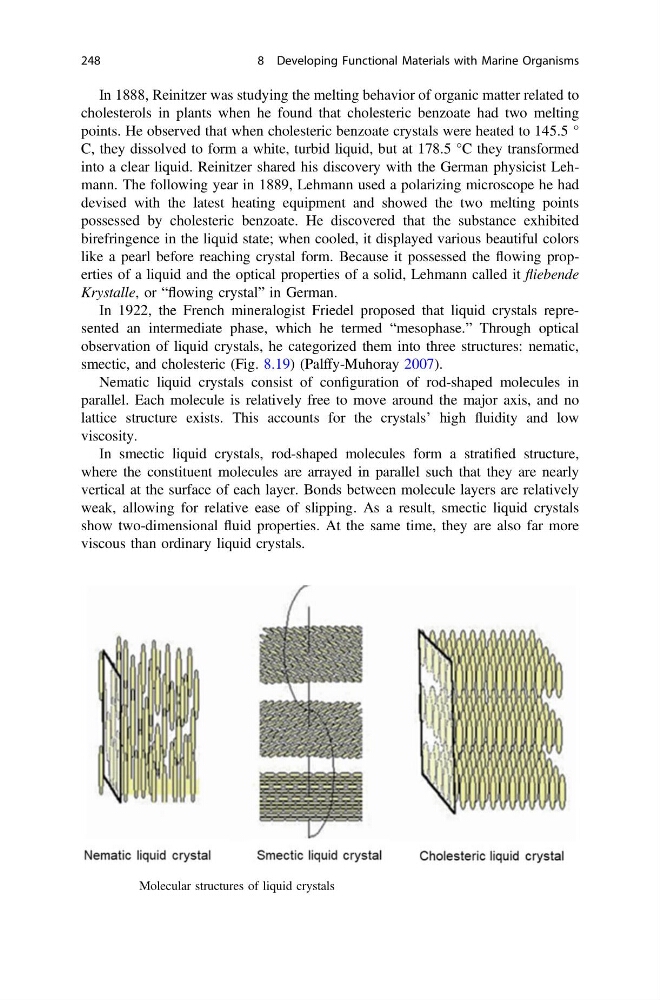
In 1922, the French mineralogist Friedel proposed that liquid crystals represented an intermediate phase, which he termed “mesophase.” Through optical
observation of liquid crystals, he categorized them into three structures: nematic,
smectic, and cholesteric (Fig. 8.19) (Palffy-Muhoray 2007).
Nematic liquid crystals consist of configuration of rod-shaped molecules in
parallel. Each molecule is relatively free to move around the major axis, and no
lattice structure exists. This accounts for the crystals’ high fluidity and low
viscosity.
In smectic liquid crystals, rod-shaped molecules form a stratified structure,
where the constituent molecules are arrayed in parallel such that they are nearly
vertical at the surface of each layer. Bonds between molecule layers are relatively
weak, allowing for relative ease of slipping. As a result, smectic liquid crystals
show two-dimensional fluid properties. At the same time, they are also far more
viscous than ordinary liquid crystals.
Fig. 8.19 Molecular structures of liquid crystals
248
8 Developing Functional Materials with Marine Organisms
cholesterols in plants when he found that cholesteric benzoate had two melting
points. He observed that when cholesteric benzoate crystals were heated to 145.5 °
C, they dissolved to form a white, turbid liquid, but at 178.5 °C they transformed
into a clear liquid. Reinitzer shared his discovery with the German physicist Lehmann. The following year in 1889, Lehmann used a polarizing microscope he had
devised with the latest heating equipment and showed the two melting points
possessed by cholesteric benzoate. He discovered that the substance exhibited
birefringence in the liquid state; when cooled, it displayed various beautiful colors
like a pearl before reaching crystal form. Because it possessed the flowing properties of a liquid and the optical properties of a solid, Lehmann called it fliebende
Krystalle, or “flowing crystal” in German.
In 1922, the French mineralogist Friedel proposed that liquid crystals represented an intermediate phase, which he termed “mesophase.” Through optical
observation of liquid crystals, he categorized them into three structures: nematic,
smectic, and cholesteric (Fig. 8.19) (Palffy-Muhoray 2007).
Nematic liquid crystals consist of configuration of rod-shaped molecules in
parallel. Each molecule is relatively free to move around the major axis, and no
lattice structure exists. This accounts for the crystals’ high fluidity and low
viscosity.
In smectic liquid crystals, rod-shaped molecules form a stratified structure,
where the constituent molecules are arrayed in parallel such that they are nearly
vertical at the surface of each layer. Bonds between molecule layers are relatively
weak, allowing for relative ease of slipping. As a result, smectic liquid crystals
show two-dimensional fluid properties. At the same time, they are also far more
viscous than ordinary liquid crystals.
Fig. 8.19 Molecular structures of liquid crystals
248
8 Developing Functional Materials with Marine Organisms