

recent shift toward paperless practices in information-related industries has resulted
in declining demand for paper. At the same time, however, the ease of printing has
led to explosive increases in the demand for different forms of paper (including
information and printing paper, hygienic paper, and cardboard), which has accelerated the devastation of foreign resources.
It was in this context that the Earth Summit in Brazil in June 1992 saw the
declaration of plans to continue pursuing sustainable development by keeping the
load on the global environment within the earth’s environmental allowance. Civilizations may have grown by consuming forests, but humankind’s development has
fed upon paper. In that sense, the continued rise in demand for paper, chiefly in
developing economies, has necessarily led to an increase in demand for timber. One
way of addressing this burgeoning demand for timber is through the use of marine
polysaccharides—products of the active purification activities of marine organisms
—as a raw material for paper.
A. Paper from Algae
If our goal is make paper from marine cellulose, our first thought may go to algae,
which possess cellulose in their cell walls. Among the different alga types, cellulose
is contained in green algae; the cell walls of brown algae are chiefly alginic acid,
while those of red algae consist of carrageenan, amylose, and/or amylopectin.
Almost none of these have a cell wall structure consisting of polysaccharides that
can be isolated in fiber form. One possible approach is artificial spinning, or
extraction of polysaccharides from the cell wall for reconstitution in fibrous form.
For a saccharide to be reprocessed into fiber form, its molecular structure must
consist of a lineament with few branches. In that sense, alginic acid offers the most
typical example.
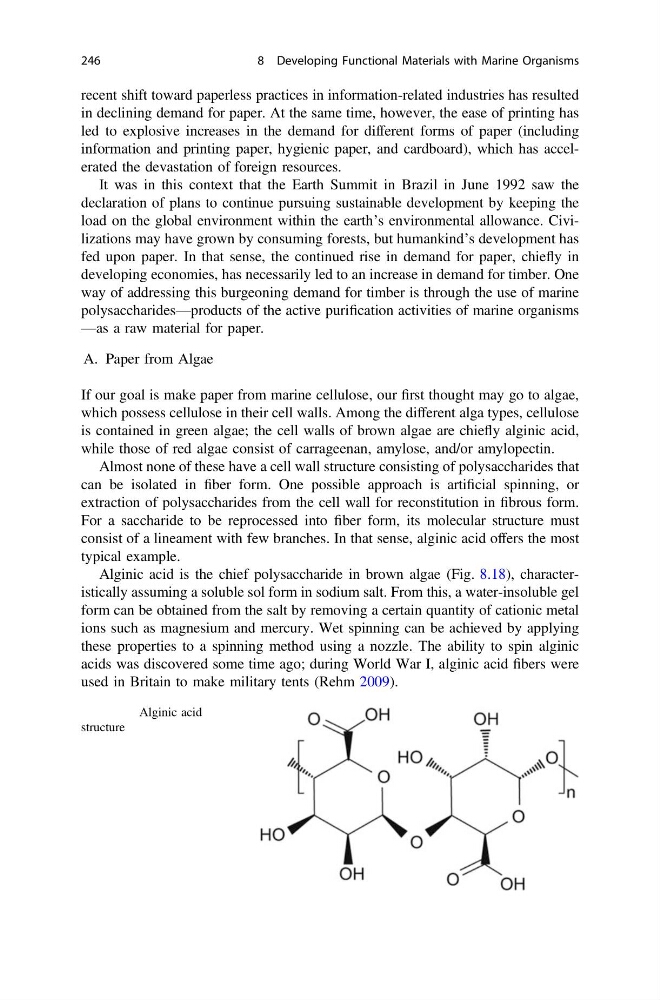
Alginic acid is the chief polysaccharide in brown algae (Fig. 8.18), characteristically assuming a soluble sol form in sodium salt. From this, a water-insoluble gel
form can be obtained from the salt by removing a certain quantity of cationic metal
ions such as magnesium and mercury. Wet spinning can be achieved by applying
these properties to a spinning method using a nozzle. The ability to spin alginic
acids was discovered some time ago; during World War I, alginic acid fibers were
used in Britain to make military tents (Rehm 2009).
Fig. 8.18 Alginic acid
structure
246
8 Developing Functional Materials with Marine Organisms
in declining demand for paper. At the same time, however, the ease of printing has
led to explosive increases in the demand for different forms of paper (including
information and printing paper, hygienic paper, and cardboard), which has accelerated the devastation of foreign resources.
It was in this context that the Earth Summit in Brazil in June 1992 saw the
declaration of plans to continue pursuing sustainable development by keeping the
load on the global environment within the earth’s environmental allowance. Civilizations may have grown by consuming forests, but humankind’s development has
fed upon paper. In that sense, the continued rise in demand for paper, chiefly in
developing economies, has necessarily led to an increase in demand for timber. One
way of addressing this burgeoning demand for timber is through the use of marine
polysaccharides—products of the active purification activities of marine organisms
—as a raw material for paper.
A. Paper from Algae
If our goal is make paper from marine cellulose, our first thought may go to algae,
which possess cellulose in their cell walls. Among the different alga types, cellulose
is contained in green algae; the cell walls of brown algae are chiefly alginic acid,
while those of red algae consist of carrageenan, amylose, and/or amylopectin.
Almost none of these have a cell wall structure consisting of polysaccharides that
can be isolated in fiber form. One possible approach is artificial spinning, or
extraction of polysaccharides from the cell wall for reconstitution in fibrous form.
For a saccharide to be reprocessed into fiber form, its molecular structure must
consist of a lineament with few branches. In that sense, alginic acid offers the most
typical example.
Alginic acid is the chief polysaccharide in brown algae (Fig. 8.18), characteristically assuming a soluble sol form in sodium salt. From this, a water-insoluble gel
form can be obtained from the salt by removing a certain quantity of cationic metal
ions such as magnesium and mercury. Wet spinning can be achieved by applying
these properties to a spinning method using a nozzle. The ability to spin alginic
acids was discovered some time ago; during World War I, alginic acid fibers were
used in Britain to make military tents (Rehm 2009).
Fig. 8.18 Alginic acid
structure
246
8 Developing Functional Materials with Marine Organisms