

demonstrated the potential for mass production of adhesive proteins, as it was able
to produce proteins with adhesive properties through recombination.
Once all of the reactions that occur in byssus synthesis within the foot are
identified, as well as the enzymes responsible for catalyzing those reactions, it
should be possible to product adhesive proteins identical to those found in nature.
Enhancement of adhesive protein gene sequences by recombinant DNA methods to
create more powerful adhesive proteins may become more than wishful thinking.
The research team of Dr. Cha Y. J. of the Pohang University of Science and
Technology, South Korea, has used molecular bioengineering production technology
to commercialize bio adhesives from the sea mussel. The team has isolated genes for
adhesive proteins from the mussels and used them to develop new forms of hybrid
bio adhesives that can be used as underwater adhesives (Choi et al. 2015).
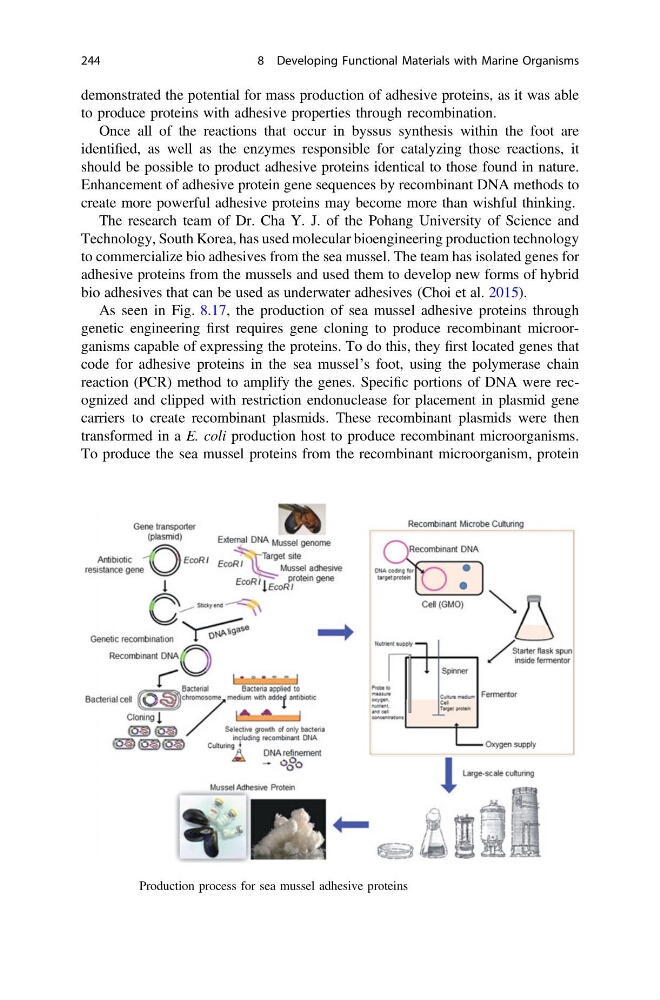
As seen in Fig. 8.17, the production of sea mussel adhesive proteins through
genetic engineering first requires gene cloning to produce recombinant microorganisms capable of expressing the proteins. To do this, they first located genes that
code for adhesive proteins in the sea mussel’s foot, using the polymerase chain
reaction (PCR) method to amplify the genes. Specific portions of DNA were recognized and clipped with restriction endonuclease for placement in plasmid gene
carriers to create recombinant plasmids. These recombinant plasmids were then
transformed in a E. coli production host to produce recombinant microorganisms.
To produce the sea mussel proteins from the recombinant microorganism, protein
Fig. 8.17 Production process for sea mussel adhesive proteins
244
8 Developing Functional Materials with Marine Organisms
to produce proteins with adhesive properties through recombination.
Once all of the reactions that occur in byssus synthesis within the foot are
identified, as well as the enzymes responsible for catalyzing those reactions, it
should be possible to product adhesive proteins identical to those found in nature.
Enhancement of adhesive protein gene sequences by recombinant DNA methods to
create more powerful adhesive proteins may become more than wishful thinking.
The research team of Dr. Cha Y. J. of the Pohang University of Science and
Technology, South Korea, has used molecular bioengineering production technology
to commercialize bio adhesives from the sea mussel. The team has isolated genes for
adhesive proteins from the mussels and used them to develop new forms of hybrid
bio adhesives that can be used as underwater adhesives (Choi et al. 2015).
As seen in Fig. 8.17, the production of sea mussel adhesive proteins through
genetic engineering first requires gene cloning to produce recombinant microorganisms capable of expressing the proteins. To do this, they first located genes that
code for adhesive proteins in the sea mussel’s foot, using the polymerase chain
reaction (PCR) method to amplify the genes. Specific portions of DNA were recognized and clipped with restriction endonuclease for placement in plasmid gene
carriers to create recombinant plasmids. These recombinant plasmids were then
transformed in a E. coli production host to produce recombinant microorganisms.
To produce the sea mussel proteins from the recombinant microorganism, protein
Fig. 8.17 Production process for sea mussel adhesive proteins
244
8 Developing Functional Materials with Marine Organisms