

Thanks to rapid advancements in marine microbe genome technology, new
attempts are now being made to understand the organisms and apply them in
industry (Medini et al. 2005).
Many often speak of the 21st century as the “bio-era.” The potential applications
of biologically based technology are great indeed, spanning pharmaceutical,
materials, the environment, energy, and most of the roles necessary for human
survival. So important is the role of marine organisms becoming in every field of
biotechnology application that some are now predicting the 21st century will more
specifically be called the “marine bio era.” A major factor in this change is the
expanding understanding of previously unfathomable marine organisms and the
rapid development of industry-related biological technology.
The world marine bioindustry market amounts today to around US$3 billion
annually, but it has grown by multiples each year. At one-in-6000, the success rate
for product development from marine materials is more than twice as high as the
one-in-13,000 rate for land-based biological materials, suggesting that research is
also high in efficiency. In recent years, advanced economies have invested heavily
in the production of chemicals, new materials, and energy products using biological
resources. In South Korea, however, both R&D and industry development in the
field have failed to occur due to a shortage of biological resources (Lee et al. 2009).
The solution to South Korea’s growing resource and energy shortage issue thus
lies in the sea. With an area four times greater than land masses, it is a potential
course for massive amounts of marine organism resources, and the development of
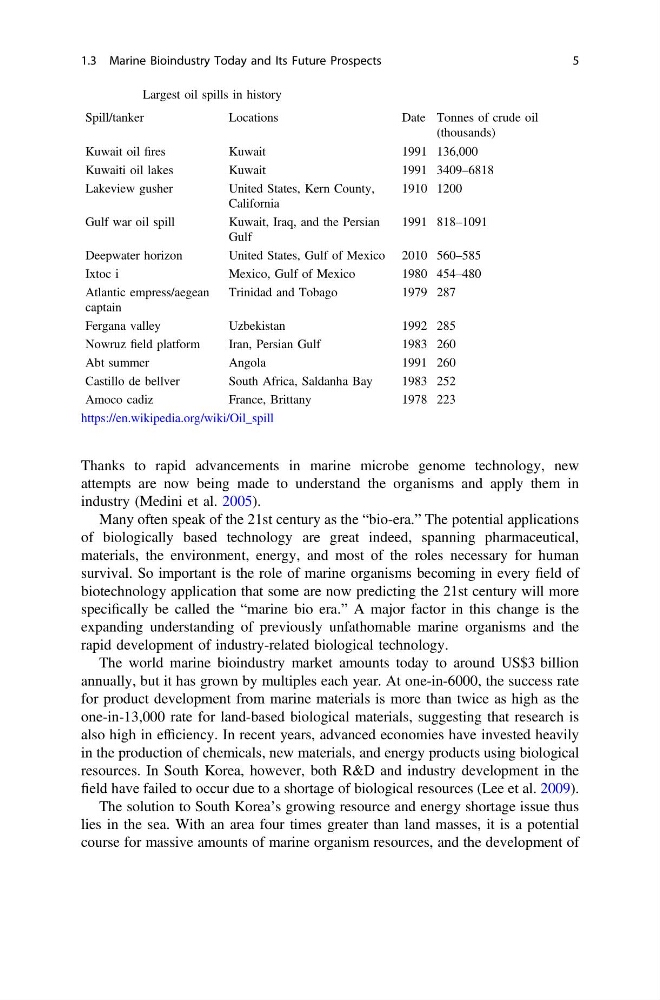
Table 1.2 Largest oil spills in history
Spill/tanker
Locations
Date Tonnes of crude oil
(thousands)
Kuwait oil fires
Kuwait
1991 136,000
Kuwaiti oil lakes
Kuwait
1991 3409–6818
Lakeview gusher
United States, Kern County,
California
1910 1200
Gulf war oil spill
Kuwait, Iraq, and the Persian
Gulf
1991 818–1091
Deepwater horizon
United States, Gulf of Mexico 2010 560–585
Ixtoc i
Mexico, Gulf of Mexico
1980 454–480
Atlantic empress/aegean
captain
Trinidad and Tobago
1979 287
Fergana valley
Uzbekistan
1992 285
Nowruz field platform
Iran, Persian Gulf
1983 260
Abt summer
Angola
1991 260
Castillo de bellver
South Africa, Saldanha Bay
1983 252
Amoco cadiz
France, Brittany
1978 223
https://en.wikipedia.org/wiki/Oil_spill
1.3 Marine Bioindustry Today and Its Future Prospects
5
attempts are now being made to understand the organisms and apply them in
industry (Medini et al. 2005).
Many often speak of the 21st century as the “bio-era.” The potential applications
of biologically based technology are great indeed, spanning pharmaceutical,
materials, the environment, energy, and most of the roles necessary for human
survival. So important is the role of marine organisms becoming in every field of
biotechnology application that some are now predicting the 21st century will more
specifically be called the “marine bio era.” A major factor in this change is the
expanding understanding of previously unfathomable marine organisms and the
rapid development of industry-related biological technology.
The world marine bioindustry market amounts today to around US$3 billion
annually, but it has grown by multiples each year. At one-in-6000, the success rate
for product development from marine materials is more than twice as high as the
one-in-13,000 rate for land-based biological materials, suggesting that research is
also high in efficiency. In recent years, advanced economies have invested heavily
in the production of chemicals, new materials, and energy products using biological
resources. In South Korea, however, both R&D and industry development in the
field have failed to occur due to a shortage of biological resources (Lee et al. 2009).
The solution to South Korea’s growing resource and energy shortage issue thus
lies in the sea. With an area four times greater than land masses, it is a potential
course for massive amounts of marine organism resources, and the development of
Table 1.2 Largest oil spills in history
Spill/tanker
Locations
Date Tonnes of crude oil
(thousands)
Kuwait oil fires
Kuwait
1991 136,000
Kuwaiti oil lakes
Kuwait
1991 3409–6818
Lakeview gusher
United States, Kern County,
California
1910 1200
Gulf war oil spill
Kuwait, Iraq, and the Persian
Gulf
1991 818–1091
Deepwater horizon
United States, Gulf of Mexico 2010 560–585
Ixtoc i
Mexico, Gulf of Mexico
1980 454–480
Atlantic empress/aegean
captain
Trinidad and Tobago
1979 287
Fergana valley
Uzbekistan
1992 285
Nowruz field platform
Iran, Persian Gulf
1983 260
Abt summer
Angola
1991 260
Castillo de bellver
South Africa, Saldanha Bay
1983 252
Amoco cadiz
France, Brittany
1978 223
https://en.wikipedia.org/wiki/Oil_spill
1.3 Marine Bioindustry Today and Its Future Prospects
5