

Because this strain does not possess A. nidulans’s marked DNA absorption
capabilities, transformation competence must be established in the cell at the time of
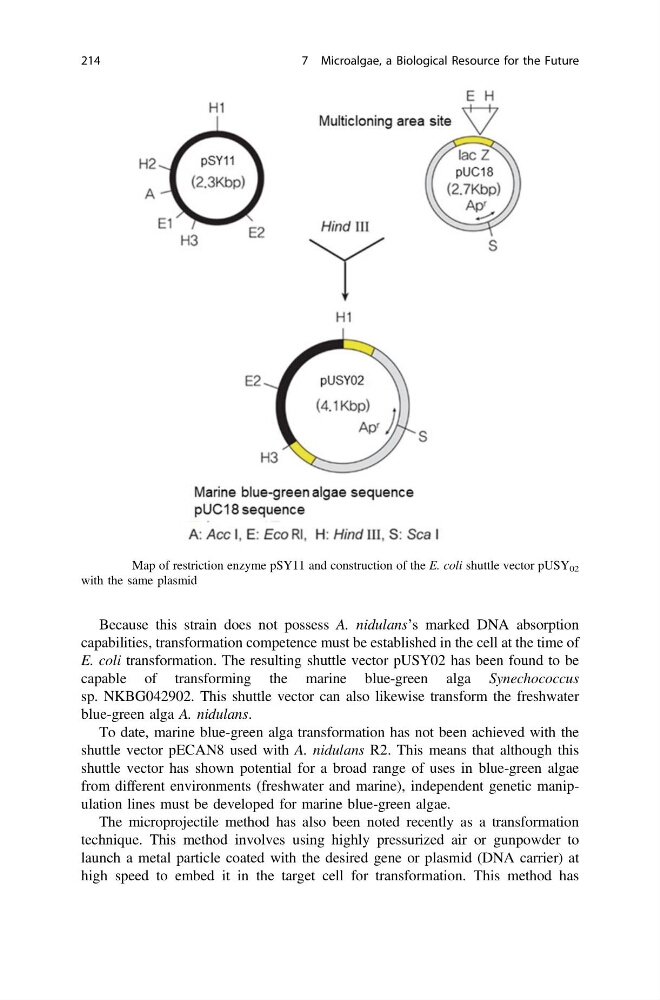
E. coli transformation. The resulting shuttle vector pUSY02 has been found to be
capable of transforming the marine blue-green alga Synechococcus
sp. NKBG042902. This shuttle vector can also likewise transform the freshwater
blue-green alga A. nidulans.
To date, marine blue-green alga transformation has not been achieved with the
shuttle vector pECAN8 used with A. nidulans R2. This means that although this
shuttle vector has shown potential for a broad range of uses in blue-green algae
from different environments (freshwater and marine), independent genetic manipulation lines must be developed for marine blue-green algae.
The microprojectile method has also been noted recently as a transformation
technique. This method involves using highly pressurized air or gunpowder to
launch a metal particle coated with the desired gene or plasmid (DNA carrier) at
high speed to embed it in the target cell for transformation. This method has
Fig. 7.5 Map of restriction enzyme pSY11 and construction of the E. coli shuttle vector pUSY 02
with the same plasmid
214
7 Microalgae, a Biological Resource for the Future
capabilities, transformation competence must be established in the cell at the time of
E. coli transformation. The resulting shuttle vector pUSY02 has been found to be
capable of transforming the marine blue-green alga Synechococcus
sp. NKBG042902. This shuttle vector can also likewise transform the freshwater
blue-green alga A. nidulans.
To date, marine blue-green alga transformation has not been achieved with the
shuttle vector pECAN8 used with A. nidulans R2. This means that although this
shuttle vector has shown potential for a broad range of uses in blue-green algae
from different environments (freshwater and marine), independent genetic manipulation lines must be developed for marine blue-green algae.
The microprojectile method has also been noted recently as a transformation
technique. This method involves using highly pressurized air or gunpowder to
launch a metal particle coated with the desired gene or plasmid (DNA carrier) at
high speed to embed it in the target cell for transformation. This method has
Fig. 7.5 Map of restriction enzyme pSY11 and construction of the E. coli shuttle vector pUSY 02
with the same plasmid
214
7 Microalgae, a Biological Resource for the Future