

the features of the collection site. At the same time, one should also bear in mind
that the environment conditions of the screening site will not necessary conform to
the optimal culturing conditions for the blue-green alga (or other microalgae) isolated from that site.
Sample collection in open-ocean regions requires a suitably equipped research
vessel. For microalgae collection, a plankton net or water sampler (e.g., Nansen or
vertical sampler) is used. Water sampling is used to collect algae with fine structure
or smaller nanoplankton (2–20 lm) and phytoplankton (under 2 lm) (Saino and
Hattori 1978).
7.2.2 Separating Marine Blue-Green Algae
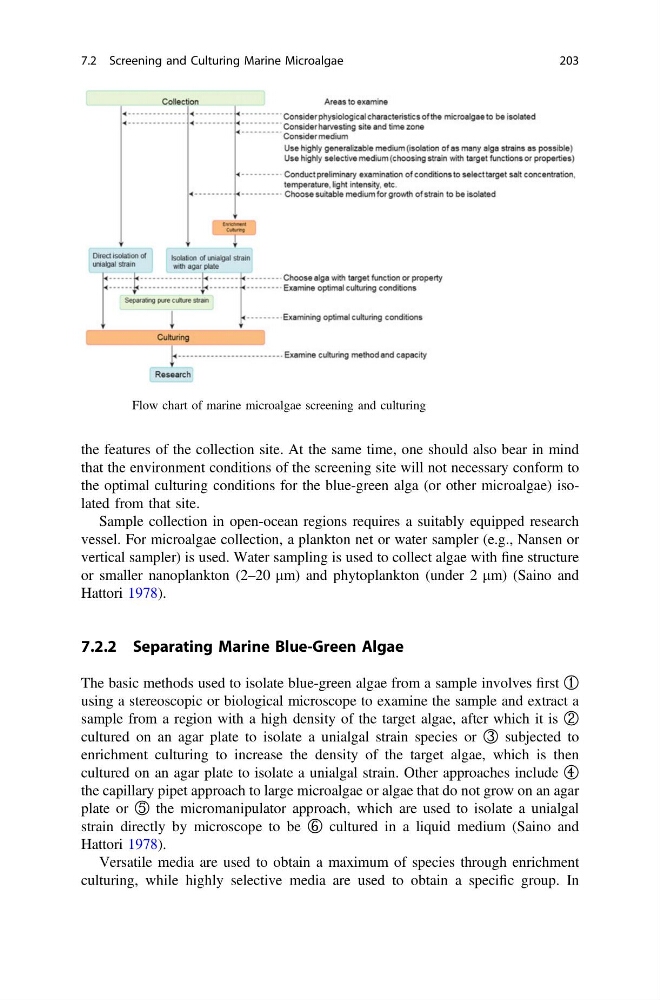
The basic methods used to isolate blue-green algae from a sample involves first ①
using a stereoscopic or biological microscope to examine the sample and extract a
sample from a region with a high density of the target algae, after which it is ②
cultured on an agar plate to isolate a unialgal strain species or ③ subjected to
enrichment culturing to increase the density of the target algae, which is then
cultured on an agar plate to isolate a unialgal strain. Other approaches include ④
the capillary pipet approach to large microalgae or algae that do not grow on an agar
plate or ⑤ the micromanipulator approach, which are used to isolate a unialgal
strain directly by microscope to be ⑥ cultured in a liquid medium (Saino and
Hattori 1978).
Versatile media are used to obtain a maximum of species through enrichment
culturing, while highly selective media are used to obtain a specific group. In
Fig. 7.2 Flow chart of marine microalgae screening and culturing
7.2 Screening and Culturing Marine Microalgae
203
that the environment conditions of the screening site will not necessary conform to
the optimal culturing conditions for the blue-green alga (or other microalgae) isolated from that site.
Sample collection in open-ocean regions requires a suitably equipped research
vessel. For microalgae collection, a plankton net or water sampler (e.g., Nansen or
vertical sampler) is used. Water sampling is used to collect algae with fine structure
or smaller nanoplankton (2–20 lm) and phytoplankton (under 2 lm) (Saino and
Hattori 1978).
7.2.2 Separating Marine Blue-Green Algae
The basic methods used to isolate blue-green algae from a sample involves first ①
using a stereoscopic or biological microscope to examine the sample and extract a
sample from a region with a high density of the target algae, after which it is ②
cultured on an agar plate to isolate a unialgal strain species or ③ subjected to
enrichment culturing to increase the density of the target algae, which is then
cultured on an agar plate to isolate a unialgal strain. Other approaches include ④
the capillary pipet approach to large microalgae or algae that do not grow on an agar
plate or ⑤ the micromanipulator approach, which are used to isolate a unialgal
strain directly by microscope to be ⑥ cultured in a liquid medium (Saino and
Hattori 1978).
Versatile media are used to obtain a maximum of species through enrichment
culturing, while highly selective media are used to obtain a specific group. In
Fig. 7.2 Flow chart of marine microalgae screening and culturing
7.2 Screening and Culturing Marine Microalgae
203