

D-galacturonic acid, their constituent sugars include uronic acids such as L-fucose,
D- and L-3,6-anhydrogalactose, 6-O-methyl-D-galactose, D-mannuronic acid, and
L-glucuronic acid.
In addition to having different constituent sugars, seaweed polysaccharides also
have more complex physical and chemical properties and structures than those of
land plants.
Because of the large distance between seaweed lines, differences in seaweed
classification and line location, form, and life patterns may be connected in some
way with polysaccharide composition. This may be seen as similar to the way in
which differences in pigments are used as classification and line indicators for
seaweed. In the broad sense, seaweeds represent a population associated with 13
phyla, but the three that account for the largest number and the most frequent use
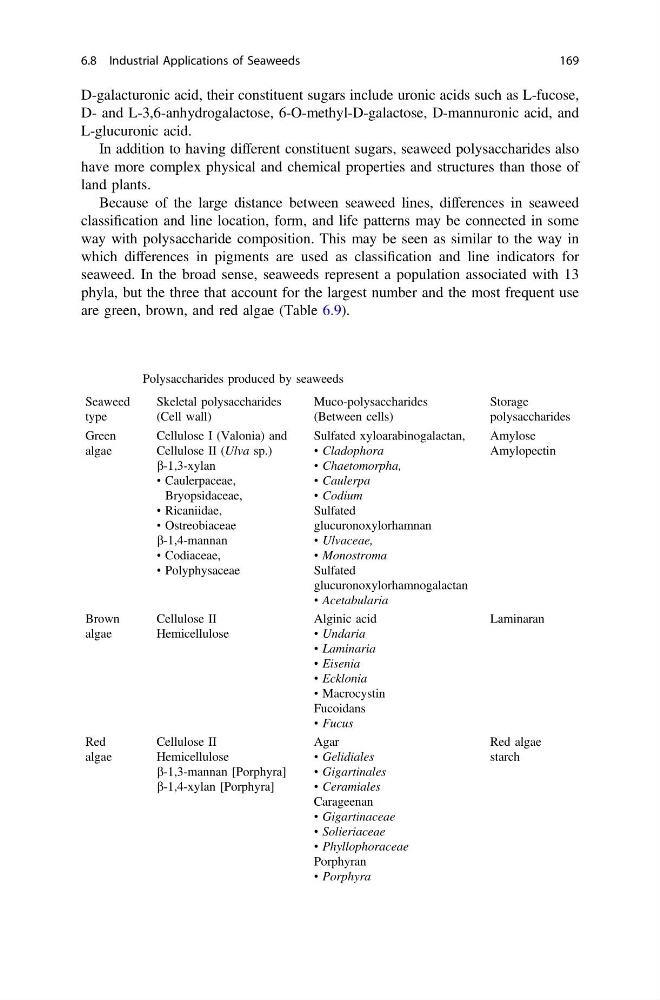
are green, brown, and red algae (Table 6.9).
Table 6.9 Polysaccharides produced by seaweeds
Seaweed
type
Skeletal polysaccharides
(Cell wall)
Muco-polysaccharides
(Between cells)
Storage
polysaccharides
Green
algae
Cellulose I (Valonia) and
Cellulose II (Ulva sp.)
b-1,3-xylan
• Caulerpaceae,
Bryopsidaceae,
• Ricaniidae,
• Ostreobiaceae
b-1,4-mannan
• Codiaceae,
• Polyphysaceae
Sulfated xyloarabinogalactan,
• Cladophora
• Chaetomorpha,
• Caulerpa
• Codium
Sulfated
glucuronoxylorhamnan
• Ulvaceae,
• Monostroma
Sulfated
glucuronoxylorhamnogalactan
• Acetabularia
Amylose
Amylopectin
Brown
algae
Cellulose II
Hemicellulose
Alginic acid
• Undaria
• Laminaria
• Eisenia
• Ecklonia
• Macrocystin
Fucoidans
• Fucus
Laminaran
Red
algae
Cellulose II
Hemicellulose
b-1,3-mannan [Porphyra]
b-1,4-xylan [Porphyra]
Agar
• Gelidiales
• Gigartinales
• Ceramiales
Carageenan
• Gigartinaceae
• Solieriaceae
• Phyllophoraceae
Porphyran
• Porphyra
Red algae
starch
6.8 Industrial Applications of Seaweeds
169
D- and L-3,6-anhydrogalactose, 6-O-methyl-D-galactose, D-mannuronic acid, and
L-glucuronic acid.
In addition to having different constituent sugars, seaweed polysaccharides also
have more complex physical and chemical properties and structures than those of
land plants.
Because of the large distance between seaweed lines, differences in seaweed
classification and line location, form, and life patterns may be connected in some
way with polysaccharide composition. This may be seen as similar to the way in
which differences in pigments are used as classification and line indicators for
seaweed. In the broad sense, seaweeds represent a population associated with 13
phyla, but the three that account for the largest number and the most frequent use
are green, brown, and red algae (Table 6.9).
Table 6.9 Polysaccharides produced by seaweeds
Seaweed
type
Skeletal polysaccharides
(Cell wall)
Muco-polysaccharides
(Between cells)
Storage
polysaccharides
Green
algae
Cellulose I (Valonia) and
Cellulose II (Ulva sp.)
b-1,3-xylan
• Caulerpaceae,
Bryopsidaceae,
• Ricaniidae,
• Ostreobiaceae
b-1,4-mannan
• Codiaceae,
• Polyphysaceae
Sulfated xyloarabinogalactan,
• Cladophora
• Chaetomorpha,
• Caulerpa
• Codium
Sulfated
glucuronoxylorhamnan
• Ulvaceae,
• Monostroma
Sulfated
glucuronoxylorhamnogalactan
• Acetabularia
Amylose
Amylopectin
Brown
algae
Cellulose II
Hemicellulose
Alginic acid
• Undaria
• Laminaria
• Eisenia
• Ecklonia
• Macrocystin
Fucoidans
• Fucus
Laminaran
Red
algae
Cellulose II
Hemicellulose
b-1,3-mannan [Porphyra]
b-1,4-xylan [Porphyra]
Agar
• Gelidiales
• Gigartinales
• Ceramiales
Carageenan
• Gigartinaceae
• Solieriaceae
• Phyllophoraceae
Porphyran
• Porphyra
Red algae
starch
6.8 Industrial Applications of Seaweeds
169