

6.6 Gene Manipulation
Protoplast production, tissue culturing, and cell fusion have already reached the
commercialization stage in the biotechnology of higher plants, and mass production
through gene manipulation is under way. In contrast, the only example of genetic
manipulation in algae concerns the ability to achieve transformation in the freshwater unicellular green alga Chlamydomonas through the use of enzyme-derived
plasmids as a vector; no examples at all have taken place for marine algae. At the
same time, advancements are likely to be made in the future thanks to rapid progress in two areas essential to genetic manipulation, namely nucleic acid isolation
and base sequence analysis (Hulata 2001).
In terms of DNA and RNA isolation, sperm DNA has been isolated from the
alga Porphyra yezoensis, and leaf body DNA from the brown alga Macrocystis, and
methods have been established for removing the polysaccharide polyphenol and
isolating mRNA from lavers (red algae) and the green alga Ulva intestinalis.
Restriction enzyme fragments of leaf body DNA from the green alga Bryopsis, the
brown alga Laminaria, and the red alga Porphyra yezoensis have also been analyzed for use in seaweed line classification. Complete ribosomal RNA base
sequences have been determined for four species of the red alga laver.
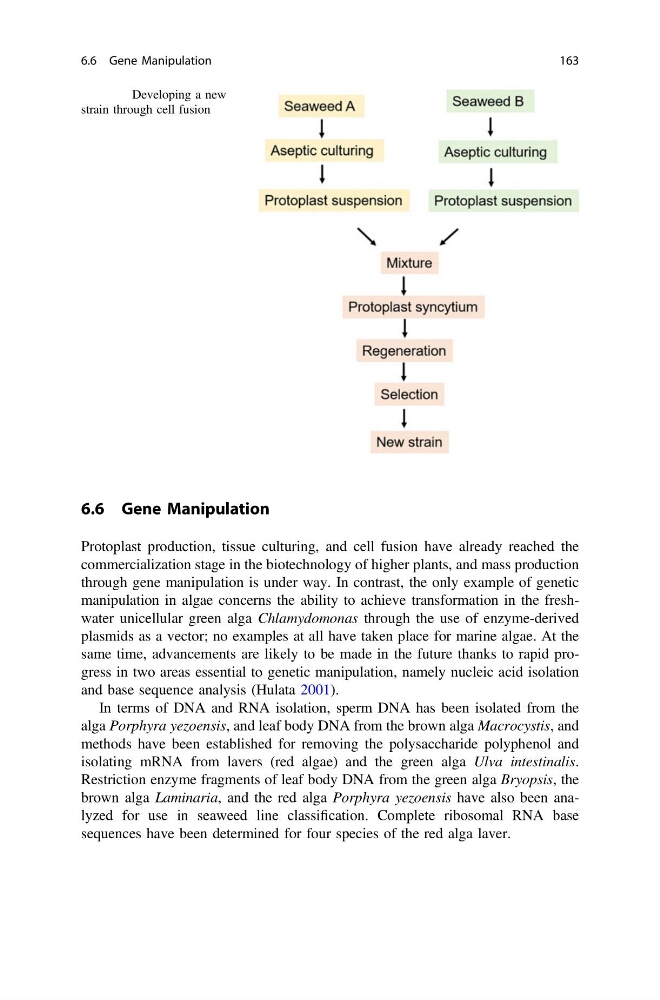
Fig. 6.8 Developing a new
strain through cell fusion
6.6 Gene Manipulation
163
Protoplast production, tissue culturing, and cell fusion have already reached the
commercialization stage in the biotechnology of higher plants, and mass production
through gene manipulation is under way. In contrast, the only example of genetic
manipulation in algae concerns the ability to achieve transformation in the freshwater unicellular green alga Chlamydomonas through the use of enzyme-derived
plasmids as a vector; no examples at all have taken place for marine algae. At the
same time, advancements are likely to be made in the future thanks to rapid progress in two areas essential to genetic manipulation, namely nucleic acid isolation
and base sequence analysis (Hulata 2001).
In terms of DNA and RNA isolation, sperm DNA has been isolated from the
alga Porphyra yezoensis, and leaf body DNA from the brown alga Macrocystis, and
methods have been established for removing the polysaccharide polyphenol and
isolating mRNA from lavers (red algae) and the green alga Ulva intestinalis.
Restriction enzyme fragments of leaf body DNA from the green alga Bryopsis, the
brown alga Laminaria, and the red alga Porphyra yezoensis have also been analyzed for use in seaweed line classification. Complete ribosomal RNA base
sequences have been determined for four species of the red alga laver.
Fig. 6.8 Developing a new
strain through cell fusion
6.6 Gene Manipulation
163