

In the case of seaweed collected from the ocean, any attached organisms visible
to the naked eye would be removed, and the seaweed would then be subjected to
ultrasound treatment to remove smaller organisms. Next, it would be cultured for
two days in a solution containing various antibiotic substances; iodine and chlorine
would be effective means for final germicidal treatment. These techniques require
considerable skill, and are unfortunately not something that anyone could apply to
achieve sterilization. In the case of seaweeds emitting zoospores, the single-stage
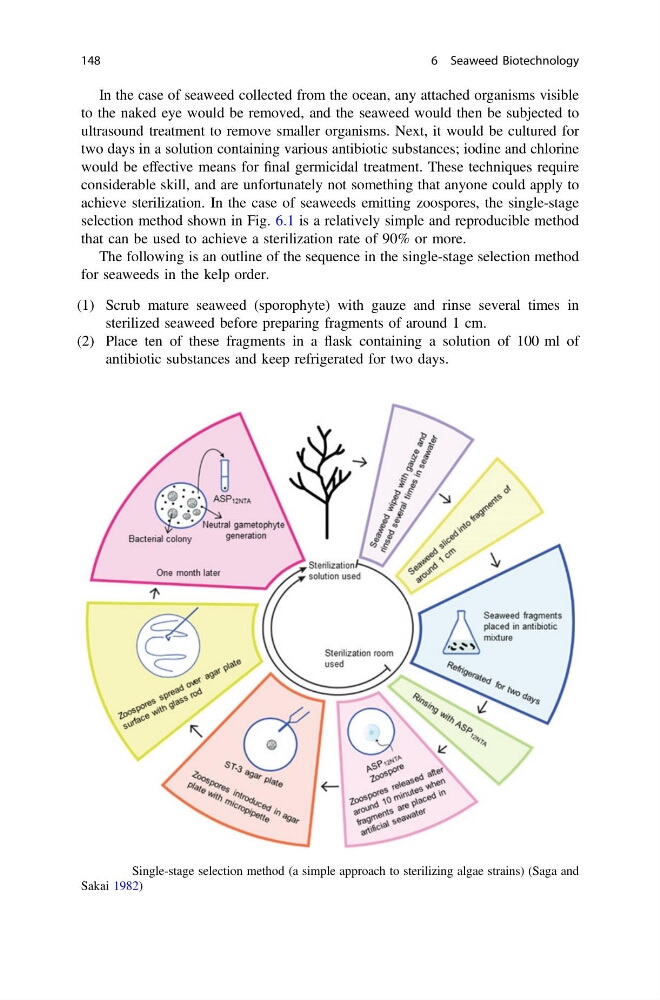
selection method shown in Fig. 6.1 is a relatively simple and reproducible method
that can be used to achieve a sterilization rate of 90% or more.
The following is an outline of the sequence in the single-stage selection method
for seaweeds in the kelp order.
(1) Scrub mature seaweed (sporophyte) with gauze and rinse several times in
sterilized seaweed before preparing fragments of around 1 cm.
(2) Place ten of these fragments in a flask containing a solution of 100 ml of
antibiotic substances and keep refrigerated for two days.
Fig. 6.1 Single-stage selection method (a simple approach to sterilizing algae strains) (Saga and
Sakai 1982)
148
6 Seaweed Biotechnology
to the naked eye would be removed, and the seaweed would then be subjected to
ultrasound treatment to remove smaller organisms. Next, it would be cultured for
two days in a solution containing various antibiotic substances; iodine and chlorine
would be effective means for final germicidal treatment. These techniques require
considerable skill, and are unfortunately not something that anyone could apply to
achieve sterilization. In the case of seaweeds emitting zoospores, the single-stage
selection method shown in Fig. 6.1 is a relatively simple and reproducible method
that can be used to achieve a sterilization rate of 90% or more.
The following is an outline of the sequence in the single-stage selection method
for seaweeds in the kelp order.
(1) Scrub mature seaweed (sporophyte) with gauze and rinse several times in
sterilized seaweed before preparing fragments of around 1 cm.
(2) Place ten of these fragments in a flask containing a solution of 100 ml of
antibiotic substances and keep refrigerated for two days.
Fig. 6.1 Single-stage selection method (a simple approach to sterilizing algae strains) (Saga and
Sakai 1982)
148
6 Seaweed Biotechnology