

numbers of organisms). Genetic influence is even more severe in small and isolated
populations (ecological corridors). Genetic drift occurring in populations with small
effective sizes results in a serious loss of genetic diversity. Genetic drift is a random
phenomenon, and selective survival of genes cannot be expected. Inbreeding also
occurs at a high rate among small populations, increasing the percentage of
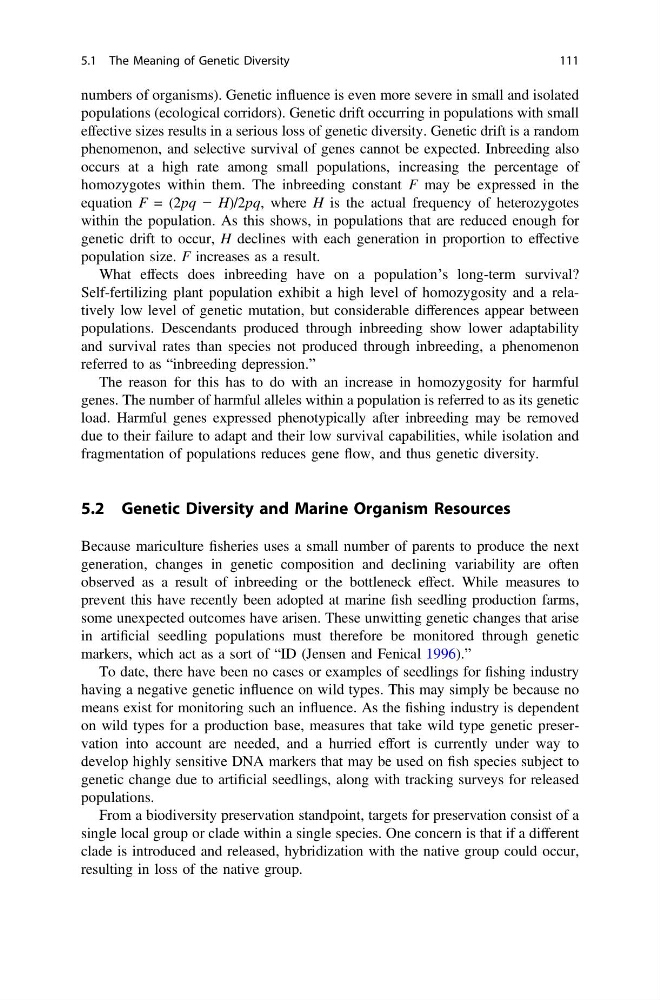
homozygotes within them. The inbreeding constant F may be expressed in the
equation F = (2pq − H)/2pq, where H is the actual frequency of heterozygotes
within the population. As this shows, in populations that are reduced enough for
genetic drift to occur, H declines with each generation in proportion to effective
population size. F increases as a result.
What effects does inbreeding have on a population’s long-term survival?
Self-fertilizing plant population exhibit a high level of homozygosity and a relatively low level of genetic mutation, but considerable differences appear between
populations. Descendants produced through inbreeding show lower adaptability
and survival rates than species not produced through inbreeding, a phenomenon
referred to as “inbreeding depression.”
The reason for this has to do with an increase in homozygosity for harmful
genes. The number of harmful alleles within a population is referred to as its genetic
load. Harmful genes expressed phenotypically after inbreeding may be removed
due to their failure to adapt and their low survival capabilities, while isolation and
fragmentation of populations reduces gene flow, and thus genetic diversity.
5.2 Genetic Diversity and Marine Organism Resources
Because mariculture fisheries uses a small number of parents to produce the next
generation, changes in genetic composition and declining variability are often
observed as a result of inbreeding or the bottleneck effect. While measures to
prevent this have recently been adopted at marine fish seedling production farms,
some unexpected outcomes have arisen. These unwitting genetic changes that arise
in artificial seedling populations must therefore be monitored through genetic
markers, which act as a sort of “ID (Jensen and Fenical 1996).”
To date, there have been no cases or examples of seedlings for fishing industry
having a negative genetic influence on wild types. This may simply be because no
means exist for monitoring such an influence. As the fishing industry is dependent
on wild types for a production base, measures that take wild type genetic preservation into account are needed, and a hurried effort is currently under way to
develop highly sensitive DNA markers that may be used on fish species subject to
genetic change due to artificial seedlings, along with tracking surveys for released
populations.
From a biodiversity preservation standpoint, targets for preservation consist of a
single local group or clade within a single species. One concern is that if a different
clade is introduced and released, hybridization with the native group could occur,
resulting in loss of the native group.
5.1 The Meaning of Genetic Diversity
111
populations (ecological corridors). Genetic drift occurring in populations with small
effective sizes results in a serious loss of genetic diversity. Genetic drift is a random
phenomenon, and selective survival of genes cannot be expected. Inbreeding also
occurs at a high rate among small populations, increasing the percentage of
homozygotes within them. The inbreeding constant F may be expressed in the
equation F = (2pq − H)/2pq, where H is the actual frequency of heterozygotes
within the population. As this shows, in populations that are reduced enough for
genetic drift to occur, H declines with each generation in proportion to effective
population size. F increases as a result.
What effects does inbreeding have on a population’s long-term survival?
Self-fertilizing plant population exhibit a high level of homozygosity and a relatively low level of genetic mutation, but considerable differences appear between
populations. Descendants produced through inbreeding show lower adaptability
and survival rates than species not produced through inbreeding, a phenomenon
referred to as “inbreeding depression.”
The reason for this has to do with an increase in homozygosity for harmful
genes. The number of harmful alleles within a population is referred to as its genetic
load. Harmful genes expressed phenotypically after inbreeding may be removed
due to their failure to adapt and their low survival capabilities, while isolation and
fragmentation of populations reduces gene flow, and thus genetic diversity.
5.2 Genetic Diversity and Marine Organism Resources
Because mariculture fisheries uses a small number of parents to produce the next
generation, changes in genetic composition and declining variability are often
observed as a result of inbreeding or the bottleneck effect. While measures to
prevent this have recently been adopted at marine fish seedling production farms,
some unexpected outcomes have arisen. These unwitting genetic changes that arise
in artificial seedling populations must therefore be monitored through genetic
markers, which act as a sort of “ID (Jensen and Fenical 1996).”
To date, there have been no cases or examples of seedlings for fishing industry
having a negative genetic influence on wild types. This may simply be because no
means exist for monitoring such an influence. As the fishing industry is dependent
on wild types for a production base, measures that take wild type genetic preservation into account are needed, and a hurried effort is currently under way to
develop highly sensitive DNA markers that may be used on fish species subject to
genetic change due to artificial seedlings, along with tracking surveys for released
populations.
From a biodiversity preservation standpoint, targets for preservation consist of a
single local group or clade within a single species. One concern is that if a different
clade is introduced and released, hybridization with the native group could occur,
resulting in loss of the native group.
5.1 The Meaning of Genetic Diversity
111