

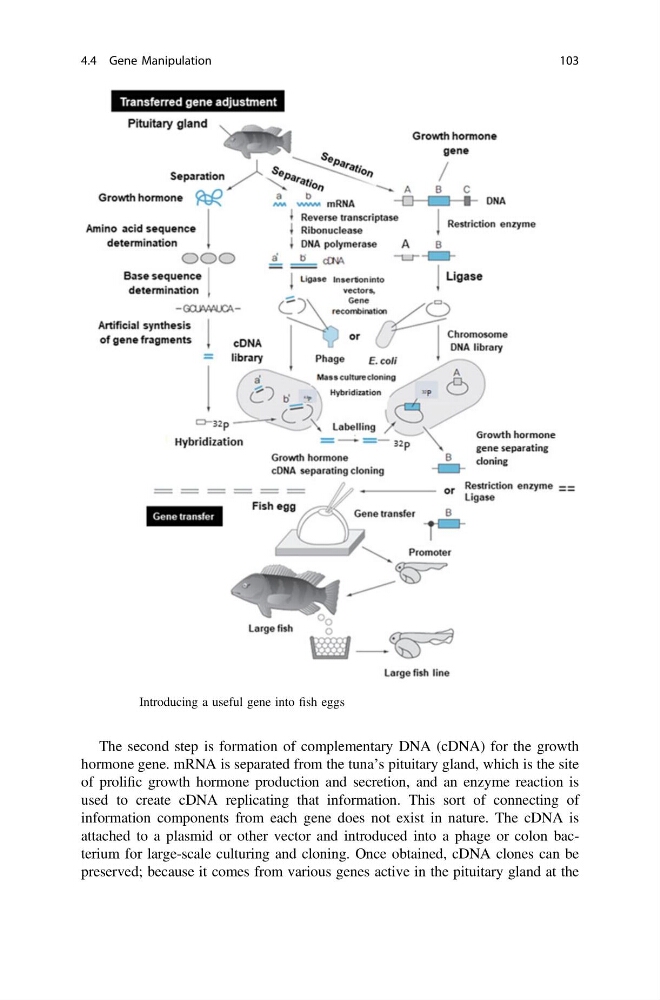
The second step is formation of complementary DNA (cDNA) for the growth
hormone gene. mRNA is separated from the tuna’s pituitary gland, which is the site
of prolific growth hormone production and secretion, and an enzyme reaction is
used to create cDNA replicating that information. This sort of connecting of
information components from each gene does not exist in nature. The cDNA is
attached to a plasmid or other vector and introduced into a phage or colon bacterium for large-scale culturing and cloning. Once obtained, cDNA clones can be
preserved; because it comes from various genes active in the pituitary gland at the
Fig. 4.14 Introducing a useful gene into fish eggs
4.4 Gene Manipulation
103
hormone gene. mRNA is separated from the tuna’s pituitary gland, which is the site
of prolific growth hormone production and secretion, and an enzyme reaction is
used to create cDNA replicating that information. This sort of connecting of
information components from each gene does not exist in nature. The cDNA is
attached to a plasmid or other vector and introduced into a phage or colon bacterium for large-scale culturing and cloning. Once obtained, cDNA clones can be
preserved; because it comes from various genes active in the pituitary gland at the
Fig. 4.14 Introducing a useful gene into fish eggs
4.4 Gene Manipulation
103