

4.2.2 Example of Application
Genome Units
Parthenogenesis, Diploid, (B) + (A) Because the egg or sperm nucleus possesses
only one genome, even successful parthenogenesis results in a haploid embryo. The
haploid is severely deformed and cannot survive, so multiplication treatment is used
to produce a diploid soon after genesis (Baldacci et al. 1980).
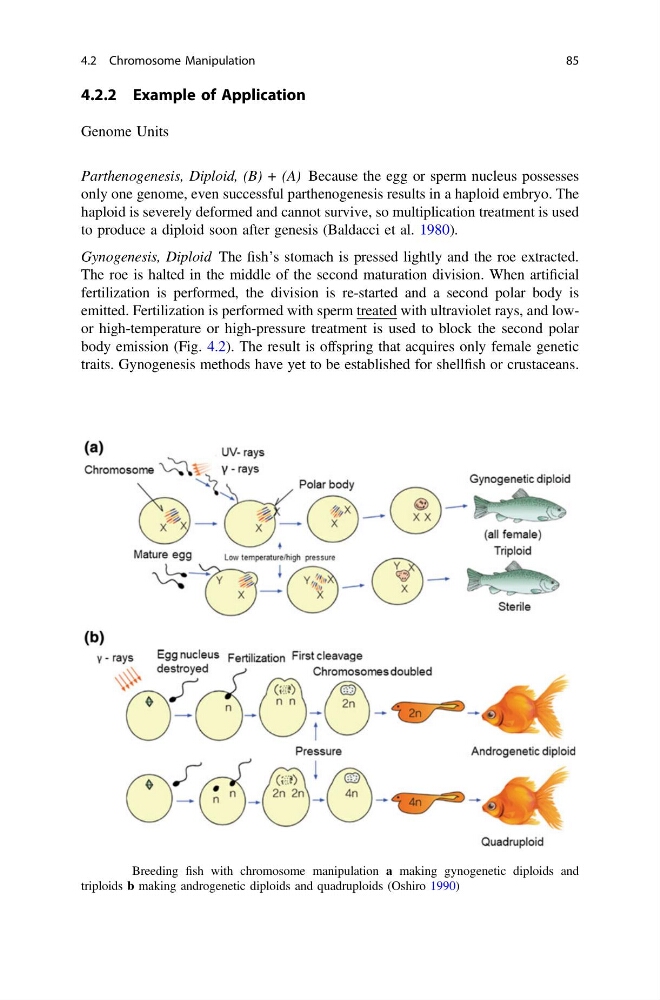
Gynogenesis, Diploid The fish’s stomach is pressed lightly and the roe extracted.
The roe is halted in the middle of the second maturation division. When artificial
fertilization is performed, the division is re-started and a second polar body is
emitted. Fertilization is performed with sperm treated with ultraviolet rays, and lowor high-temperature or high-pressure treatment is used to block the second polar
body emission (Fig. 4.2). The result is offspring that acquires only female genetic
traits. Gynogenesis methods have yet to be established for shellfish or crustaceans.
Fig. 4.2 Breeding fish with chromosome manipulation a making gynogenetic diploids and
triploids b making androgenetic diploids and quadruploids (Oshiro 1990)
4.2 Chromosome Manipulation
85
Genome Units
Parthenogenesis, Diploid, (B) + (A) Because the egg or sperm nucleus possesses
only one genome, even successful parthenogenesis results in a haploid embryo. The
haploid is severely deformed and cannot survive, so multiplication treatment is used
to produce a diploid soon after genesis (Baldacci et al. 1980).
Gynogenesis, Diploid The fish’s stomach is pressed lightly and the roe extracted.
The roe is halted in the middle of the second maturation division. When artificial
fertilization is performed, the division is re-started and a second polar body is
emitted. Fertilization is performed with sperm treated with ultraviolet rays, and lowor high-temperature or high-pressure treatment is used to block the second polar
body emission (Fig. 4.2). The result is offspring that acquires only female genetic
traits. Gynogenesis methods have yet to be established for shellfish or crustaceans.
Fig. 4.2 Breeding fish with chromosome manipulation a making gynogenetic diploids and
triploids b making androgenetic diploids and quadruploids (Oshiro 1990)
4.2 Chromosome Manipulation
85