

The Great Barrier Reef
64
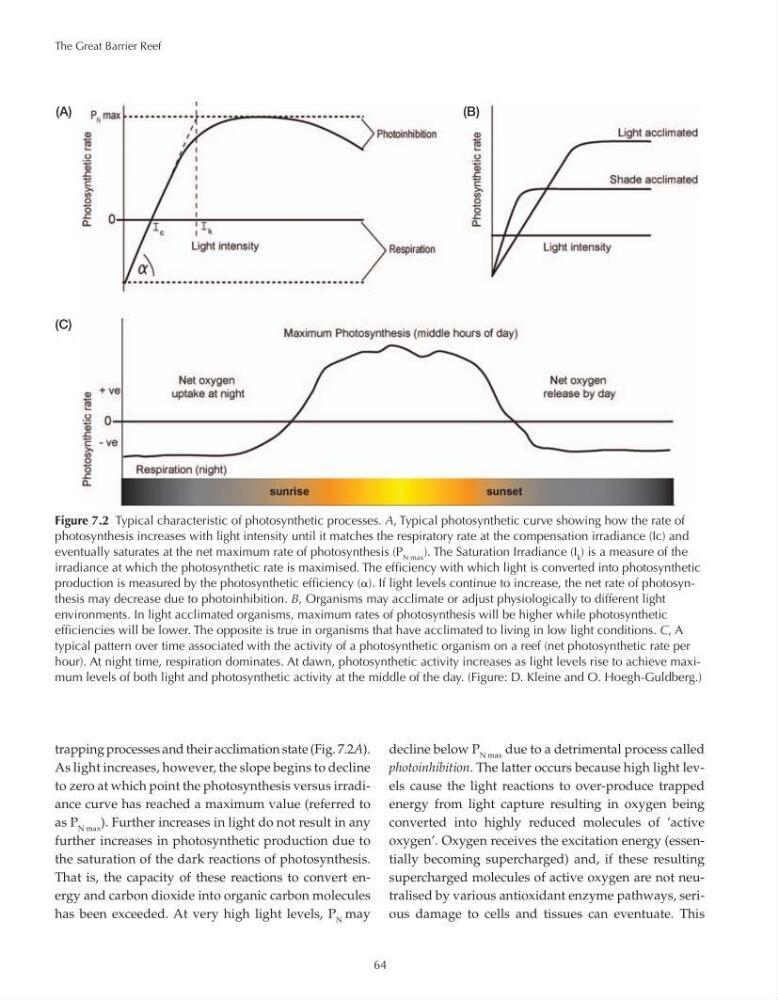
trapping processes and their acclimation state (Fig. 7.2A).
As light increases, however, the slope begins to decline
to zero at which point the photosynthesis versus irradiance curve has reached a maximum value (referred to
as P N max ). Further increases in light do not result in any
further increases in photosynthetic production due to
the saturation of the dark reactions of photosynthesis.
That is, the capacity of these reactions to convert energy and carbon dioxide into organic carbon molecules
has been exceeded. At very high light levels, P N may
decline below P N max due to a detrimental process called
photoinhibition. The latter occurs because high light levels cause the light reactions to over-produce trapped
energy from light capture resulting in oxygen being
converted into highly reduced molecules of ‘active
oxygen’. Oxygen receives the excitation energy (essentially becoming supercharged) and, if these resulting
supercharged molecules of active oxygen are not neutralised by various antioxidant enzyme pathways, serious damage to cells and tissues can eventuate. This
(A)
(B)
(C)
Figure 7.2 Typical characteristic of photosynthetic processes. A, Typical photosynthetic curve showing how the rate of
photosynthesis increases with light intensity until it matches the respiratory rate at the compensation irradiance (Ic) and
eventually saturates at the net maximum rate of photosynthesis (P N max ). The Saturation Irradiance (I k ) is a measure of the
irradiance at which the photosynthetic rate is maximised. The efficiency with which light is converted into photosynthetic
production is measured by the photosynthetic efficiency (A). If light levels continue to increase, the net rate of photosynthesis may decrease due to photoinhibition. B, Organisms may acclimate or adjust physiologically to different light
environments. In light acclimated organisms, maximum rates of photosynthesis will be higher while photosynthetic
efficiencies will be lower. The opposite is true in organisms that have acclimated to living in low light conditions. C, A
typical pattern over time associated with the activity of a photosynthetic organism on a reef (net photosynthetic rate per
hour). At night time, respiration dominates. At dawn, photosynthetic activity increases as light levels rise to achieve maximum levels of both light and photosynthetic activity at the middle of the day. (Figure: D. Kleine and O. Hoegh-Guldberg.)
64
trapping processes and their acclimation state (Fig. 7.2A).
As light increases, however, the slope begins to decline
to zero at which point the photosynthesis versus irradiance curve has reached a maximum value (referred to
as P N max ). Further increases in light do not result in any
further increases in photosynthetic production due to
the saturation of the dark reactions of photosynthesis.
That is, the capacity of these reactions to convert energy and carbon dioxide into organic carbon molecules
has been exceeded. At very high light levels, P N may
decline below P N max due to a detrimental process called
photoinhibition. The latter occurs because high light levels cause the light reactions to over-produce trapped
energy from light capture resulting in oxygen being
converted into highly reduced molecules of ‘active
oxygen’. Oxygen receives the excitation energy (essentially becoming supercharged) and, if these resulting
supercharged molecules of active oxygen are not neutralised by various antioxidant enzyme pathways, serious damage to cells and tissues can eventuate. This
(A)
(B)
(C)
Figure 7.2 Typical characteristic of photosynthetic processes. A, Typical photosynthetic curve showing how the rate of
photosynthesis increases with light intensity until it matches the respiratory rate at the compensation irradiance (Ic) and
eventually saturates at the net maximum rate of photosynthesis (P N max ). The Saturation Irradiance (I k ) is a measure of the
irradiance at which the photosynthetic rate is maximised. The efficiency with which light is converted into photosynthetic
production is measured by the photosynthetic efficiency (A). If light levels continue to increase, the net rate of photosynthesis may decrease due to photoinhibition. B, Organisms may acclimate or adjust physiologically to different light
environments. In light acclimated organisms, maximum rates of photosynthesis will be higher while photosynthetic
efficiencies will be lower. The opposite is true in organisms that have acclimated to living in low light conditions. C, A
typical pattern over time associated with the activity of a photosynthetic organism on a reef (net photosynthetic rate per
hour). At night time, respiration dominates. At dawn, photosynthetic activity increases as light levels rise to achieve maximum levels of both light and photosynthetic activity at the middle of the day. (Figure: D. Kleine and O. Hoegh-Guldberg.)