

The Great Barrier Reef
48
undergo a natural succession of community states in
which the space is colonised by encrusting coralline
algae, which then provides a suitable substratum for
coral settlement. Rapidly growing forms, such as
branching and plating corals, then occupy this space
but may be supplanted over time by more wave resistant forms. Extreme physical disturbances or widespread
coral death may result in a reef being covered by coral
rubble. Whether the rubble forms a substratum for coral
or algal communities may be dictated by the numbers
of herbivores on the reef. Exclusion of herbivores can
result in algal takeovers of areas previously occupied by
corals and fleshy and tufting algae such as Padina can
occupy space following COTS outbreaks or bleaching.
It is important to realise that coral reefs are not static,
stable, unchanging ecosystems. The abundances of coral
reef organisms change at temporal scales ranging from
days to multiple decades, and at spatial scales ranging
from a single coral head to entire reefs in which their
preferred habitat occurs. Species that are not as habitatspecific will be found on a wider range of reefs. So, a
reef with a diverse range of corals will tend to have
more species, both specialists and generalists. However, not all species are associated with corals. Some
species prefer areas without corals, or the interfaces
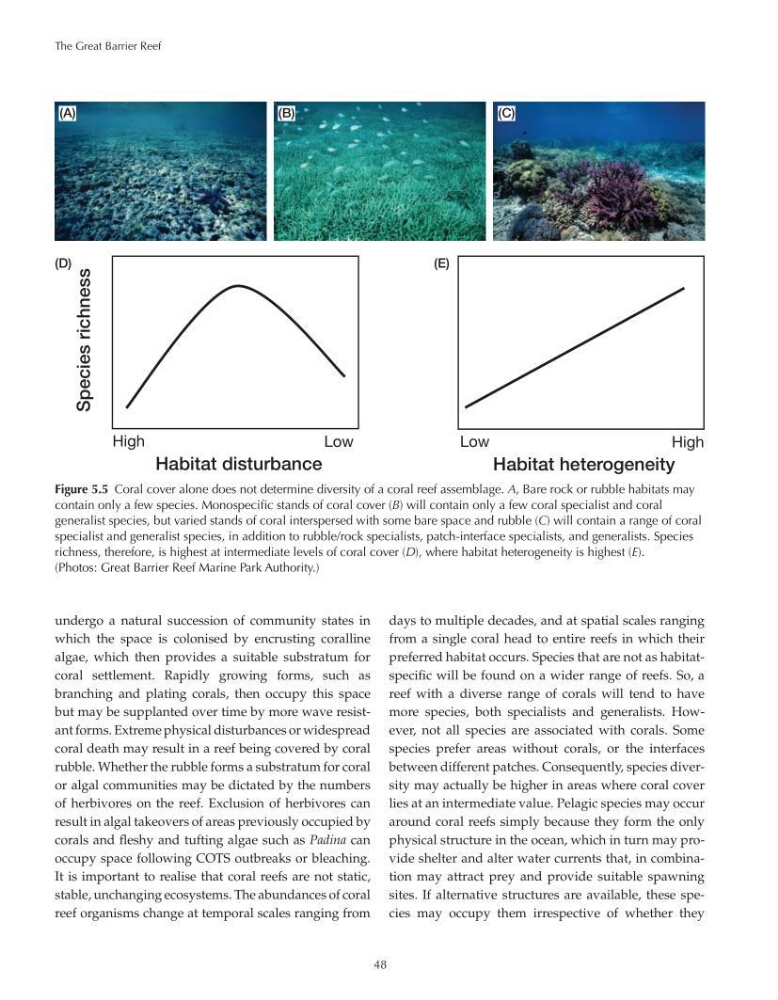
between different patches. Consequently, species diversity may actually be higher in areas where coral cover
lies at an intermediate value. Pelagic species may occur
around coral reefs simply because they form the only
physical structure in the ocean, which in turn may provide shelter and alter water currents that, in combination may attract prey and provide suitable spawning
sites. If alternative structures are available, these species may occupy them irrespective of whether they
Figure 5.5 Coral cover alone does not determine diversity of a coral reef assemblage. A, Bare rock or rubble habitats may
contain only a few species. Monospecific stands of coral cover (B) will contain only a few coral specialist and coral
generalist species, but varied stands of coral interspersed with some bare space and rubble (C) will contain a range of coral
specialist and generalist species, in addition to rubble/rock specialists, patch-interface specialists, and generalists. Species
richness, therefore, is highest at intermediate levels of coral cover (D), where habitat heterogeneity is highest (E).
(Photos: Great Barrier Reef Marine Park Authority.)
(E)
Low
High
Habitat heterogeneity
(D)
Species richness
Habitat disturbance
High
Low
(C)
(B)
(A)
48
undergo a natural succession of community states in
which the space is colonised by encrusting coralline
algae, which then provides a suitable substratum for
coral settlement. Rapidly growing forms, such as
branching and plating corals, then occupy this space
but may be supplanted over time by more wave resistant forms. Extreme physical disturbances or widespread
coral death may result in a reef being covered by coral
rubble. Whether the rubble forms a substratum for coral
or algal communities may be dictated by the numbers
of herbivores on the reef. Exclusion of herbivores can
result in algal takeovers of areas previously occupied by
corals and fleshy and tufting algae such as Padina can
occupy space following COTS outbreaks or bleaching.
It is important to realise that coral reefs are not static,
stable, unchanging ecosystems. The abundances of coral
reef organisms change at temporal scales ranging from
days to multiple decades, and at spatial scales ranging
from a single coral head to entire reefs in which their
preferred habitat occurs. Species that are not as habitatspecific will be found on a wider range of reefs. So, a
reef with a diverse range of corals will tend to have
more species, both specialists and generalists. However, not all species are associated with corals. Some
species prefer areas without corals, or the interfaces
between different patches. Consequently, species diversity may actually be higher in areas where coral cover
lies at an intermediate value. Pelagic species may occur
around coral reefs simply because they form the only
physical structure in the ocean, which in turn may provide shelter and alter water currents that, in combination may attract prey and provide suitable spawning
sites. If alternative structures are available, these species may occupy them irrespective of whether they
Figure 5.5 Coral cover alone does not determine diversity of a coral reef assemblage. A, Bare rock or rubble habitats may
contain only a few species. Monospecific stands of coral cover (B) will contain only a few coral specialist and coral
generalist species, but varied stands of coral interspersed with some bare space and rubble (C) will contain a range of coral
specialist and generalist species, in addition to rubble/rock specialists, patch-interface specialists, and generalists. Species
richness, therefore, is highest at intermediate levels of coral cover (D), where habitat heterogeneity is highest (E).
(Photos: Great Barrier Reef Marine Park Authority.)
(E)
Low
High
Habitat heterogeneity
(D)
Species richness
Habitat disturbance
High
Low
(C)
(B)
(A)